Pakistan approves agriculture relief package to support farmers

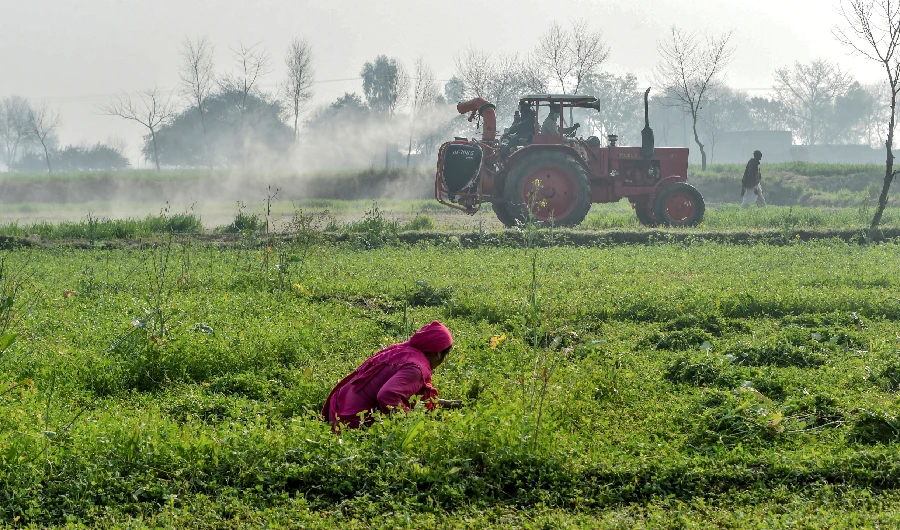
In this picture taken on February 23, 2020, officials of the Agriculture Department on a tractor spray pesticides to kill locusts as a farmer works in a field in Pipli Pahar village in Pakistan's central Punjab province. (AFP)
Short Url
Updated 14 May 2020
Follow

Pakistan approves agriculture relief package to support farmers

  • Agriculture contributes 18.5 percent to Pakistan’s GDP and provides 38.5 percent employment to the national labor force
  • Farmers reject the package, saying it will only benefit ‘seed and pesticide mafia’

ISLAMABAD: Pakistan on Wednesday approved a Rs56.6 billion agriculture relief package for farmers to provide them subsidy on fertilizers, cotton seed, pesticides and sales tax on locally manufactured tractors amid the coronavirus pandemic.

The stimulus package is part of the Rs100 billion out of Rs1200 billion coronavirus relief package already announced for small and medium enterprises and the agriculture sector.

The Economic Coordination Committee of the Cabinet (ECC) – an apex federal institution to discuss and decide economic and financial matters – has approved the package as prepared by the Ministry of National Food Security and Research.

Under the package, the government is offering a Rs37 billion subsidy to farmers on the purchase of fertilizers. This amount will include a subsidy of Rs925 per bag on phosphorus fertilizers and Rs243 per bag on urea and other nitrogen fertilizers.

The government is expecting an offtake of about 3.04 million tons for urea and 0.95 million tons for the phosphate fertilizers in the upcoming cultivation season.

The fertilizer share in the cost of production for major crops is estimated to be around 10 to 15 percent. “The provision of subsidy would reduce cost of production for farmers,” the ECC said in a statement, adding that this would also increase farmers’ affordability to use quality fertilizers for their crops.

Other items in the relief package include a reduction of Rs8.8 billion in mark-up of agriculture loans, Rs2.3 billion subsidy on cotton seed and Rs6 billion subsidy on pesticides.

The government has also granted a subsidy of Rs2.5 billion on the sales tax on locally-manufactured tractors for a period of one year.

Provincial governments will be responsible for the utilization of the relief package, though a clear-cut implementation mechanism for it is yet to be devised.

In Pakistan, the agriculture sector contributes 18.5 percent to the country’s Gross Domestic Product (GDP) and provides 38.5 percent employment to the national labor force, though it has always remained a low priority for successive governments.

“Over the last decade, the performance of agriculture sector has fallen short of desirable level, mainly because of stagnant productivity of all important crops,” said the Pakistan Economic Survey 2018-19.

Farmers on the other hand rejected the package, saying it will only benefit “seed and pesticide mafia” in the absence of an effective mechanism for its implementation.

“The government should give interest-free loans to small farmers to help them bear the escalating cost instead of playing these gimmicks,” Mian Muhammad Umair Masood, general-secretary of the Pakistan Kissan Ittihad, told Arab News on Wednesday.

He said the government should also announce a fixed electricity rate for tube-wells along with lowering the cost of phosphorus fertilizers from Rs3,800 to Rs2,400 per bag and urea fertilizers from Rs1,650 to Rs1,200 per bag.

“Farmers are using decades-old bt2 cotton seed which is highly susceptible to pests and other diseases,” Masood said. “The government should invest in seed research instead of doling out funds to mafia in the name of farmers.”

Pakistan says multilateralism in peril, urges global powers to prioritize diplomacy over confrontation

Updated 8 sec ago
Follow

Pakistan says multilateralism in peril, urges global powers to prioritize diplomacy over confrontation

  • The country tells the UN international security system is eroding, asks rival blocs to return to dialogue
  • It emphasizes lowering of international tensions, rebuilding of channels of communication among states

ISLAMABAD: Pakistan warned the world community on Monday that multilateralism was “in peril” amid rising global tensions, urging major powers to revive diplomacy and dialogue to prevent a further breakdown in international security.

Speaking at a UN Security Council briefing, Pakistan’s ambassador to the UN, Asim Iftikhar Ahmad, said the world was drifting toward confrontation at a time when cooperative mechanisms were weakening.

His comments came during a session addressed by Finland’s foreign minister Elina Valtonen, chairing the Organization for Security and Co-operation in Europe (OSCE), the world’s largest regional security body.

Formed out of the 1975 Helsinki Final Act, the OSCE was designed during the Cold War to reduce tensions, uphold principles of sovereignty and human rights and promote mechanisms for peaceful dispute resolution.

“Today, the foundational ethos of international relations, multilateralism, cooperation and indivisible security, as envisaged in the preamble of Helsinki Final Act, is perhaps facing its biggest challenge in decades,” Ahmed said. “The OSCE, too, is navigating a difficult geopolitical landscape, with conflict raging in the heart of Europe for nearly four years, depletion of trust and unprecedented strains on peaceful co-existence.”

He said a return to the “Helsinki spirit” of dialogue, confidence-building and cooperative security was urgently needed, not only in Europe but globally.

“This is not a matter of choice but a strategic imperative to lower tensions, rebuild essential channels of communication, and demonstrate that comprehensive security is best preserved through cooperative instruments, and not by the pursuit of hegemony and domination through military means,” he said. “Objective, inclusive, impartial, and principle-based approaches are indispensable for success.”

Ahmed’s statement came in a year when Pakistan itself fought a brief but intense war after India launched missile strikes at its city in May following a militant attack in Indian-administered Kashmir. New Delhi blamed Pakistan for the assault, an allegation Islamabad denied while calling for a transparent international investigation.

The Pakistani diplomat said the international system was increasingly defined by bloc politics, mistrust and militarization, warning that such trends undermine both regional stability and the authority of multilateral institutions, including the UN itself.

He urged member states to invest more in preventive diplomacy and the peaceful settlement of disputes as reaffirmed by the Council in Resolution 2788.

Ahmad said Pakistan hoped the OSCE would continue reinforcing models of cooperative security and that the Security Council would back partnerships that strengthen international law and the credibility of multilateral frameworks.

The path forward, he added, required “choosing cooperation over confrontation, dialogue over division, and inclusive security over bloc-based divides.”