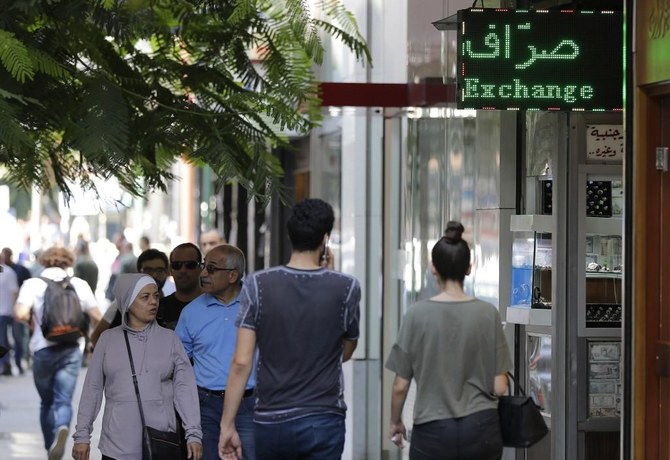

BEIRUT: Lebanon’s financial prosecutor arrested on Thursday evening the head of the money changers’ syndicate, Mahmoud Mrad.
Judge Ali Ibrahim accused Mrad on Friday of “manipulating the exchange rate of the dollar against the Lebanese pound,” and transferred him to the first investigative judge for questioning.
Authorities arrested 50 certified money changers a week ago for not having complied with the Central Bank’s circulars to set the exchange rate to 3,200 pounds for $1.
Some of those arrested were released after having signed a pledge to abide by the circulars, while others were kept in custody.
Lebanon is suffering from a dollar liquidity crisis. This has led banks to stop paying hard currency transfers in dollars, and instead pay them in pounds based on an exchange rate of 3,000 pounds for $1, not the market exchange rate.
The crisis was aggravated by the country’s severe economic crisis and the coronavirus pandemic, which led to a surge in the exchange rate to 4,000 pounds for $1 on the black market.
Arrested certified and illegal money changers said they had acted upon instructions from Mrad, and defied the Central Bank circulars by buying dollars at high rates then selling them at even higher rates.
Mrad’s arrest led on Friday to a further rise in the exchange rate on the black market to 4,350 pounds for $1.
The money changers’ syndicate declared in a statement that it will abide by the Central Bank’s circulars, including the exchange rate of 3,200 pounds for $1.
Meanwhile, opposition figures on Friday raised the issue of subsidized goods being smuggled to Syria. These goods mainly consist of fuel oil and flour subsidized by the Lebanese state.
Samir Geagea, chairman of the Lebanese Forces party, called on the general prosecutor to launch an investigation.
MP Mohammed Al-Hajjar of the Future Movement said smuggling via illegal crossings controlled by an “illegal armed group” (meaning Hezbollah) is causing annual losses of billions of dollars in customs revenues, and thefts from the Central Bank’s reserves.
Former Minister Richard Kuyumijian called for “the immediate closure of illegal crossings, the end of smuggling through the international port and airport, and the banning of smuggling of subsidized goods, especially diesel and flour with Syria in both directions, as it is leading to losses of billions of dollars.”
Media outlets have reported that the smuggling of diesel oil and flour to Syria is due to the difference in prices between the two countries, earning smugglers huge profits.
Lebanon’s millers’ association said it is “doing its best to prevent its members from selling flour to smugglers.”
But it added that it does not have the capacity to control all merchants throughout Lebanon due to the current political and economic situation in the country. The association urged government authorities to do their duty in this regard.
Lebanon is seeking the help of the International Monetary Fund to face an unprecedented economic crisis that has led to a contraction of its gross domestic product by 13 percent, an inflation rate of 50 percent, a deterioration of the pound / dollar exchange rate, paralysis of the banking sector, 45 percent of Lebanese now living below the poverty line, an increase in the unemployment rate to 35 percent, and high fiscal deficit and debt.