

Inside a quarantine facility: How hotel employees serve potential COVID-19 carriers

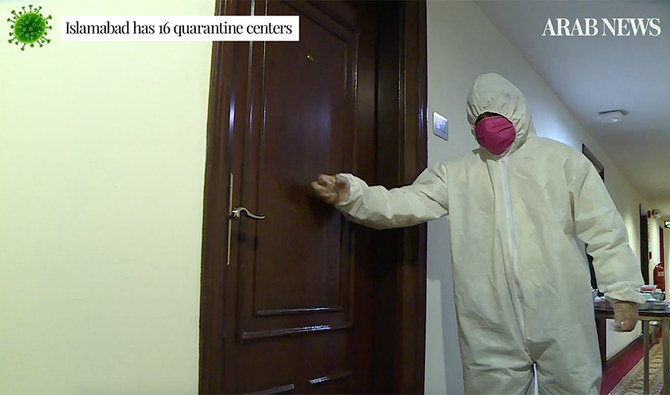
Hospitality staff wearing protective suit knocks on a door of a quarantined hotel guest in Islamabad to serve Iftar during Ramadan. (AN Photo)
Short Url
Updated 08 May 2020
Follow

Inside a quarantine facility: How hotel employees serve potential COVID-19 carriers

  • Only limited staff is allowed at quarantine centers to reduce the chances of infections
  • The National Institute of Health trains the hotel staff and checks them for the infectious disease twice a week

ISLAMABAD: Khurshid Ahmed had never thought he would be risking his life while serving his hotel guests in the heart of the federal capital.

The three-star residential facility where he works as a supervisor was turned into a temporary quarantine center by the government in March to facilitate the stranded Pakistanis returning to their homeland from other countries amid the coronavirus pandemic.

The repatriates get an option to stay at state-run quarantine centers or designated establishments under government control.

Instead of his regular formal wear for work, Ahmed puts on the protective clothing while serving his guests arriving from different countries who are immediately quarantined in separate rooms until the National Institute of Health (NIH) administers COVID-19 tests.

“I have been working for two years at this hotel, but I could not have imagined a situation where my work would become so hazardous,” he told Arab News while getting into his protective attire to prepare and serve the evening iftar meal to his guests who are usually required to stay at the facility for four days before being permitted to leave by the authorities.

“The number of hotel staff dealing with the guests has been deliberately limited by officials to lessen the chances of infections. We work in [three] shifts, and none of us is allowed to step outside the premises until our tests have concluded with negative results,” he said, adding that the NIH, which has given health safety training to the hotel staff, runs COVID-19 tests twice a week to check the employees.

While health professionals and doctors treating the coronavirus patients are acknowledged to be doing high-risk jobs, Ahmed says that hotel employees like him are also putting themselves in harm’s way while working on the front line to meet the needs of people who may be potential carriers of the virus.

According to the city magistrate, Ghulam Murtaza Chandio, Ahmed’s hotel has witnessed the highest number of positive cases among the 16 quarantine centers in Islamabad.

“Praise be to God, none of us has tested positive,” Ahmed told Arab News. “We can’t fear the virus since we have to fight it.”

Despite his enthusiasm to defeat the pathogen that has claimed about 600 lives in Pakistan as the country reports over 25,600 confirmed cases, he faces a string of complaints of his guests who are either unhappy about being quarantined or dissatisfied with the hotel’s curtailed serves.

“We understand their frustration, but the guests are not allowed to leave their rooms. They cannot have visitors, and nothing can be brought for them from outside,” front desk clerk Asif Kiani told Arab News.

Asked if he fears the temporary residents of the facility, Kiani says: “I am definitely fearful of working in this environment. But we have to conceal our emotions since any display of anxiety will only make the atmosphere more burdensome.”


Pakistani, Bangladeshi officials discuss trade, investment and aviation as ties thaw

Updated 28 December 2025
Follow

Pakistani, Bangladeshi officials discuss trade, investment and aviation as ties thaw

  • Pakistan and Bangladesh were once one nation, but they split in 1971 as a result of a bloody civil war
  • Ties between Pakistan, Bangladesh have warmed up since last year and both nations have resumed sea trade

ISLAMABAD: Pakistan's High Commissioner to Bangladesh Imran Haider on Sunday met Chief Adviser Muhammad Yunus in Dhaka, the latter's office said on, with the two figures discussing trade, investment and aviation.

Pakistan and Bangladesh were once one nation, but they split in 1971 as a result of a bloody civil war, which saw the part previously referred to as East Pakistan seceding to form the independent nation of Bangladesh.

Ties between Pakistan and Bangladesh have warmed up since former prime minister Sheikh Hasina’s ouster as a result of a student-led uprising in August 2024. Relations remain frosty between Dhaka and New Delhi over India’s decision to grant asylum to Hasina.

Pakistan has attempted to forge closer ties with Bangladesh in recent months and both South Asian nations last year began sea trade, followed by efforts to expand government-to-government commerce.

"During the meeting, both sides discussed ways to expand cooperation in trade, investment, and aviation as well as scaling up cultural, educational and medical exchanges to further strengthen bilateral relations between the two South Asian nations," Yunus's office said in a statement on X.

In 2023-24 Pakistan exported goods worth $661 million to Bangladesh, while its imports were only $57 million, according to the Trade Development Authority of Pakistan. In Aug. this year, the Pakistani and Bangladeshi commerce ministries signed a memorandum of understanding to establish a Joint Working Group on Trade, aiming to raise their bilateral trade volume to $1 billion in the financial year that began in July.

The Pakistani high commissioner noted that bilateral trade has recorded a 20 percent growth compared to last year, with business communities from both countries actively exploring new investment opportunities, according to the statement.

He highlighted a significant increase in cultural exchanges, adding that Bangladeshi students have shown strong interest in higher education opportunities in Pakistan, particularly in medical sciences, nanotechnology, and artificial intelligence. Haider also said that Dhaka-Karachi direct flights are expected to start in January.

"Chief Adviser Professor Muhammad Yunus welcomed the growing interactions between the two countries and emphasized the importance of increased visits as well as cultural, educational and people-to-people exchanges among SAARC (South Asian Association for Regional Cooperation) member states," the statement read.

"Professor Yunus also underscored the need to further boost Bangladesh–Pakistan trade and expressed hope that during Mr. Haider’s tenure, both countries would explore new avenues for investment and joint venture businesses."