Colombia has removed the contact-tracing feature in its official app for informing residents about the coronavirus after experiencing glitches, but aims to rebuild using potentially more reliable technology from Apple and Alphabet’s Google, a government official said.
The previously unreported moves by the Colombian government add to a growing number of accounts of countries adopting the Apple-Google technology and dropping alternatives aimed at helping them curtail outbreaks faster.
Contact tracing involves identifying, testing and isolating people exposed to the virus before they spread it to others, something that governments globally have said is vital to keep their economies safely opened until a vaccine exists. Apps that tap the Bluetooth sensors in smartphones to detect encounters with those who test positive could speed the process, experts say.
But some governments that planned to forge ahead with such apps without the help of the American technology giants have been forced to reverse course. The head of Australia’s contact-tracing app told senators on Tuesday his team is moving to the Apple-Google technology over a glitchy internal solution, and the government agency behind the UK’s forthcoming app disclosed in a contract signed on Tuesday that it is asking engineers to test the Apple-Google system amid privacy concerns about its previously planned alternative.
The decisions have wide ramifications for using smartphone apps to log encounters between people to make it easier to find and alert those who crossed paths with a virus-carrier.
Apple and Google have said their Bluetooth-based technology will work more smoothly than alternatives and be trusted by consumers wary of government surveillance, with the companies banning government collection of app users’ GPS location and other personal data. Several governments including France, the United Kingdom and some US states contend Apple and Google’s rules to protect privacy prevent the robust data analysis needed to slow the virus’ spread.
But Colombia’s struggle to use alternative technology highlights the challenges that await governments reluctant to accept Apple’s and Google’s terms.
“There have certainly been several lessons learned in this process,” Colombia presidential adviser Victor Munoz said.
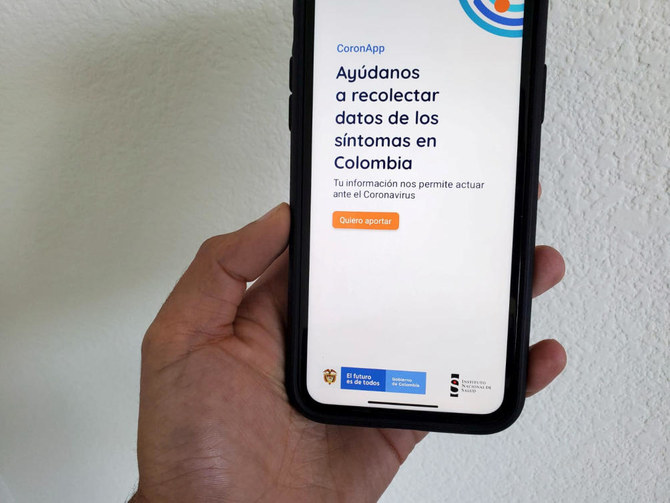
The Colombian government had felt well on its way with its CoronApp, which had been downloaded by 4.3 million people as of May 2 and also includes features to report symptoms and see where cases are located on a map.
But the CoronApp dropped its contact tracing feature last month just days after launching it.
Apple and Google, the leading makers of smartphone operating systems, allow government contact tracing apps to bypass their technology. But without it, iPhones do not send a readable Bluetooth signal while locked, a feature designed to prevent tracking and save battery life.
Contact tracing apps are useless unless at least about half of a population downloads them, and iPhone usage is too substantial in most countries to be ignored.
So CoronApp used alternative technology from Portuguese company HypeLabs, which sells networking technology to gaming apps and other businesses, that purports to overcome the iPhone Bluetooth limitation.
But Munoz said Colombia encountered multiple challenges with the contact tracing feature that relied on HypeLabs, including inaccuracies in logging contacts using Bluetooth and Wi-Fi.
Colombia needed a better way to “minimize the risk of generating unnecessary alerts” and decided to align CoronApp with the Apple-Google technology instead, Munoz added.
His team had met representatives of Apple and Google and was studying their technology, he said.
“It’s very important to us that we evaluate any alternative that can help the government make better decisions,” Munoz said.
HypeLabs said it remains in discussions with several other countries.
Randall Brugeaud, chief executive of Australia’s Digital Transformation Agency, said on Tuesday that the country’s COVIDSafe app increasingly struggles to log encounters the longer an iPhone remains locked.
“The big shift in performance of Bluetooth connectivity will be the point we’re able to leverage the new Apple-Google Bluetooth management software,” he told senators.
Apple and Google last month began working on a joint solution to the connectivity problem between devices. But their offering, which will not be available for use until mid-May, restricts governments from amassing databases of people’s movements.
Colombia is one of several governments that has been hoping to gather such location data for use detecting coronavirus hotspots where businesses may need to be shut down or deep cleaned.


Colombia’s coronavirus app troubles show rocky path without tech from Apple, Google
https://arab.news/b7s8f
Colombia’s coronavirus app troubles show rocky path without tech from Apple, Google

- Contact tracing involves identifying, testing and isolating people exposed to the virus before they spread it to others


Indonesia reaffirms Yemen’s territorial integrity, backs stability efforts amid tensions
- Statement comes after Saudi Arabia bombed a UAE weapons shipment at Yemeni port city
- Jakarta last week said it ‘appreciates’ Riyadh ‘working together’ with Yemen to restore stability
JAKARTA: Indonesia has called for respect for Yemen’s territorial integrity and commended efforts to maintain stability in the region, a day after Saudi Arabia bombed a weapons shipment from the UAE at a Yemeni port city that Riyadh said was intended for separatist forces.
Saudi Arabia carried out a “limited airstrike” at Yemen’s port city of Al-Mukalla in the southern province of Hadramout on Tuesday, following the arrival of an Emirati shipment that came amid heightened tensions linked to advances by the UAE-backed Southern Transitional Council in the war-torn country.
In a statement issued late on Wednesday, the Indonesian Ministry of Foreign Affairs said it “appreciates further efforts by concerned parties to maintain stability and security,” particularly in the provinces of Hadramout and Al-Mahara.
“Indonesia reaffirms the importance of peaceful settlement through an inclusive and comprehensive political dialogue under the coordination of the United Nations and respecting Yemen’s legitimate government and territorial integrity,” Indonesia’s foreign affairs ministry said.
The latest statement comes after Jakarta said last week that it “appreciates the efforts of the Kingdom of Saudi Arabia, as well as other relevant countries, working together with Yemeni stakeholders to de-escalate tensions and restore stability.”
Saudi Arabia leads the Coalition to Restore Legitimacy in Yemen, which includes the UAE and was established in 2015 to combat the Houthi rebels, who control most of northern Yemen.
Riyadh has been calling on the STC, which initially supported Yemen’s internationally recognized government against the Houthi rebels, to withdraw after it launched an offensive against the Saudi-backed government troops last month, seeking an independent state in the south.
Indonesia has also urged for “all parties to exercise restraint and avoid unilateral action that could impact security conditions,” and has previously said that the rising tensions in Yemen could “further deteriorate the security situation and exacerbate the suffering” of the Yemeni people.
Indonesia, the world’s biggest Muslim-majority country, maintains close ties with both Saudi Arabia and the UAE, which are its main trade and investment partners in the Middle East.


