

Pakistani charity opens COVID-19 testing lab in Lahore

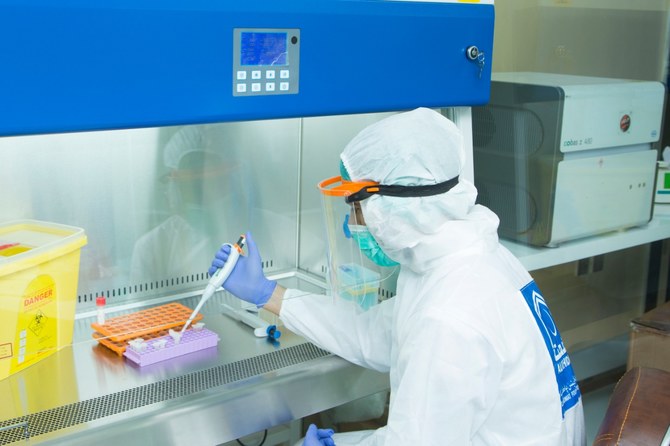
A technician is seen at work at the Al-Khidmat COVID-19 testing lab, which was opened in Lahore on May 3, 2020. (Photo courtesy: Al-Khidmat)
Short Url
Updated 04 May 2020
Follow

Pakistani charity opens COVID-19 testing lab in Lahore

  • Al-Khidmat lab charges a third of the price at other private labs
  • Plans to open similar facilities in Karachi, Faisalabad and Peshawar by mid-June

LAHORE: Al-Khidmat Foundation, the charity wing of religious-politico party Jamaat-e-Islami, opened a COVID-19 testing laboratory in Lahore on Saturday, the first such facility to be established by any political party.

“Al-Khidmat has a medical setup of 28 hospitals, ambulances and diagnostic centers across the country. Now a special COVID-19 center has been established in Lahore to facilitate those who are unable to pay the fees at private medical centers. All our hospitals, ambulances and other facilities are available to every Pakistani in this testing time,” Muhammad Abdul Shakoor, president of Al-Khidmat Foundation, told Arab News on Monday.
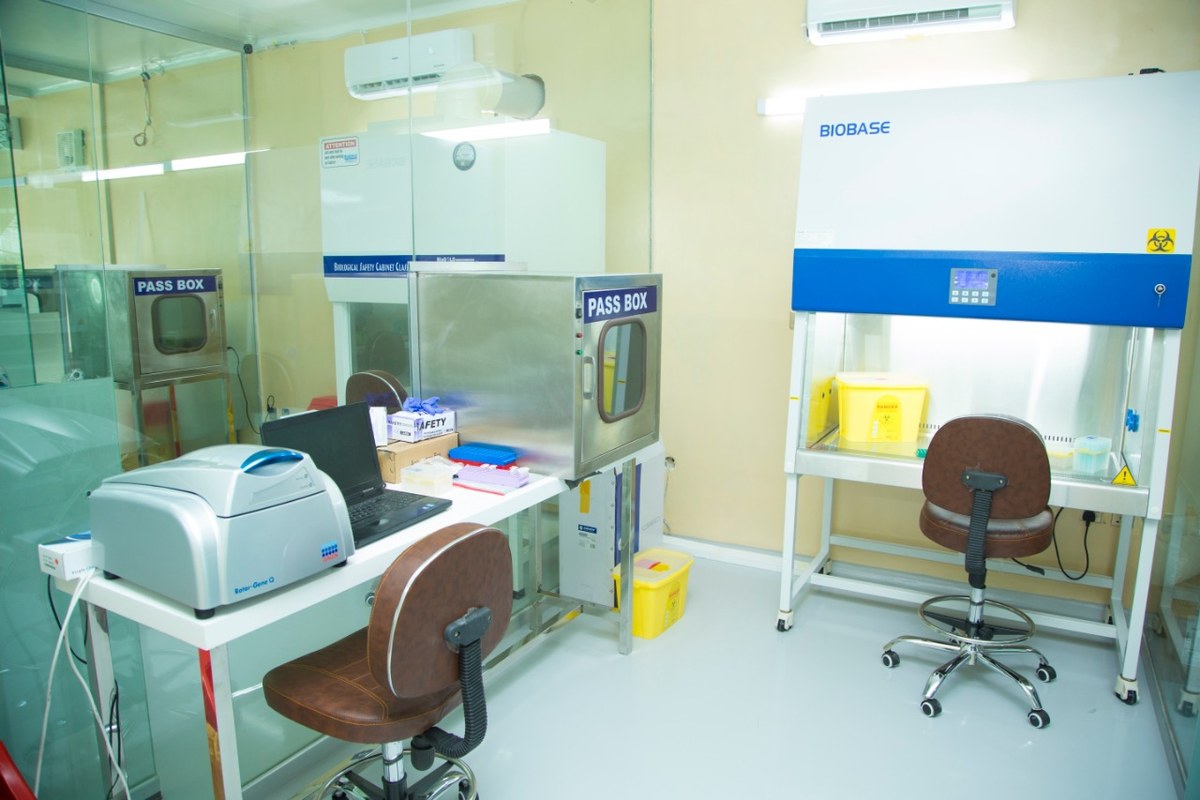


The photograph shows the interior of the Al-Khidmat COVID-19 testing lab in Lahore. The group says the lab can conduct 100 tests a day. (Photo courtesy: Al-Khidmat) 

While at private testing centers, the cost of undergoing a COVID-19 test is about Rs9,000 ($56), the Al-Khidmat lab charges Rs3,000, according to the group’s media manager Shoaib Hashmi.

“We are charging only the cost of the test, even less than that,” he said, “Results are available within 48 hours.”


Laboratory equipment is seen at the Al-Khidmat COVID-19 testing lab in Lahore. (Photo courtesy: Al-Khidmat)

The Al-Khidmat COVID-19 laboratory can conduct 100 tests a day, with testing kits purchased from international health care companies Roche and Qiagen.

The lab was designed by Pakistani experts and its equipment comes from the local market.

“The Al-Khidmat COVID-19 lab is a great facility for the people of Pakistan amid the coronavirus outbreak. We must appreciate the organization for providing quality tests at low rates. The kits used by the facility are of good quality,” Dr. Javed Akram, vice chancellor of the University of Health Sciences (UHS) in Lahore, told Arab News.

Al-Khidmat plans to establish similar facilities in Karachi, Faisalabad and Peshawar.

“Work on the Karachi lab is almost complete, and it will start working in 15 days. The Faisalabad and Peshawar labs will open in about six weeks,” Hashmi said.


Pakistani, Bangladeshi officials discuss trade, investment and aviation as ties thaw

Updated 28 December 2025
Follow

Pakistani, Bangladeshi officials discuss trade, investment and aviation as ties thaw

  • Pakistan and Bangladesh were once one nation, but they split in 1971 as a result of a bloody civil war
  • Ties between Pakistan, Bangladesh have warmed up since last year and both nations have resumed sea trade

ISLAMABAD: Pakistan's High Commissioner to Bangladesh Imran Haider on Sunday met Chief Adviser Muhammad Yunus in Dhaka, the latter's office said on, with the two figures discussing trade, investment and aviation.

Pakistan and Bangladesh were once one nation, but they split in 1971 as a result of a bloody civil war, which saw the part previously referred to as East Pakistan seceding to form the independent nation of Bangladesh.

Ties between Pakistan and Bangladesh have warmed up since former prime minister Sheikh Hasina’s ouster as a result of a student-led uprising in August 2024. Relations remain frosty between Dhaka and New Delhi over India’s decision to grant asylum to Hasina.

Pakistan has attempted to forge closer ties with Bangladesh in recent months and both South Asian nations last year began sea trade, followed by efforts to expand government-to-government commerce.

"During the meeting, both sides discussed ways to expand cooperation in trade, investment, and aviation as well as scaling up cultural, educational and medical exchanges to further strengthen bilateral relations between the two South Asian nations," Yunus's office said in a statement on X.

In 2023-24 Pakistan exported goods worth $661 million to Bangladesh, while its imports were only $57 million, according to the Trade Development Authority of Pakistan. In Aug. this year, the Pakistani and Bangladeshi commerce ministries signed a memorandum of understanding to establish a Joint Working Group on Trade, aiming to raise their bilateral trade volume to $1 billion in the financial year that began in July.

The Pakistani high commissioner noted that bilateral trade has recorded a 20 percent growth compared to last year, with business communities from both countries actively exploring new investment opportunities, according to the statement.

He highlighted a significant increase in cultural exchanges, adding that Bangladeshi students have shown strong interest in higher education opportunities in Pakistan, particularly in medical sciences, nanotechnology, and artificial intelligence. Haider also said that Dhaka-Karachi direct flights are expected to start in January.

"Chief Adviser Professor Muhammad Yunus welcomed the growing interactions between the two countries and emphasized the importance of increased visits as well as cultural, educational and people-to-people exchanges among SAARC (South Asian Association for Regional Cooperation) member states," the statement read.

"Professor Yunus also underscored the need to further boost Bangladesh–Pakistan trade and expressed hope that during Mr. Haider’s tenure, both countries would explore new avenues for investment and joint venture businesses."