
ISLAMABAD: In a bid to prevent further spread of the coronavirus, a full-scale lockdown of Pakistan was not feasible given its huge human and economic cost, but the partial lockdown itself has not yielded entirely desired results to stop the zoonotic disease which has cast its shadow nationwide with domestic transmission of the contagion up by 84 percent, forcing the government back to the drawing board for a smart new plan -- the "smart lockdown."
“Every city has one or two cases so placing entire Pakistan under quarantine was never possible,” said Islamabad’s Deputy Commissioner Hamza Shafqaat, “so the next possible solution was to impose a partial lockdown to slow down the spread of the disease while we focus on building our own capacity and enhancing our protection infrastructure but now we are moving to smart lockdowns.”
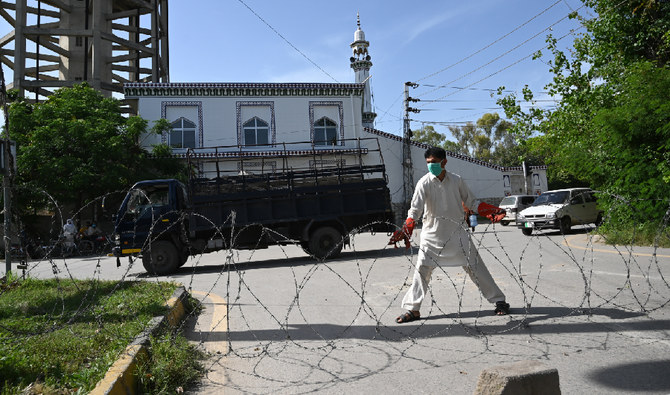
As Pakistan has eased restrictions on the lockdown, the smart lockdown features concentrate on sealing any section or area of a city deemed a COVID-19 epicenter, shutting it down and cutting it off completely from the outside for at least 14 days.
Shafqat explained that the smart lockdown strategy has produced encouraging results halting spread of the virus.
Islamabad administration also plans to ban movement of the elderly, people with health problems, and children as part of the smart lockdown procedures and says face mask will become compulsory carrying hefty fines imposed on those found in violation.
“These measures we anticipate will bring down the spread of the disease down to 10 percent” he said adding that the move will allow resumption of most of the business activity saving peoples’ livelihoods.
Shafqaat admits “that would be a huge challenge” and “implementing SOPs through police in the entire city” is another challenge he said adding “and for that we need volunteers and massive awareness, and we are working on it.”
Arab News was given a rare opportunity to exclusively cover COVID-19 epicenters placed under smart lockdowns in Islamabad where entire towns and sections of residential sectors were sealed with certain exceptions at the discretion of the government.
Outside the town of Shah Allah Ditta, densely populated with 30,000 people, security forces stood at entry and exit points guarding moveable barriers, enforcing a complete lockdown. Government permitted transports carrying food and rations for the quarantined community of the city’s low-income segment were permitted inside the perimeter. One resident attempting to leave the zone was stopped and told to return home. An ambulance travelled on a twisted road as the Assistant Commissioner gave the official account of the situation with barely a soul in sight other than the security personnel.
“After discovering two confirmed (coronavirus) cases and through contact tracing finding seven or eight more positive cases in a close vicinity, authorities decided to lock down this village or town,” said Gohar Zaman, who assists the deputy commissioner.
“This is one of the strategies, smart approaches we have been doing in Islamabad. We started from Bara Kahu, then we shifted to Shehzad Town. The mains idea is to stop the virus from spreading across the city and this lockdown is very different from the lockdown in Islamabad because we totally seal the area,” Zaman said.
“We do give exceptions to medical emergencies or serious emergencies. We do allow a couple of stores to operate so people can buy food items. We are also providing them daily rations through support of philanthropists and civic society. We have convinced some from the business community to provide Iftaar boxes. A list has been made of people in the town who are at the bottom of the hierarchy and then there are mobile food vans and trucks to ensure food security as well”, the assistant commissioner said.
At sector I-10, similar situation emerged with smart lockdown procedures employed following over 20 positive cases according to the district official. Half the sector which borders Rawalpindi was sealed. Days later, lockdown perimeter was reduced to a few streets after sections of the residential area tested negative. Zaman said these actions were necessary because of the uncooperative attitude of people with authorities looking after the health safety of the city, agreed that the emergency imposition of a full lockdown was an inconvenience to people.
Back at the deputy commissioner’s office, Arab News was given a tour of the capital’s COVID-19 nerve center and the digitization steps, some under the directives of Prime Minister Imran Khan were shared which are also part of the smart plans to reduce chances of infection through e-governance and virtual healthcare. Arab News has more in this video.