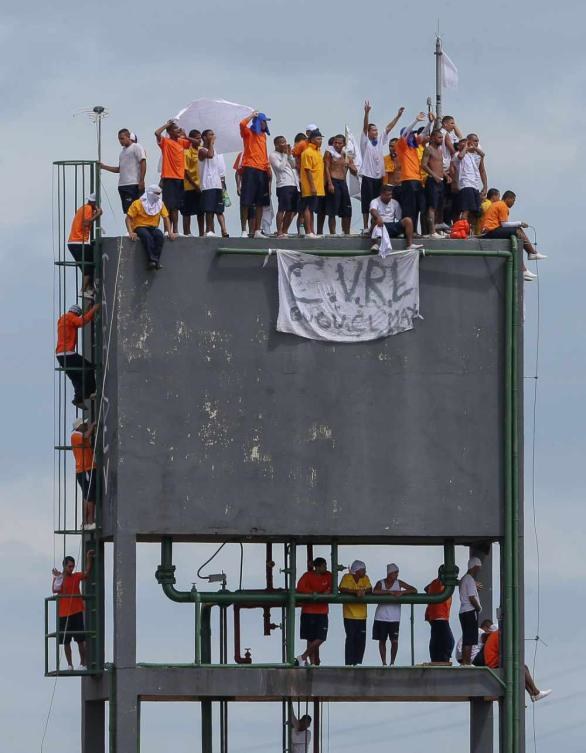
MANAUS/RIO DE JANEIRO: An inmate uprising at a Brazilian prison stoked by fears of a coronavirus outbreak saw seven prison guards briefly taken hostage on Saturday in Manaus, a state capital deep in the Amazon rainforest where public services have been overwhelmed by the pandemic.
Prison authorities reported no deaths and said 10 guards and five inmates suffered non-critical injuries in the rebellion, which they described as a distraction from a foiled escape attempt.
Relatives of inmates who gathered outside the lockup said prisoners were rebelling due to poor conditions, including a lack of food, power and medical attention. Some said the spread of the coronavirus in Manaus made their concerns more urgent.
Officials did not respond to questions about fears of coronavirus spreading in the prison. Two other penitentiaries in the same state of Amazonas have had confirmed cases of the virus, according to local prison authorities.
Inmates in various Latin American nations have rebelled during the pandemic, amid fears the virus will rip through the region’s notoriously underfunded and overcrowded jails. In late April, inmates in the Argentine capital Buenos Aires climbed to the roof of a jail and set fire to mattresses, saying they refused to die while locked up. Nine inmates died in a prison riot in Peru earlier this week.
On Friday in Venezuela, a riot at a prison in Portuguesa state left at least 46 people dead and 60 injured, according to a rights group and an opposition lawmaker.
The violence at Brazil’s Puraquequara Penitentiary came as the coronavirus outbreak overwhelms public services in Manaus, which is burying victims in mass graves and warning of an imminent shortage of coffins.
Television network Globonews reported that Brazil’s national prison chaplaincy has sent a formal complaint to the public defender’s office in Manaus alleging that up to 300 inmates at the prison were sick, some with symptoms compatible with coronavirus. According to the report, authorities denied there were coronavirus cases inside the prison.
The chaplaincy, which is tied to the Catholic Church in Brazil, and state prison officials did not respond to requests for comment from Reuters on Saturday evening.
The defender’s office said it visited the prison in late March, and the chaplaincy’s complaint regarding the coronavirus “was not confirmed.” However, it said the possibility of the coronavirus spreading within the prison population is a concern, and it is working to move vulnerable prisoners to house arrest where possible.
Violence is rife in Brazil’s prisons, which are often controlled by organized crime. Human rights groups call conditions medieval, with food scarce and cells so packed that prisoners sometimes have no space to lie down.
In January 2017, almost 150 prisoners were killed as rival gangs battled each other in several prisons in northern and northeastern Brazil. In one particularly violent incident in Manaus, 57 inmates were killed, some of whom were decapitated and thrown over prison walls.
Last year, over 50 inmates were strangled or stabbed to death as rival gangs battled each other in four separate Manaus jails.


![]()

Prisoners take guards hostage in Brazil’s coronavirus-hit Manaus
Short Url
https://arab.news/rj8dv
Prisoners take guards hostage in Brazil’s coronavirus-hit Manaus
- Ten guards and five inmates suffered non-critical injuries in the rebellion
- Inmates in various Latin American nations have rebelled during the pandemic


Latest updates





© 2026 SAUDI RESEARCH & PUBLISHING COMPANY, All Rights Reserved And subject to Terms of Use Agreement.