

Philippines' top court moves to decongest jails across the country over COVID-19 fears

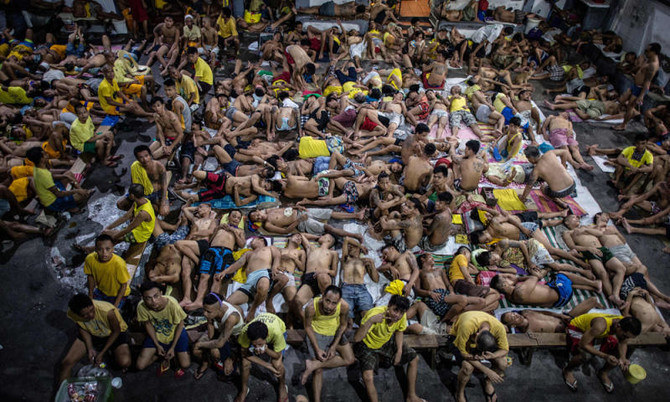
COVID-19 infections has prompted the Philippine Supreme Court to expedite the release of thousands of Philippine inmates. (AFP file photo)
Short Url
Updated 02 May 2020
Follow

Philippines' top court moves to decongest jails across the country over COVID-19 fears

  • Reports say hundreds of inmates contracting coronavirus 
  • 9,731 inmates had been released based on the revised measures

MANILA: The Philippines’ top court has revised procedures to release inmates at the earliest opportunity in order to decongest jails and limit the spread of COVID-19, a Supreme Court official said Saturday.

Marvic Leonen, an associate justice at the court, said that 9,731 inmates had been released based on the revised measures between March 15 and April 29.

“Of the 9,731, 2,801 are from the National Capital Region (Metro Manila); 4,657 from Luzon; 1,072 from the Visayas and 1,920 from Mindanao ... and we continue as much as we can to decongest the jails,” Leonen said in a virtual news briefing.

It follows calls from human rights groups and prison reform advocates to release low-level offenders and sick and elderly prisoners after the Bureau of Jail Management and Penology said last week that at least 195 prisoners had contracted the disease, while the Bureau of Corrections had recorded 50 cases.

The Philippines has the most congested penal system in the world, with a total jail population of more than 215,000 as of November 2019 occupying space intended for a maximum capacity of 40,000, based on data from World Prison Brief.

Additionally, the International Committee of the Red Cross reported that the 467 jails nationwide were at 534 percent capacity in March 2020. 

Leonen said the release of more inmates under the initiative depended on the outcome of court procedures.

“I can only hope that those that deserve to be released will be released, and those that deserve to be detained will be detained.”

He added that they were monitoring the revised mechanisms to address the urgent needs of inmates, despite the courts being closed due to the coronavirus pandemic.

Among the new measures adopted is the use of video-conferencing to hear and resolve pressing matters filed by inmates in areas that remain under lockdown, or in detention facilities with reported cases of infections.

The Supreme Court has also allowed the online filing of cases and posting of bail requests, in addition to reducing the bail amount and authorizing the release of certain prisoners. 

“I have heard that the Department of Justice is planning to make enforceable some abbreviated rules in terms of pardons and parole,” Leonen said, adding that trimming the jail population was not just the responsibility of the court but of local governments, the executive as well as the legislature.

While the Supreme Court understood the gravity of the humanitarian crisis facing the country, it needed to hear all parties to be able to come out with a solution.

“It may not be as fast as people think. We are not the executive, certainly we are not the legislature, but we are careful about setting a precedent during these times.”


EU, India successfully conclude major trade deal: New Delhi

Updated 3 sec ago
Follow

EU, India successfully conclude major trade deal: New Delhi

  • Indian government officials say the pact, which was two decades in the making, will be unveiled Tuesday
  • European Commission President Ursula von der Leyen and European Council president Antonio Costa appear as guests of honor at India’s Republic Day parade
NEW DELHI: India and the European Union have finalized a massive free trade deal, Indian government officials said on Monday, about two decades after negotiations were first launched.
Facing challenges from China and the United States, Brussels and New Delhi have sought closer ties, producing a pact that is to be unveiled in the Indian capital on Tuesday.
Feted Monday as guests of honor at India’s Republic Day parade, European Commission President Ursula von der Leyen and European Council president Antonio Costa are to meet Indian Prime Minister Narendra Modi for a summit.
“Official level negotiations are being concluded and both sides are all set to announce the successful conclusion” of talks at the Tuesday summit, Indian commerce secretary Rajesh Agrawal told AFP.
The EU has eyed India — the world’s most populous nation — as an important market for the future, while New Delhi sees the European bloc as an important source of much-needed technology and investment to rapidly upscale its infrastructure and create millions of new jobs.

’Mother of all deals’

Bilateral trade in goods reached 120 billion euros ($139 billion) in 2024, an increase of nearly 90 percent over the past decade, according to EU figures, with a further 60 billion euros ($69 billion) in trade in services.
India’s Commerce Minister Piyush Goyal has described the new pact as “the mother of all deals.”
“Final negotiations have been focused and fruitful, and we are now very optimistic that we will land this historic trade deal,” an EU official said Monday speaking on condition of anonymity.
Under the agreement, India is expected to ease market access for key European products, including cars and wine, in return for easier exports of textiles and pharmaceuticals, among other things.
“The EU stands to gain the highest level of access ever granted to a trade partner in the traditionally protected Indian market,” von der Leyen said on Sunday, adding that she expected exports to India to double.
“We will gain a significant competitive advantage in key industrial and agri-good sectors.”
Talks went down to the wire on Monday, focusing on a few sticking points, including the impact of the EU’s carbon border tax on steel, according to sources familiar with the discussions.
The accord comes as both Brussels and New Delhi have sought to open up new markets in the face of US tariffs and Chinese export controls.
India and the EU were also expected to conclude an accord to facilitate movement for seasonal workers, students, researchers and highly skilled professionals, and a security and defense pact.
“India and Europe have made a clear choice. The choice of strategic partnership, dialogue and openness,” von der Leyen wrote on social media. “We are showing a fractured world that another way is possible.”
New Delhi, which has relied on Moscow for key military hardware for decades, has tried to cut its dependence on Russia in recent years by diversifying imports and pushing its own domestic manufacturing base.
Europe is doing the same with regard to the United States.