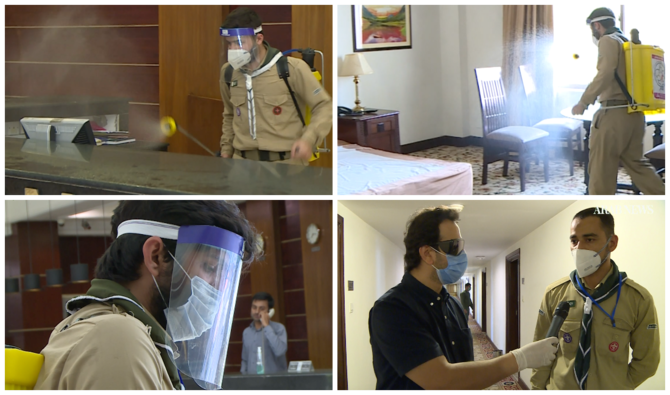
ISLAMABAD: A group of volunteers arrived at a local hotel in Islamabad on Thursday to disinfect the premises before 250 stranded Pakistanis from Saudi Arabia were brought to the facility by the authorities on Friday which had turned the building into a quarantine center early last month.
The young members of the team belonged to Al-Mustafa Scouts who were forced to temporarily discontinue their education due to the COVID-19 situation.
“Al-Mustafa Scouts is an open group of individuals that seeks to serve Pakistan,” said the team leader, Shabih-ul-Hassan, speaking to Arab News while working inside one of 16 quarantine centers in the federal capital. “We are not going to let this virus hold us hostage and confine us to our homes.”
The scouts claimed they were self-funded and supported by their families.
Equipped with face shields, masks, gloves, and chlorine-based disinfectant spray containers, the group is asked to cleanse quarantine centers by the Islamabad administration before the repatriated Pakistani nationals arrive at the facility and after they leave the accommodation.
Pakistan recently introduced special flights to bring back its citizens from other countries. Many of these people were stranded abroad due to the suspension of international flights after much of the world went into lockdown to prevent the spread of coronavirus.
The incoming Pakistani nationals also include those expatriate workers who lost their jobs as businesses around the world suffered huge losses due to the global economic downturn triggered by the pandemic.
According to Foreign Minister Shah Mahmood Qureshi, some 60,000 overseas Pakistanis intend to return to their country and the government was hoping to bring them back before the Muslim festival of Eid Al-Fitr.
Arab News was given a rare opportunity to visit a quarantine facility and captured in this video what Pakistani nationals should expect upon their return to the country

Unsung heroes disinfect quarantine centers for returning Pakistanis
https://arab.news/rs6dm
Unsung heroes disinfect quarantine centers for returning Pakistanis
- Government intends to bring back 60,000 Pakistanis stranded abroad before Eid Al-Fitr, says FM Qureshi
- Members of Al-Mustafa Scouts say they want to serve their country and will not let a virus hold them hostage
Pakistan terms climate change, demographic pressures as ‘pressing existential risks’
- Pakistan has suffered frequent climate change-induced disasters, including floods this year that killed over 1,000
- Pakistan finmin highlights stabilization measures at Doha Forum, discusses economic cooperation with Qatar
ISLAMABAD: Pakistan’s Finance Minister Muhammad Aurangzeb on Saturday described climate change and demographic pressures as “pressing existential risks” facing the country, calling for urgent climate financing.
The finance minister was speaking as a member of a high-level panel at the 23rd edition of the Doha Forum, which is being held from Dec. 6–7 in the Qatari capital. Aurangzeb was invited as a speaker on the discussion titled: ‘Global Trade Tensions: Economic Impact and Policy Responses in MENA.’
“He reaffirmed that while Pakistan remained vigilant in the face of geopolitical uncertainty, the more pressing existential risks were climate change and demographic pressures,” the Finance Division said.
Pakistan has suffered repeated climate disasters in recent years, most notably the 2022 super-floods that submerged one-third of the country, displaced millions and caused an estimated $30 billion in losses.
This year’s floods killed over 1,000 people and caused at least $2.9 billion in damages to agriculture and infrastructure. Scientists say Pakistan remains among the world’s most climate-vulnerable nations despite contributing less than 1 percent of global greenhouse-gas emissions.
Aurangzeb has previously said climate change and Pakistan’s fast-rising population are the only two factors that can hinder the South Asian country’s efforts to become a $3 trillion economy in the future.
The finance minister noted that this year’s floods in Pakistan had shaved at least 0.5 percent off GDP growth, calling for urgent climate financing and investment in resilient infrastructure.
When asked about Pakistan’s fiscal resilience and capability to absorb external shocks, Aurangzeb said Islamabad had rebuilt fiscal buffers. He pointed out that both the primary fiscal balance and current account had returned to surplus, supported significantly by strong remittance inflows of $18–20 billion annually from the Middle East and North Africa (MENA) and Gulf Cooperation Council (GCC) regions.
Separately, Aurangzeb met his Qatari counterpart Ali Bin Ahmed Al Kuwari to discuss bilateral cooperation.
“Both sides reaffirmed their commitment to strengthening economic ties, particularly by maximizing opportunities created through the newly concluded GCC–Pakistan Free Trade Agreement, expanding trade flows, and deepening energy cooperation, including long-term LNG collaboration,” the finance ministry said.
The two also discussed collaboration on digital infrastructure, skills development and regulatory reform. They agreed to establish structured mechanisms to continue joint work in trade diversification, technology, climate resilience, and investment facilitation, the finance ministry said.


