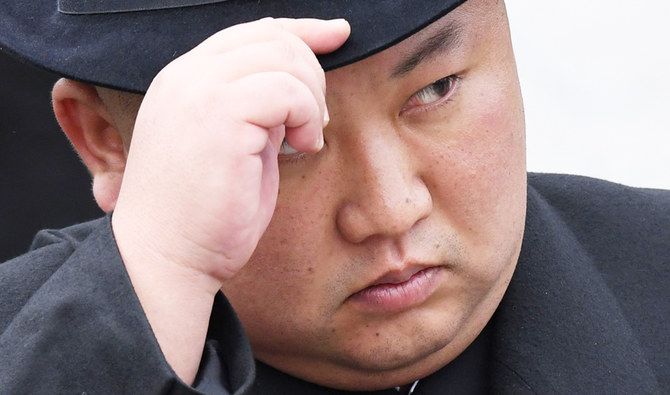
SEOUL, South Korea: North Korean leader Kim Jong Un made his first public appearance in 20 days as he celebrated the completion of a fertilizer factory near Pyongyang, state media said Saturday, ending an absence that had triggered global rumors that he may be seriously ill.
The North’s official Korean Central News Agency reported that Kim attended the ceremony Friday in Sunchon with other senior officials, including his sister Kim Yo Jong, who many analysts predict would take over if her brother is suddenly unable to rule.
The official Rodong Sinmun newspaper published several photos of Kim wearing black and smiling as he looked around the factory and cut a red ribbon.
The KCNA said workers broke into “thunderous cheers” for Kim, who it said is guiding the nation in a struggle to build a self-reliant economy in the face of “head wind” by “hostile forces,” a clear reference to US-led sanctions over the North’s nuclear ambitions.
The agency said Kim warmly acknowledged the workers and said his late father and grandfather “would be greatly pleased” the factory was completed. The report didn’t mention any direct comment toward Washington or Seoul.
US President Donald Trump, speaking to reporters at the White House, declined to comment about Kim’s reappearance but said he would “have something to say about it at the appropriate time.”
It was Kim’s first public appearance since April 11, when he presided over a ruling Workers’ Party meeting to discuss the coronavirus and reappoint his sister as an alternate member of the powerful decision-making political bureau of the party’s central committee. That move confirmed her substantial role in the government.
Speculation about his health swirled after he missed the April 15 birthday celebration for his late grandfather Kim Il Sung, the country’s most important holiday, for the first time since taking power in 2011.
Without publishing images, state media reported he was carrying out routine activities outside public view, such as sending greetings to the leaders of Syria, Cuba and South Africa and expressing gratitude to workers building tourist facilities in the coastal town of Wonsan, where some speculated he was staying.
South Korea’s government, which has a mixed record of tracking Pyongyang’s ruling elite, repeatedly downplayed speculation that Kim, believed to be 36, was in poor health following surgery.
The office of President Moon Jae-in said it detected no unusual signs in North Korea or any emergency reaction by its ruling party, military and cabinet. Seoul said it believed Kim was still managing state affairs but staying at an unspecified location outside Pyongyang.
The possibly of high-level instability raised troubling questions about the future of the secretive, nuclear-armed state that has been steadily building an arsenal meant to threaten the US mainland while diplomacy between Kim and Trump has stalled.
Following an unusually provocative run in missile and nuclear tests in 2017, Kim used the Winter Olympics in South Korea to initiate diplomacy with Washington and Seoul in 2018.
That led to a surprising series of summits, including three between Kim and Trump, as Kim pursued diplomacy in hopes of ending crippling economic sanctions and obtaining security guarantees.
But negotiations have faltered in past months over disagreements in exchanging sanctions relief and disarmament steps, which raised doubts about whether Kim would ever fully deal away an arsenal he likely sees as his strongest guarantee of survival.
Kim entered 2020 vowing to build up his nuclear arsenal and achieve a breakthrough against sanctions while urging his nation to stay resilient in a struggle for economic “self-reliance.” Some experts say the North’s self-imposed lockdown amid the coronavirus crisis could potentially hamper his ability to mobilize people for labor.
It wasn’t immediately clear what caused Kim’s absence in past weeks. In 2014, Kim vanished from the public eye for nearly six weeks and then reappeared with a cane. South Korea’s spy agency said he had a cyst removed from his ankle.
Analysts say his health could become an increasing factor in years ahead: he’s overweight, smokes and drinks, and has a family history of heart issues.
If he’s suddenly unable to rule, some analysts said his sister would be installed as leader to continue Pyongyang’s heredity dynasty that began after World War II.
But others question whether core members of North Korea’s elite, mostly men in their 60s or 70s, would find it hard to accept a young and untested female leader who lacks military credentials. Some predict a collective leadership or violent power struggles.
Some experts say South Korea, as well as its regional neighbors and ally Washington, must begin preparing for instability that could come if Kim is sidelined by health problems or even dies. That could include North Korean refugees flooding South Korea or China or military hard-liners letting loose nuclear weapons.


![]()

North Korea’s Kim Jong Un appears in public amid health rumors
Short Url
https://arab.news/8t65f
North Korea’s Kim Jong Un appears in public amid health rumors
- His absence unleashed a series of unconfirmed reports over his condition, triggering global fears over the North’s nuclear arsenal — and who would succeed Kim were he unable to lead


Latest updates


© 2026 SAUDI RESEARCH & PUBLISHING COMPANY, All Rights Reserved And subject to Terms of Use Agreement.