

Afghan president’s rival says agreement underway to end political crisis

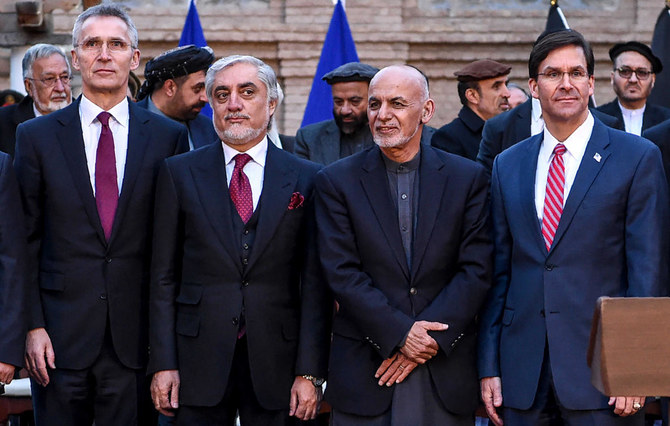
NATO’s Jens Stoltenberg, Afghan opposition leader Abdullah Abdullah, Afghan President Ashraf Ghani, and US Secretary of Defense Mark Esper at the presidential palace in Kabul. (File/AFP)
Short Url
Updated 01 May 2020
Follow

Afghan president’s rival says agreement underway to end political crisis

  • In a series of tweets Abdullah said that work was underway to finalize a settlement between him and the president
  • The two leaders have been sharing power following a deal brokered by Washington after previously disputed elections in 2014

KABUL: Afghan President Ashraf Ghani’s rival Abdullah Abdullah said on Friday they were nearing a settlement to end divisions which have sent the country into political freefall.

The two men have been at loggerheads since a presidential election in September, with Abdullah rejecting the eventual result, declaring himself the winner and announcing the formation of his own government to run in parallel to Ghani’s.

A US peace deal brokered with the Taliban and signed in late February was expected to clear the way for intra-Afghan negotiations, but Ghani and Abdullah have been unable to reach an agreement.

In a series of tweets, however, Abdullah said that work was underway to finalize a settlement between him and the president.

“Glad to assure the people of Afghanistan that efforts by respected national personalities to resolve the political crisis have borne fruit. We have made progress in negotiations and reached tentative agreement on a range of principles. Work on details is underway to finalize the agreement,” he wrote, adding that both sides hoped it would be ready soon so that they could “pay undivided attention” to tackling the COVID-19 pandemic.

He gave no further details, but reports suggest he would become Afghanistan's “executive prime minister” — a role similar to the one he has played since 2014.

The two leaders have been sharing power — Ghani as president and Abdullah as chief executive — following a deal brokered by Washington after previously disputed elections in 2014.

There was no immediate comment from Ghani’s camp regarding Abdullah’s tweets.

The tentative agreement comes as Afghanistan fights on two fronts - the global health emergency and an escalation in Taliban attacks. 

According to the IMF, Afghanistan faces mounting problems as a result of the COVID-19 outbreak, with the country’s economy expected to contract sharply this year, “threatening the livelihood of a significant segment of the population.”

On Thursday Ministry of Finance spokesman Shamrooz Khan Masjidi told Arab News that $540 million in grants and interest-free loans from international financial institutions to bolster the country's pandemic response.


Japan PM’s big election win could mean more beef with Beijing

Updated 3 sec ago
Follow

Japan PM’s big election win could mean more beef with Beijing

TOKYO: Japanese Prime Minister Sanae Takaichi’s thumping election win has blunted domestic opposition to her hawkish security agenda, encouraging plans to press ahead with a defense expansion that China has condemned as a return ​to militarism. As the scale of her government’s historic victory became clear on Sunday — capturing 352 of the 465 seats in the lower house — Takaichi said she would “work flat out to deliver” an agenda that includes building a military strong enough to deter Chinese threats to its islands, including those close to Taiwan. In November, Takaichi touched off a diplomatic storm with Beijing by suggesting Japan could respond militarily to any Chinese attack on the democratically governed island if it also threatened Japanese territory.

STANDING UP TO CHINA
“I expect to see Japan very forward-leaning on defense policy, such as her statements on a Taiwan contingency,” said Kevin Maher, a former US diplomat now with NMV Consulting in Washington. “One impact could be that President Xi Jinping comes to ‌understand her strong ‌stance,” he added.
China
responded furiously
to Takaichi’s Taiwan comment, promising to “resolutely prevent the resurgence of ‌Japanese ⁠militarism” ​if Tokyo continued ‌on its “wrong path.” Beijing also imposed a series of economic countermeasures including a boycott on travel to Japan and export restrictions on items such as rare earths it says Tokyo could use in military equipment.
Shingo Yamagami, a senior fellow at the Sasakawa Peace Foundation and a former Japanese ambassador to Australia, said the “hidden agenda” of the Sunday election was China.
“In light of belligerent actions and waves of economic coercion, should Japan acquiesce or stand tall?” he wrote on X. “The Japanese people clearly chose the latter.”
Taiwan’s de facto ambassador to Japan, Lee Yi-yang, was among the first foreign dignitaries to congratulate Takaichi, writing on Facebook that her victory showed ⁠Japan was not intimidated by China’s “threats and pressure.”
China’s foreign ministry on Monday again
urged Takaichi
to withdraw her remarks on Taiwan and said its policy toward Japan would not ‌be changed by one election.
“We urge Japan’s ruling authorities to take ‍seriously, rather than ignore, the concerns of the international community, and ‍to pursue the path of peaceful development instead of repeating the mistakes of militarism,” foreign ministry spokesman Lin Jian said.

SECURITY ‍STRATEGY Takaichi, a fan of Britain’s former leader Margaret Thatcher, is already accelerating defense spending to bring it to a record 2 percent of gross domestic product by the end of March. She has also pledged to ease restrictions on arms exports and allow Japan to pursue joint defense equipment projects with other countries.
Her administration plans to formulate a new national security strategy, likely by year end, that would further accelerate ​military spending.
That could lift defense outlays to around 3 percent of GDP, an LDP lawmaker told Reuters ahead of Sunday’s election, speaking on condition of anonymity because of the sensitivity surrounding such a move.
The potential ⁠increase would follow pressure from US President Donald Trump on Washington’s allies to raise defense spending.
Drawing lessons from nearly four years of war in Ukraine, Japan wants to build up munitions stockpiles and buy new equipment, including drones, to prepare for any prolonged conflict against a more powerful adversary, analysts say. The scale of Takaichi’s security ambitions could, however, be constrained by tax cuts and economic stimulus measures that would strain public finances, said Jeffrey Hornung, an expert on Japanese security policy at the RAND Corporation.
“Maybe you’ll see an effort to spend more, but because of her plans to spend on consumer measures, they may not choose to push much further,” he said.
The landslide victory could also bring a long-taboo security goal into view, one that would not burden public finances.
With more than a two-thirds majority in the lower house, she could table an amendment to Japan’s pacifist constitution to formally recognize the Self-Defense Forces as a military. Any such change would still require a two-thirds majority in the upper house — which she does ‌not currently control — and approval in a national referendum.
“It’s not a slam dunk,” Hornung said, “but probably the best chance for any prime minister.”