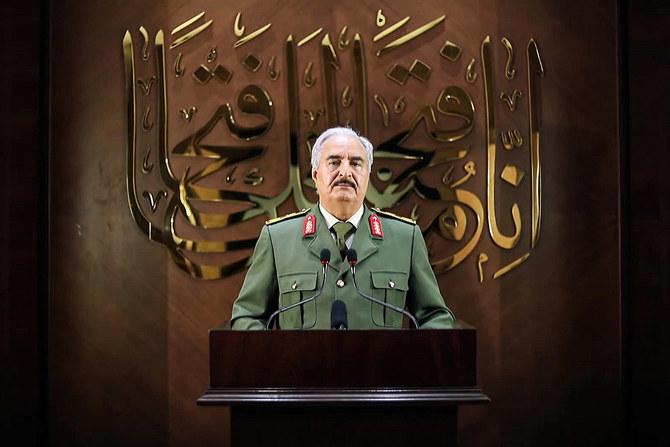
TRIPOLI: Libya's UN-recognised government on Thursday rejected a truce unilaterally called the day before by military strongman Khalifa Haftar, saying it "did not trust" its eastern-based rival.
The move follows successes on the ground for forces loyal to the Tripoli-based Government of National Accord (GNA) against Haftar's troops in recent weeks, just over a year since he launched an offensive on the capital.
The GNA said in a statement that it did not trust Haftar, who controls the east and swathes of southern Libya, accusing him of violating previous truces.
"These violations make it so we do not trust truce announcements (from Haftar)," the GNA said.
Any "ceasefire needs to have international safeguards and mechanisms" to monitor its implementation and to document violations, it added.
Haftar's camp had said on Wednesday it would cease hostilities for the duration of Ramadan in response to international calls for a truce.
On April 24, the United Nations, European Union and several countries called for both sides to lay down their arms during the holy month, which began in Libya that day.
The oil-rich North African nation has been gripped by chaos since the 2011 ouster and killing of longtime dictator Moamer Kadhafi, with rival administrations in the east and west vying for power.
"The commander general announces the halting of military operations from his side," Ahmad al-Mesmari, a spokesman for Haftar, had declared on Wednesday from the eastern city of Benghazi.
He warned violations by the GNA would be met with an "immediate and harsh response."
However, fighting did not stop in Tripoli after Mesmari's announcement, with explosions still heard from the centre of the capital, according to an AFP correspondent.
The GNA said in its own statement that it would continue in its "legitimate defence", attacking "any threat where it exists and putting an end to outlaw groups", alluding to forces loyal to Haftar.
Since fighting began in April 2019, several ceasefires between Haftar's forces and the GNA have fallen through, with both sides blaming the other for violations.
Haftar's opponents accuse him of wanting to establish a new military dictatorship in the country.
On Monday he claimed he had "a popular mandate" to govern, declaring a key 2015 political deal to be finished and vowing to press his assault to seize Tripoli.
But the UN, EU, Washington and other countries have reiterated that the 2015 agreement remains the only framework for recognised institutions in Libya.
Haftar claims legitimacy from an eastern-based parliament elected in 2014, but the body has not said whether it supported his move.
He did not offer specifics on how he had received his "mandate" or from which institution.
Nor did he say whether the parliament, which was forced to move its headquarters after violence ripped apart Tripoli six years ago, would be dissolved.
The GNA dismissed Haftar's announcement as a "farce", saying Thursday that he was "not a partner for peace".
"We have before us a bloodthirsty person obsessed with power," it added in its statement.
Haftar's call for a truce comes after several setbacks for his forces in recent weeks, with GNA fighters ousting them from two key coastal cities west of Tripoli.
Backed by Turkey, GNA troops are now encircling Haftar's main rear base at Tarhuna, 80 kilometres (50 miles) southeast of the capital.
In recent months, foreign military involvement has exacerbated Libya's conflict, with the United Arab Emirates and Russia backing Haftar and Ankara supplying the GNA.


![]()

Libya’s unity government says rejects Haftar’s truce offer
Short Url
https://arab.news/nt75d
Libya’s unity government says rejects Haftar’s truce offer
- Libya's UN-recognised government Thursday rejected a truce unilaterally called the day before by military strongman Khalifa Haftar
- The Tripoli-based Government of National Accord (GNA) said in a statement that it will continue in its "legitimate defence"


Latest updates


Recommended



© 2026 SAUDI RESEARCH & PUBLISHING COMPANY, All Rights Reserved And subject to Terms of Use Agreement.