

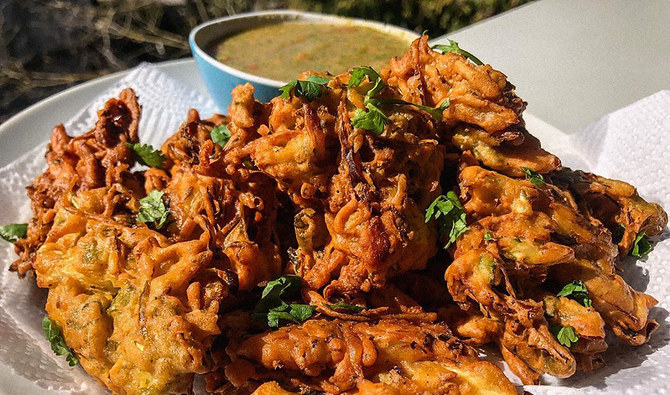

RAWALPINDI: Ramadan is underway and if there is one food item Pakistanis look forward to at the end of a reflective day of fasting it is the humble, the salty, the delicious fried pakora.
In a poll of 200 Pakistanis conducted by Arab News, which asked them to choose their favorite Ramadan fried treat, 63 percent picked the pakora. Samosas came in at 20 percent, dahi bhalay (a fried lentil cake served in yogurt) at 12 percent.
Why do Pakistanis love pakoras so much?
“What a question!” said Lahore’s Blue Door Supper Club’s chef and owner Unum Amin, "It’s like our tempura! You can fry anything within the pakora framework, it is the most versatile food."
Pakoras are vegetables, cheese, meat or even full chili peppers dipped in seasoned gram or chickpea flour batter. Crispy, deep-fried till golden and dipped into various sauces, the delicious fritters are a favorite snack of not only Pakistan but the entire Indian subcontinent.
Since children usually do not enjoy eating vegetables, pakoras are also a great way to smuggle some plant fiber into their diet.
In another poll, Arab News asked Pakistanis what types of pakoras they loved.
Most of respondents, 65 percent, said the classic potato pakora was their favorite, with onion, spinach, eggplant, chili and paneer versions trailing far behind.
"Thin, super thin potato pakoras that are extra crispy, that's the perfect way to eat them. They can be devoured with anything!" Rakhshana Asghar from Rawalpindi told Arab News, as she underlined the snack’s universality.
Depending on the pakora base, their dips can be spicy and minty green chutney, sweet tamarind chutney, ketchup, sweet garlic sauce and even chili mayonnaise. Relish is what gives pakora lovers space to get creative.
Their creativity gets a boost during Ramadan, when pakoras become the most popular food item.
At each household pakoras taste different, reflecting the preferences of family members. The snack is indeed largely a family affair.
New York-based public relations expert Zahra Ahsan told Arab News she thinks of pakoras with nostalgia. "They take me back to being in Lahore with my entire family. If there’s one thing that brings everyone to the table in Ramadan, it’s pakoras."
Easy, quick, cheap and light, pakoras are the most natural choice for iftar, or fast-breaking meal. According to Amin, "It wouldn’t be Ramadan in Pakistan without pakoray!”
She shared with Arab News her own pakora recipe. For those who are going to try it, Amin gives a tip: "You can add each filling to the batter individually or, as I like to do, mix them together in different combinations — spinach with cottage cheese, potato with onion, eggplant with onion, or everything together!"
As pakora batter can be made in various ways and should be individually adjusted to taste buds, Amin's recipe, she said, is open to modification.
PAKORAS OF BLUE DOOR SUPPER CLUB
(Serves 4-6)
- 200 g besan/chickpea flour
- 2 tablespoons rice flour (secret ingredient)
- 1.5 tsp Himalayan pink salt
- 1 tsp red chili powder
- 2 tsp ground coriander (or 1 tsp and you can add 1 tsp whole coriander seeds for added crunch)
- 2 tsp cumin powder
- 1 tsp baking soda
- 200-250ml water (use as needed)
Optional: finely chopped green chili and coriander leaves
- Oil for deep frying
- Chaat masala for sprinkling
- Green chutney and chili garlic ketchup
FILLING SUGGESTIONS
- Cottage cheese slices or chunks
- Potato matchsticks or thinly sliced rounds
- Onion half rings
- Eggplant slices
- Chopped spinach
METHOD
- Mix dry ingredients together, and slowly add water while mixing to make a smooth, thick batter. You are looking for a consistency that will stick to and coat your chosen filling, and it should be well seasoned. Be wary of adding too much water as vegetables you fry will also release water into the batter.
- Heat your oil in a wok or deep-frying pan.
- To check if the oil is ready, do a little batter drip test, if the batter immediately sizzles and floats to the top, you can begin frying.
- Add cottage cheese to the batter and coat evenly. Using a spoon or your hand, slide pieces of coated cheese carefully into the hot oil. Work in batches without overcrowding the pan.
- Fry pakoras until golden brown on all sides, remove to a paper towel lined plate or grill rack to drain. You can keep them warm in an oven preheated to 100 C.
- Sprinkle with a pinch of chaat masala for an extra kick, serve with chutney and chili garlic sauce.


