

Saudi cabinet urges southern Yemeni separatists to reverse self-rule decision

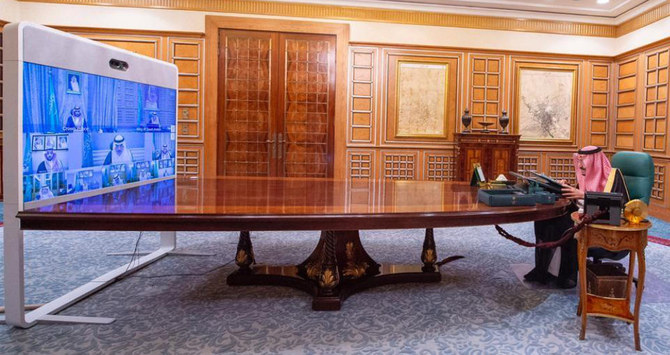
King Salman chaired the session on Tuesday. (SPA)
Short Url
Updated 29 April 2020
Follow

Saudi cabinet urges southern Yemeni separatists to reverse self-rule decision

  • Pompeo said that Washington is “concerned” about the actions of the STC
  • Cabinet ministers approved in principle the setting up of a state-owned, joint-stock company for mining services

RIYADH: The Saudi cabinet on Tuesday called for the situation in Yemen to return to the way it was before separatists seized control in the interim capital Aden and some southern governorates, according to state news agency SPA. The Southern Transitional Council declared a state of emergency on Sunday and said it would self-govern these areas.

The Saudi-led coalition in Yemen on Monday urged the separatists to reverse their decision, describing it as “escalatory action” at a time when everyone should be focusing on the coronavirus crisis.

Also on Tuesday, US Secretary of State Mike Pompeo said that Washington is “concerned” about the actions of the STC, warning that they threaten the efforts to revive peace talks between the Yemeni government and Houthi rebels.

“Such unilateral actions only exacerbate instability in Yemen,” he said. “We call on the STC and the Republic of Yemen government to re-engage in the political process provided under the Riyadh Agreement.”

King Salman began the cabinet meeting, which took place by video conference, by thanking everyone in the Kingdom and other countries who had sent congratulations for the start of Ramadan.

The cabinet members passed on their own best wishes for the holy month to the king, Crown Prince Mohammed bin Salman bin Abdulaziz, Saudi citizens and all the Islamic peoples of the world.

They also expressed their appreciation to the king for his speech on the eve of Ramadan, during which he said he was proud of the precautionary and preventive measures being taken by Saudi authorities to combat the coronavirus, and thanked all those working tirelessly to slow its spread, including health-care providers, military and security personnel, government officials and all those on the front lines of the battle.

Acting Minister of Media Dr. Majid Al-Qasabi said after the meeting that the cabinet reviewed a number of reports on local and international developments relating to the pandemic. These including the latest information about confirmed cases in the Kingdom, the care provided to patients, and progress reports on the implementation of procedures and measures to preserve public health.

He praised the efforts by authorities in the Kingdom to provide immediate examinations for patients showing symptoms of infection, and supply the tests, medical equipment and medicines needed to deal with the virus. In particular he welcomed the signing of a SR995 million ($265 million) contract to carry out 9 million tests and increase the capacity of laboratories across the Kingdom to analyze the results.

The cabinet also welcomed a royal order to partially lift the curfew in most parts of the country, as well as the resumption of some economic activities, subject to adherence to precautionary and preventive measures.

Ministers discussed the Kingdom’s work with the international community to combat the pandemic, and highlighted the appeal by leaders of the G20 nations to all countries, international organizations, the private sector, charitable institutions and individuals to contribute to the global response and bridge the funding gap.

Al-Qasabi said that the cabinet also noted the king’s approval for an increase of the funds allocated to the Ramadan Iftar (Breaking-Fast) Project, organized by the Ministry of Islamic Affairs, Call and Guidance, which aims to provide Iftar meals for a million people in 18 countries.

Cabinet ministers approved in principle the setting up of a state-owned, joint-stock company for mining services. No further details were given about the size of capital or time frame for its launch.

They also approved a number of other initiatives, including: a memorandum of understanding with the government of the UAE on food security; an agreement with Greece on air transport services; a memorandum of understanding for cooperation in the field of medical products with India’s Central Drugs Standard Control Organization; a memorandum of understanding between the Saudi Control and Anti-Corruption Authority and the UN Development Programme on the prevention of corruption; and the establishment of a Supreme Equestrian Commission.


Saudi Arabia designates 2026 the Year of Artificial Intelligence

Updated 9 sec ago
Follow

Saudi Arabia designates 2026 the Year of Artificial Intelligence

  • SDAIA unveils official logo after it was approved by the Cabinet

RIYADH: Saudi Arabia has designated 2026 as the Year of Artificial Intelligence, underscoring the Kingdom’s growing leadership in global AI adoption, and reaffirming AI as a top priority by supporting the nation’s AI ambitions in line with Saudi Vision 2030.

With the Kingdom emerging as a global hub for data and AI, driven by the support of Crown Prince Mohammed bin Salman, the move was underscored by the Saudi Cabinet’s approval on Tuesday.

The Saudi Data and Artificial Intelligence Authority, meanwhile, launched the official logo for the Year of Artificial Intelligence, Saudi Press Agency reported Wednesday.

The logo integrates symbolism in its elements: a palm tree signifies the national emblem and the Kingdom’s cultural heritage, while the letters “AI” highlight the technological and innovative aspects central to promoting digital inclusion as part of Vision 2030.

The palm tree’s green color symbolizes the Saudi flag and the Kingdom’s national identity, while the accompanying blue color represents digital technology and progression toward advanced technological development.

The logo is accompanied by the official hashtag for the Year of Artificial Intelligence: #SaudiAIYear.

Muhammad Khurram Khan, a professor of cybersecurity at King Saud University, told Arab News: “Saudi Arabia’s decision to designate 2026 as the Year of Artificial Intelligence represents a strategic milestone in the Kingdom’s digital transformation under Vision 2030.

“Over the past several years, SDAIA has successfully moved the national AI agenda from planning to large-scale implementation. The progress is visible in the Kingdom’s rapid rise in global AI rankings, its significant investment in emerging technologies, and the development of advanced infrastructure such as national data platforms and large-scale data centers,” he said.

The Kingdom ranked 14th in the 2025 Global AI Index and holds a leading position in the Arab world for AI model development.

Investment in the sector has grown significantly, with government spending on emerging technologies rising by more than 56 percent in 2024 and AI companies securing $9.1 billion in funding.

“The newly unveiled logo effectively reflects this vision. The logo thoughtfully blends Saudi Arabia’s heritage with its technological ambitions, reflecting the Kingdom’s forward-looking vision for a technology-driven future,” said the professor.

“What distinguishes Saudi Arabia’s approach is its holistic strategy. Rather than focusing solely on technology deployment, the Kingdom has invested heavily in talent development, regulatory frameworks, and ecosystem building. Training thousands of specialists and engaging more than a million participants through national AI initiatives demonstrates a long-term commitment to building a sustainable knowledge economy. Equally important is the Kingdom’s emphasis on responsible AI governance, reflected in its participation in international AI partnerships focused on ethics,” he added.

Welcoming the Cabinet’s decision to designate 2026 as the Year of Artificial Intelligence, Abdullah bin Sharaf Al-Ghamdi, SDAIA president, said on Tuesday the decision reflects the crown prince’s vision to strengthen the Kingdom’s global standing in advanced technologies.

He described it as an important step toward creating national momentum around innovation and the role of artificial intelligence in shaping a smarter and more sustainable future.

Since its establishment in 2019, SDAIA has led the National Strategy for Data and Artificial Intelligence, which focuses on six pillars: ambition, competencies, policies, investment, innovation, and ecosystem.

These efforts have moved the Kingdom from strategic planning to implementation, including regulating AI sectors and developing advanced digital infrastructure.

Infrastructure has expanded with the launch of the Shaheen III supercomputer and the Hexagon data center, the world’s largest government data facility with a capacity of 480 megawatts.

The Kingdom has also established a National Data Lake integrating more than 430 government systems.

Human capital development remains a priority. More than 11,000 specialists have been trained, and the SAMAI program has reached over one million participants.

Internationally, Saudi Arabia has strengthened its presence in the AI sector. It became the first Arab nation to join the Global Partnership on AI and hosts the UNESCO-sponsored International Center for Artificial Intelligence Research and Ethics in Riyadh.

These initiatives reflect the Kingdom’s commitment to the responsible and ethical use of artificial intelligence to support economic diversification and serve humanity globally.