CAIRO: Eastern Libyan forces laying siege to the country’s capital of Tripoli accused their rivals Tuesday of staging an attack in which a Turkish drone hit a food truck convoy in the country’s west, killing at least five civilians.
The militia groups loosely allied with a UN-supported but weak government in Tripoli denied attacking civilians, saying they targeted trucks carrying equipment and ammunition for eastern forces trying to take the capital.
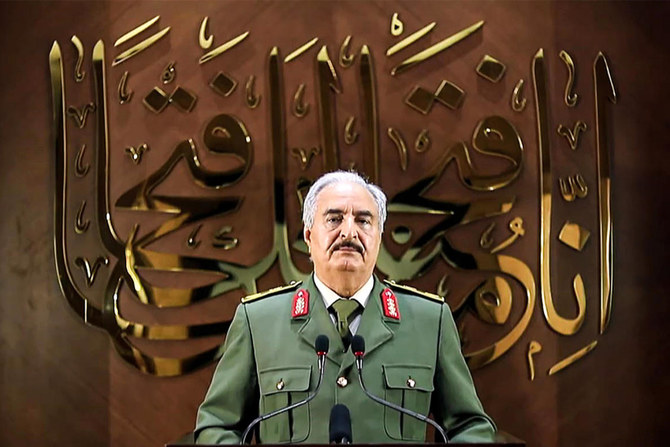
Khalifa Haftar, who declared the start of an operation to root out the militias and unify the country in 2014, is commander of the east-based forces attempting to take control of Tripoli. They control most of eastern and southern Libya. The besieged administration in Tripoli rules just a corner of the country’s west. Both sides are supported by a network of fractious militias and foreign powers.
Haftar launched his Tripoli offensive last April. In recent weeks, violence has escalated, with both sides accusing each other of shelling civilian neighborhoods. The UN has said the violence and worsening humanitarian crisis in Libya could amount to war crimes.
Turkey has sent armored drones, air defenses and more recently, Syrian militants with links to extremist groups to prop up the embattled Tripoli government.
There was no immediate comment from Turkish officials on the alleged drone attack.
Ahmed Al-Mosmari, a spokesman for Haftar forces, said the drone strike took place late Monday near the district of Mizda, 184 kilometers south of Tripoli.
The attack came after Haftar, in an attempted show of strength, declared Monday that a 2015 UN-brokered political deal to unite the oil-rich country was “a thing of the past.”
The Tripoli-based government said it wasn’t surprised by Haftar’s announcement and urged Libyans to join “a comprehensive dialogue and continue on the democratic path to reach a comprehensive and permanent solution based on ballot boxes.”
While the 2015 agreement has failed to bring unity or stability to the divided country, Haftar’s announcement threatens to further complicate UN efforts to broker a political settlement to the civil war.
In Brussels, European Commission spokesman Peter Stano on Tuesday criticized Haftar’s announcement. He said “any attempt to push forward unilateral solutions, even more so by force, will never provide a sustainable solution for the country.”
Stano said the December 2015 agreement remains the mos viable framework for a political solution in Libya. He called on international stakeholders in Libya to “increase their pressure” on the warring parties to end the fighting and bring about a political settlement.
Jalel Harchaoui, a Libya expert at The Netherlands Institute of International Relations, said Haftar’s move was “pretty much a coup” that revealed “aspirations that aren’t new.”
“Haftar takes yet another step toward full military autocracy and absolute control over the territories currently aligned with the LNA,” he said.
The move could also give the military commander an opportunity to take economic measures to address serious economic and financial crises in areas under his control.
Libya has been in turmoil since 2011, when a civil war toppled long-time dictator Muammar Qaddafi, who was later killed. The chaos has worsened in the recent round of fighting as foreign backers increasingly intervene, despite their pledges to the contrary at a high-profile peace summit in Berlin earlier this year.


![]()

Eastern Libyan forces say Turkish drone killed 5 civilians
Short Url
https://arab.news/ws8qk
Eastern Libyan forces say Turkish drone killed 5 civilians
- Drone strike took place late Monday near the district of Mizda, 184 kilometers south of Tripoli
- Turkey has sent armored drones, air defenses and Syrian militants to prop up Tripoli government


Latest updates


© 2026 SAUDI RESEARCH & PUBLISHING COMPANY, All Rights Reserved And subject to Terms of Use Agreement.