Government approves additional funds for fencing Pakistan-Iran border

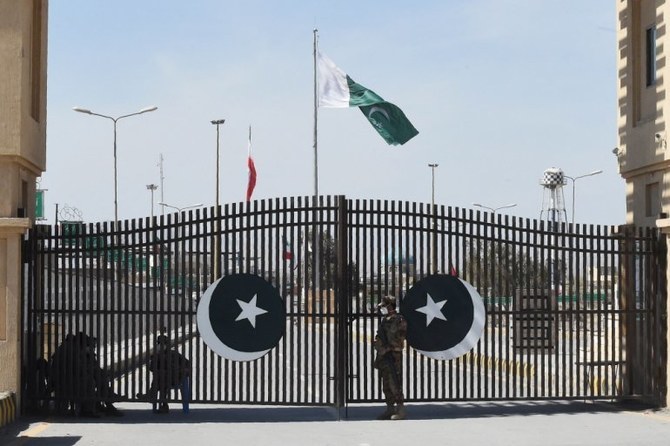
Pakistani soldiers wearing facemasks stand guard at the closed Pakistan-Iran border in Taftan on February 25, 2020. (AFP photo)
Short Url
Updated 29 April 2020
Follow

Government approves additional funds for fencing Pakistan-Iran border

  • Pakistan started fencing border in May last year, despite Iran’s resistance 
  • Five border crossings with Iran will be open three days a week for cargo trucks

KARACHI: The Economic Coordination Committee (ECC) of the Pakistani government on Monday approved additional funds in the form of a technical supplementary grant of Rs3 billion for the fencing of the country’s porous border with Iran.

Pakistan started fencing certain areas of the border in May last year. Iran has resisted the move, of which Senate of Pakistan was informed by Frontier Constabulary Balochistan on May 10, 2019.

The 900-kilometer border begins at the Koh-i-Malik Salih mountain and ends at Gwadar Bay in the Gulf of Oman. It goes through a diverse landscape of mountain ridges, seasonal streams and rivers, and is notorious for human trafficking, smuggling and cross-border militancy.

Meanwhile, Pakistan has opened five crossings on the border to allow cargo trucks to cross over to Balochistan, Foreign Office spokeswoman Aisha Farooqui confirmed on Tuesday, adding that no individual movement was permitted.

“All five border points are open for cargo only. Pedestrians can come only through Taftan,” Farooqui told Arab News, referring to another crossing on the 900-kilometer Pakistani-Iranian border in Balochistan province.

Pakistan sealed the border on Feb. 24, after Tehran confirmed coronavirus related deaths.

At Taftan, however, Pakistanis who were in Iran for pilgrimage, continued to cross into Balochistan as Iranian authorities stamped them out.

Other crossing points, namely Gabd, Mand, Katagar and Chedgi, remained closed until the National Command and Operation Center (NCOC) decided to open them for transports of dates and other essential commodities.

According to a notification issued by the Ministry of Interior on April 21, the crossing points will remain open three days a week to facilitate trade. Three entry points — Gabd, Mand and Taftan — were reopened on April 21 for up to 50 trucks and 110 pickup vehicles a day in total.

From Monday, entry of 40 trucks and up to 100 pickup vehicles a day — also thrice a week — is allowed at Katagar and Chedgi as well.

According to the ministry’s notification, the trucks can enter between 8 a.m. and 2 p.m. The vehicles and cargo have to undergo disinfection after customs clearance. Protective measures are in place to prevent the spread of the virus.


Pakistan IT exports rise nearly 20 percent to $2.61 billion in first seven months of fiscal year

Updated 4 sec ago
Follow

Pakistan IT exports rise nearly 20 percent to $2.61 billion in first seven months of fiscal year

  • January ICT exports climb to $374 million year-on-year
  • Sector remains country’s top-earning services export

KARACHI: Pakistan’s information and communication technology (ICT) export earnings rose 19.78 percent year-on-year to $2.61 billion in the first seven months of the fiscal year ending June 2026, the IT ministry said on Tuesday, highlighting the sector’s growing role as a source of foreign exchange.

Pakistan’s IT and IT-enabled services sector has emerged as one of the country’s fastest-growing sources of foreign exchange, generating over $3 billion annually and employing roughly a million freelancers in addition to formal software firms.

Unlike traditional manufacturing exports, the industry relies primarily on remote digital labor, from software development to back-office services, making it resilient during economic crises but constrained by payment barriers, talent migration and infrastructure reliability challenges. However, IT services require minimal imports and benefit from a large pool of young workers and freelancers, making the sector central to government plans to boost dollar inflows and reduce pressure on the balance of payments.

“ICT export remittances surged 19.78 percent, reaching $ 2.61 billion during the first seven months of FY 2025-26 compared to $ 2.18 billion achieved during the corresponding period last year,” the IT ministry said in a statement.

Monthly exports also expanded, with ICT services exports reaching $374 million in January 2026, up 19.5 percent from $313 million a year earlier, according to the ministry’s data.

The ministry said ICT remained the country’s highest-earning services sector, well ahead of “other business services,” which generated $1.21 billion over the same July-January period.

Pakistan has increasingly relied on technology exports, including software development, outsourcing and freelance services, to generate foreign exchange as the economy adjusts under structural reforms and tight import controls following a balance-of-payments crisis.

Officials say continued growth will depend on easing payment bottlenecks, improving digital infrastructure and expanding higher-value technology services beyond traditional outsourcing.