

UK denies antibody test ready for rollout

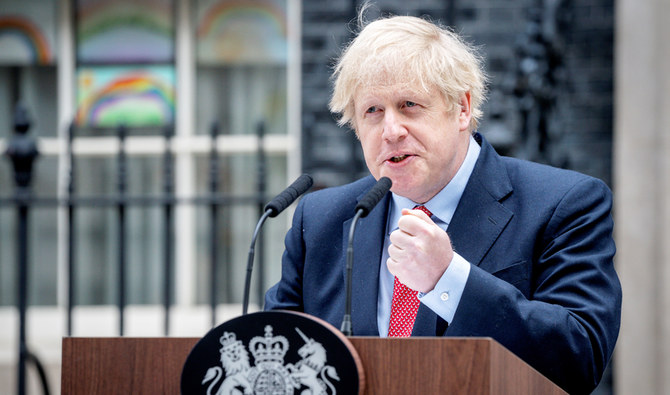
UK Prime Minister Boris Johnson gives a statement outside 10 Downing Street, as he returns to work on Monday after recovering from coronavirus. (AFP)
Short Url
Updated 28 April 2020
Follow

UK denies antibody test ready for rollout

  • Pressure to deliver viable antibody tests has also been driven by a number of existing designs failing en masse in Britain and across Europe

LONDON: The UK government has denied ordering up to 50 million home testing kits for COVID-19 from a consortium based in Oxford, weeks after admitting that along with several EU states, it had imported millions of faulty kits from abroad.
The news has dealt another blow to global efforts to contain the virus. UK Foreign Secretary Dominic Raab on Sunday said it was unclear whether the kits were reliable, warning that faulty testing, potentially giving people the all clear when they were still at risk, would be extremely dangerous.
An antibody test that can be taken at home, and that would be able to tell people whether they had already contracted COVID-19 — and therefore possibly built up a level of immunity — has been seen as a key step in developing a global strategy to end lockdowns worldwide that have caused widespread economic damage.
The hope is that by identifying those with a degree of immunity, and by being able to map the spread of infection, governments might be able to safely restart parts of their economies and reopen areas of major cities without risking a “second peak” of infections.
Reports over the weekend suggested that 50 million tests had been ordered from scientists working for the Rapid Testing Consortium at Oxford University — a partnership between four private companies and the university — which has received UK government backing.

HIGHLIGHT

News deals blow to global hopes of home-use kits to help end lockdowns.

The test, based on analyzing antibodies in blood obtained through a finger prick, and differing from the antigen test needed to identify someone with an active case by taking samples from the throat or nasal cavity, supposedly gives positive or negative results for COVID-19 antibodies in under an hour.
But a source at the UK’s Department of Health and Social Care told the Daily Telegraph newspaper that the test had yet to meet approval.
“The claims are overblown. It is premature to be talking about ordering large numbers of a test that hasn’t passed a regulator,” the source said.
Pressure to deliver viable antibody tests has also been driven by a number of existing designs failing en masse in Britain and across Europe.
The UK admitted that it had been forced to return 17.5 million tests bought from China — the source of the global pandemic — earlier this month.
Spain, the Czech Republic, Slovakia and other EU states have also discarded hundreds of thousands of faulty imported kits.
In the US, meanwhile, the Food and Drug Administration (FDA) has come in for criticism after allowing the sale of more than 90 different test kits on the open market that have been described as being of “dubious quality.”
Eric Topol, director of the Scripps Research Translational Institute, told the Financial Times: “Usually you can rely on the FDA to do due diligence and really make sure the test is valid but here the criteria have been loosened. If anything we need more oversight, rather than less.”
The Switzerland-based Foundation for Innovative New Diagnostics said 280 antibody tests have gone into development or reached markets since the start of the outbreak in late 2019.
But none has yet been found to approach 100 percent accuracy, with some registering as little as 30 percent.
Part of the issue arises from the difficulty in accurately identifying antibodies specific to Sars-CoV-2, the virus responsible for COVID-19, when other antibodies are present in a sample.

The UK’s National Covid Testing Scientific Advisory Panel, also based at Oxford University, has so far trialed, and declined, nine different commercially available antibody tests.

Prime Minister Boris Johnson had previously referred to developing an accurate antibody test as a potential “game changer” in the global quest to overcome the virus.

But in a speech upon his return to work on Monday he did not make any reference to such a test, instead imploring people to stick to lockdown guidelines.


Pakistani fighter jet crashes in Jalalabad, pilot captured: Afghan military, police

Updated 28 February 2026
Follow

Pakistani fighter jet crashes in Jalalabad, pilot captured: Afghan military, police

  • Fighting between Pakistan and Afghanistan’s Taliban military entered its third day on Saturday
  • Pakistan’s strikes on Friday hit Taliban military installations and posts, including in Kabul and Kandahar

JALALABAD: A Pakistani jet has crashed in Jalalabad city and the pilot captured alive, the Afghan military and police said Saturday, with residents telling AFP the man parachuted from the plane before being detained.
"A Pakistani fighter jet was shot down in the sixth district of Jalalabad city, and its pilot was captured alive," police spokesman Tayeb Hammad said.
Wahidullah Mohammadi, spokesman for the military in eastern Afghanistan, confirmed the Pakistani jet was downed by Afghan forces "and the pilot was captured alive".

The AFP journalist heard a jet overhead before blasts from the direction of the airport in Jalalabad, the capital of Nangarhar province, which sits on the road between Kabul and the Pakistani border.

Fighting between Pakistan and Afghanistan’s Taliban military entered its third day on Saturday, following overnight clashes as the international community expressed increasing concern about the conflict and called for urgent talks.

Pakistan’s strikes on Friday hit Taliban military installations and posts, including in Kabul and Kandahar, in one of the deepest Pakistani incursions into its western neighbor in years, officials said.

Islamabad accuses the Taliban of harboring Tehreek-e-Taliban Pakistan (TTP) militants, who it claims are waging an insurgency inside Pakistan, a charge the Taliban denies.

Pakistan described its actions as a response to cross-border assaults, while Kabul denounced them as a breach of its sovereignty, saying it remained open to dialogue but warned any wider conflict would result in serious consequences.

The fighting has raised ‌the risk ‌of a protracted conflict along the rugged 2,600-kilometer frontier.

Diplomatic efforts gathered ‌pace ⁠late on Friday ⁠as Afghanistan said its foreign minister, Amir Khan Muttaqi, spoke by telephone with Saudi Arabia’s Prince Faisal bin Farhan about reducing tensions and keeping diplomatic channels open.

The European Union called for both sides to de-escalate and engage in dialogue, while the United Nations urged an immediate end to hostilities.

Russia urged both sides to halt the clashes and return to talks, while China said it was deeply concerned and ready to help ease tensions.

The United States supports Pakistan’s right to defend itself against attacks by ⁠the Taliban, a State Department spokesperson said.

Border fighting continues

Exchanges of fire continued along ‌the border overnight.

Pakistani security sources said an operation dubbed “Ghazab Lil Haq” was ongoing and that Pakistani forces had destroyed multiple Taliban posts and camps in several sectors. Reuters could not independently verify the claims.

Both sides have reported heavy losses with conflicting tolls that Reuters could not verify. Pakistan said 12 of its ‌soldiers and 274 Taliban were killed while the Taliban said 13 of its fighters and 55 Pakistani soldiers died.

Taliban deputy spokesman Hamdullah Fitrat ⁠said 19 civilians were ⁠killed and 26 wounded in Khost and Paktika. Reuters could not verify the claim.

Pakistan’s Defense Minister Khawaja Muhammad Asif said “our cup of patience has overflowed” and described the fighting as “open war,” warning that Pakistan would respond to further attacks.

Taliban Interior Minister Sirajuddin Haqqani said in a speech in Khost province that the conflict “will be very costly,” and that Afghan forces had not deployed broadly beyond those already engaged.

He said the Taliban had defeated “the world, not through technology, but through unity and solidarity,” and through “great patience and perseverance,” rather than superior military power.

Pakistan’s military capabilities far exceed those of Afghanistan, with a standing army of hundreds of thousands and a modern air force.

In stark contrast, the Taliban lacks a conventional air force and relies largely on light weaponry and ground forces.

However, the Islamist group is battle-hardened after two decades of insurgency against US-led forces before returning to power in 2021.