

Iran’s regional proxy machine has been derailed, says expert

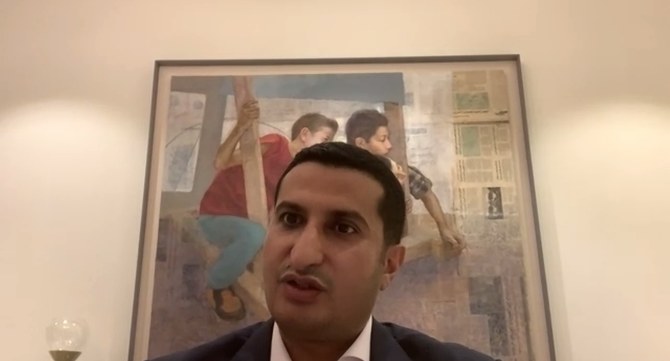
Editor in Chief of Al Arabiya English Mohammed Khalid Alyahya. (Screengrab)
Short Url
Updated 27 April 2020
Follow

Iran’s regional proxy machine has been derailed, says expert

  • Mohammed Khalid Alyahya: In the region, limiting Iran’s ability to fund its proxy network is the strategy
  • Lack of a charismatic leader to replace Soleimani is derailing the proxy machine even further

LONDON: The killing of Iranian Maj. Gen. Qassem Soleimani and the lack of dollars have derailed Tehran’s regional proxy machine, which will need time to recover, the editor in chief of Al Arabiya English said at a webinar on Monday.
“The Iranian regime needs US dollars to fund dozens and dozens of militias in Iraq. Many of them it exercises full control over, others a considerable amount — same in Syria and Lebanon,” said Mohammed Khalid Alyahya.

The lack of a charismatic leader to replace Soleimani, the commander of Iran’s Quds Force who was killed in a US drone strike in Iraq in January, is derailing the proxy machine even further, Alyahya added.
“In the region, limiting Iran’s ability to fund its proxy network is the strategy. The US strategy is working. It’s not perfect, but it’s working,” he said.
“What we’re seeing right now is the maximum-pressure campaign putting Iran in a corner scrambling for resources.”

Alyahya noted that none of the regional actors had a say in the talks that led to the Iran nuclear deal.
“Every country within range of Iran’s ballistic missiles, long range or short, or that contains militias, which are many in the region, wasn’t included in the nuclear negotiations,” he said. 

“Those most at risk from Iranian aggression and expansionism were an afterthought of the discussions,” he added.
“Since the deal, Iran stepped up its activities across the region, doubled down on ethnic cleansing and genocide in Syria … and empowered Hezbollah.”
On Saudi-Iranian relations, Alyahya said: “If you go to Riyadh and ask what their biggest national security threat is, invariably you’d hear Iran. However, if you were to go to Iran to ask them what their biggest national security threat is, they’d say the US or Israel, or both … 

So primarily it’s a conflict between the US and Iran.”
The webinar was hosted by the Harvard Kennedy School’s Belfer Center for Science and International Affairs, and was co-sponsored by Managing the Atom, the Iran Working Group and the Middle East Initiative.


Family of Palestinian-American shot dead by Israeli settler demand accountability

Updated 21 February 2026
Follow

Family of Palestinian-American shot dead by Israeli settler demand accountability

  • Relatives say Abu Siyam was among about 30 residents from the village of Mukhmas who confronted armed settlers attempting to steal goats from the community

LONDON: The family of a 19-year-old Palestinian-American man reportedly shot dead by an Israeli settler in the occupied West Bank have demanded accountability, amid mounting scrutiny over a surge in settler violence and a lack of prosecutions.

Nasrallah Abu Siyam, a US citizen born in Philadelphia, was killed near the city of Ramallah on Wednesday, becoming at least the sixth American citizen to die in incidents involving Israeli settlers or soldiers in the territory in the past two years.

Relatives say Abu Siyam was among about 30 residents from the village of Mukhmas who confronted armed settlers attempting to steal goats from the community. Witnesses said that stones were thrown by both sides before settlers opened fire, wounding at least three villagers.

Abu Siyam was struck and later died of his injuries.

Abdulhamid Siyam, the victim’s cousin, said the killing reflected a wider pattern of impunity.

“A young man of 19 shot and killed in cold blood, and no responsibility,” he told the BBC. “Impunity completely.”

The US State Department said that it was aware of the death of a US citizen and was “carefully monitoring the situation,” while the Trump administration said that it stood ready to provide consular assistance.

The Israeli embassy in Washington said the incident was under review and that an operational inquiry “must be completed as soon as possible.”

A spokesperson for the Israeli Defense Forces said troops were deployed to the scene and used “riot dispersal means to restore order,” adding that no IDF gunfire was reported.

The military confirmed that the incident remained under review and said that a continued presence would be maintained in the area to prevent further unrest.

Palestinians and human rights organizations say such reviews rarely lead to criminal accountability, arguing that Israeli authorities routinely fail to prosecute settlers accused of violence.

A US embassy spokesperson later said that Washington “condemns this violence,” as international concern continues to grow over conditions in the occupied West Bank.

Palestinians and human rights groups say Israeli authorities routinely fail to investigate or prosecute settlers accused of violence against civilians.

Those concerns were echoed this week by the UN, which warned that Israel’s actions in the occupied West Bank may amount to ethnic cleansing.

A UN human rights office report on Thursday said that Israeli settlement expansion, settler attacks and military operations have increasingly displaced Palestinian communities, with dozens of villages reportedly emptied since the start of the Gaza war.

The report also criticized Israeli military tactics in the northern West Bank, saying that they resembled warfare and led to mass displacement, while noting abuses by Palestinian security forces, including the use of unnecessary lethal force and the intimidation of critics.

Neither Israel’s foreign ministry nor the Palestinian Authority has commented on the findings.