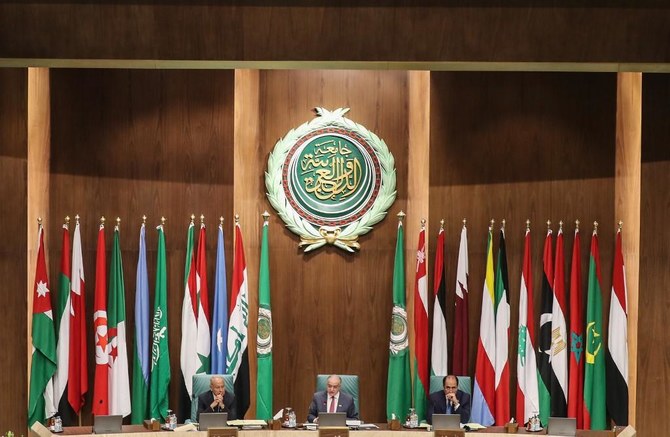
Arab league to meet over Israel’s plans to annex West Bank

Arab League chief Ahmed Ahmed Aboul Gheit had last week sent a message to UN Secretary General Antonio Guterres. (File/AFP)
Short Url
Updated 27 April 2020
Follow

Arab league to meet over Israel’s plans to annex West Bank

  • Arab League chief Ahmed Ahmed Aboul Gheit had last week sent a message to UN Secretary General
  • Benjamin Netanyahu and Benny Gantz signed a deal for a unity government that could accelerate the annexation of parts of the West Bank

CAIRO: The Arab League said Monday it will convene an urgent virtual meeting this week to discuss how to galvanize opposition to Israeli plans to annex parts of the occupied West Bank.
The extraordinary meeting — scheduled for Thursday at the request of the Palestinian leadership — will bring together Arab foreign ministers via video conference, rather than a face-to-face meeting, due to the global coronavirus pandemic.
The Arab League’s deputy secretary Hossam Zaki said the ministers will “discuss in their virtual meeting providing political, legal and financial support to the Palestinian leadership to confront the Israeli plans.”
It comes after Israeli Prime Minister Benjamin Netanyahu and his political rival Benny Gantz signed a deal for a unity government that could accelerate the premier’s plans to annex parts of the West Bank in the coming months.
Those Israeli plans — while subject to caveats, including the need to maintain “regional stability” and uphold the peace agreement with Jordan — have drawn wide criticism including from the United Nations and the European Union.
Arab League chief Ahmed Ahmed Aboul Gheit had last week sent a message to UN Secretary General Antonio Guterres warning against Israel’s plans saying they risk “igniting tension in the region.”
He also accused Israel of “exploiting the world’s preoccupation with the novel coronavirus to impose a new reality on the ground.”
Israel occupied the West Bank in the 1967 Six-Day War and has since extended its control by expanding its settlements there.
On Wednesday, US Secretary of State Mike Pompeo said a decision regarding the annexation of West Bank territories was up to Israel’s new unity government.
Earlier this year, the US unveiled a controversial Middle East peace plan that would allow Israel to retain control of the contested city of Jerusalem as its “undivided capital” and annex Jewish settlements on Palestinian lands including in the West Bank.
Arab states rejected Trump’s plan, saying it favored Israel and failed to grant Palestinians their minimum rights.
The Palestinians as well as the European Union have likewise criticized the plan, saying it effectively closes the door to a two-state solution in the Middle East.


Israel says Hamas ‘will be disarmed’ after group proposes weapons freeze

Updated 3 sec ago
Follow

Israel says Hamas ‘will be disarmed’ after group proposes weapons freeze

  • A top Hamas leader said on Wednesday that the militant group is open to a weapons “freeze,” but rejects the demand for disarmament

DOHA: Israel said on Thursday that Hamas “will be disarmed” as part of the US-sponsored peace plan for Gaza, after a top leader from the Islamist movement suggested a weapons freeze.
“There will be no future for Hamas under the 20-point plan. The terror group will be disarmed and Gaza will be demilitarised,” the Israeli official told AFP.
Hamas’s Khaled Meshaal told Qatari news channel Al Jazeera on Wednesday that the militant group is open to a weapons “freeze,” but rejects the demand for disarmament put forward in US President Donald Trump’s plan for Gaza.

A top Hamas leader told Qatari news channel Al Jazeera on Wednesday that the militant group is open to a weapons “freeze,” but rejects the demand for disarmament put forward in the US-sponsored peace plan for Gaza.
“The idea of total disarmament is unacceptable to the resistance (Hamas). What is being proposed is a freeze, or storage (of weapons)... to provide guarantees against any military escalation from Gaza with the Israeli occupation,” said Khaled Meshaal in an interview aired Wednesday.
“This is the idea we’re discussing with the mediators, and I believe that with pragmatic American thinking... such a vision could be agreed upon with the US administration,” he said.
The US-sponsored ceasefire deal, in effect since October 10, halted the war that began after Hamas’s deadly attack on Israel on October 7, 2023. But it remains fragile as Israel and Hamas accuse each other almost daily of breaches.
The agreement is composed of three phases. Israeli Prime Minister Benjamin Netanyahu recently indicated that it was about to enter the second phase.
Under that phase Israeli troops would further withdraw from their positions in Gaza and be replaced by an international stabilization force (ISF), while Hamas would lay down its weapons.
Netanyahu is expected to meet with US President Donald Trump in the US later this month to discuss the steps forward in the truce.
But the Palestinian militant group has indicated it would not agree to giving up its arsenal.
“Disarmament for a Palestinian means stripping away his very soul. Let’s achieve that goal another way,” Meshaal added.
In the first phase of the deal Palestinian militants committed to releasing the remaining 48 living and dead captives held in the territory. All of the hostages have so far been released except for one body.
In exchange, Israel has released nearly 2,000 Palestinian prisoners in its custody and returned the bodies of hundreds of dead Palestinians.
As for the international peacekeeping force, Meshaal said the group was open to its deployment along Gaza’s border with Israel, but would not agree to it operating inside the Palestinian territory, calling such a plan an “occupation.”
“We have no objection to international forces or international stabilization forces being deployed along the border, like UNIFIL,” he said, referring to the UN peacekeeping force deployed in southern Lebanon near the Israeli border.
“They would separate Gaza from the occupation,” he added, referring to Israel.
“As for the presence of international forces inside Gaza, in Palestinian culture and consciousness that means an occupying force.”
Mediators as well as Arab and Islamic nations, he said, could act as “guarantors” that there would be no escalation originating from inside Gaza.
“The danger comes from the Zionist entity, not from Gaza,” he added, referring to Israel.