

Filipino president urges ‘patience’ as Manila virus lockdown extended to May 15

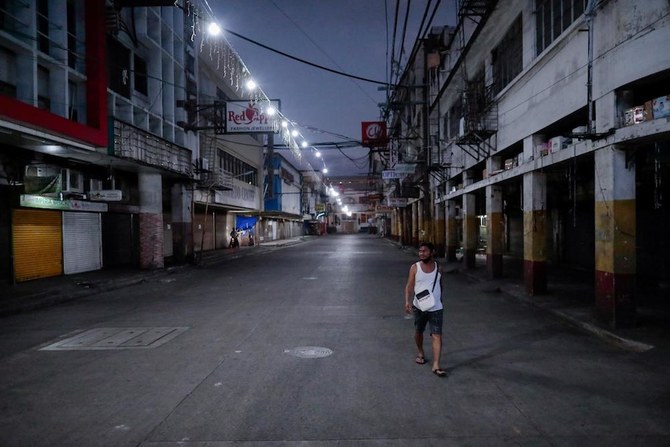
The Luzon island-wide enhanced community quarantine measure, one of the world’s strictest lockdowns to curb the spread of the deadly virus, was imposed in March. (Reuters/File Photo)
Short Url
Updated 24 April 2020
Follow

Filipino president urges ‘patience’ as Manila virus lockdown extended to May 15

  • Quarantine in lower-risk regions of Philippines to be modified for partial resumption of commercial activities

MANILA: Filipino President Rodrigo Duterte on Friday urged citizens to “be patient” as he announced an extension to the coronavirus disease (COVID-19) lockdown in the country’s capital region until May 15.

The Luzon island-wide enhanced community quarantine measure, one of the world’s strictest lockdowns to curb the spread of the deadly virus, was imposed in March with a view to it being lifted on April 30.

But in a recorded public address, Duterte said: “We are just waiting for the right time. Just be patient, please. We are trying to limit the contamination. We are all at risk. But do not increase the odds or the chances of getting it (COVID-19).”

Following a series of meetings with medical experts and the Inter-Agency Task Force for the Management of Emerging Infectious Diseases (IATF-EID), the president moved to extend the quarantine period in the Metro Manila region, where the outbreak has been at its worst, along with other high-risk areas in Luzon and parts of Visayas and Mindanao, including the city of Davao.

The latest measures will be re-evaluated by Filipino authorities on May 16.

Quarantine in lower-risk regions will be modified, allowing partial resumption of commercial activity, transportation and construction works from May 1. If there is no deterioration, normalization will start on May 16.

In a press briefing at the presidential palace, National Task Force COVID chief Carlito Galvez Jr. said Metro Manila had “more or less” 12,000 suspected COVID-19 cases out of a population of more than 12.8 million. Through aggressive testing, he added, the government aimed to bring the number down to zero.

He pointed out that the enhanced community quarantine in the capital region could not be lifted due to the risk of a second wave of infections, and that the government’s extension was in accordance with World Health Organization (WHO) guidelines.

Filipino Health Undersecretary Maria Rosario Vergeire said that the additional two weeks’ extension was to allow time for the country’s health care system to prepare medical facilities and reach a high testing capacity in readiness to deal with any rise in the number of COVID-19 cases.

Vergeire added that the public should be ready for a “new normal” where physical distancing and stricter hygiene measures would remain as the “virus will still be here.”

Meanwhile, Duterte repeated his threat to impose martial law if communist guerrillas active in the country’s north attacked government forces delivering aid to communities during the COVID-19 quarantine.

“I am now warning everybody and putting the armed forces and police on notice. I might declare martial law and there will be no turning back,” he said.


Rubio meets Orbán in Budapest as US and Hungary are to sign a civilian nuclear pact

Updated 8 sec ago
Follow

Rubio meets Orbán in Budapest as US and Hungary are to sign a civilian nuclear pact

  • Trump has been outspoken in his support for the nationalist Orbán in the Hungarian leader’s bid for reelection in two months

BUDAPEST, Hungary: US Secretary of State Marco Rubio was in the Hungarian capital on Monday for meetings with Prime Minister Viktor Orbán and his government during which they plan to sign a civilian-nuclear cooperation agreement heralded by US President Donald Trump.
Trump has been outspoken in his support for the nationalist Orbán in the Hungarian leader’s bid for reelection in two months. Orbán and his Fidesz party are facing their most serious challenge in the April 12 vote since the right-wing populist retook power in 2010.
The stop in Hungary’s capital follows Rubio’s visit to Slovakia on Sunday, after he previously attended the Munich Security Conference in Germany.
Led by Euroskeptic populists who oppose support for Ukraine and vocally back Trump, Slovakia and Hungary represent friendly territory for Rubio as he pushes to shore up energy agreements with both Central European countries.
Widely considered Russian President Vladimir Putin’s most reliable advocate in the European Union, Orbán has maintained warm relations with the Kremlin despite its war against Ukraine while currying favor with Trump and his MAGA — short for the 2016 Trump campaign slogan “Make America Great Again” — movement.
Many in MAGA and the broader conservative world view Hungary as a shining example of successful conservative nationalism, despite the erosion of its democratic institutions and its status as one of the EU’s poorest countries.
In a post on his Truth Social site earlier this month, Trump endorsed Orbán for the coming elections and called him a “truly strong and powerful Leader” and “a true friend, fighter, and WINNER.”
Trump has praised Orbán’s firm opposition to immigration, exemplified by a fence his government erected on Hungary’s southern border in 2015 as hundreds of thousands of refugees fled Syria and other countries in the Middle East and Africa.
Other US conservatives admire Orbán’s hostility to LGBTQ+ rights. His government last year banned the popular Budapest Pride celebration and allowed facial recognition technology to be used to identify anyone participating despite the ban. It has also effectively banned same-sex adoption and same-sex marriage, and disallowed transgender individuals from changing their sex in official documents.
Orbán has remained firmly committed to purchasing Russian energy despite efforts by the EU to wean off such supplies, and received an exemption from US sanctions on Russian energy after a November meeting in the White House with Trump.
Apparently trusting that his political and personal affinity with the US leader could pay even greater dividends, Orbán and his government have sought to woo Trump to Hungary before the pivotal April 12 elections — hoping such a high-profile visit and endorsement would push Orbán, who is trailing in most polls, over the finish line.
Budapest has hosted several annual iterations of the Conservative Political Action Conference, or CPAC, and another was hastily rescheduled this year to fall in March, just before Hungary’s elections.