Lebanon tightens security around refugee camp over virus

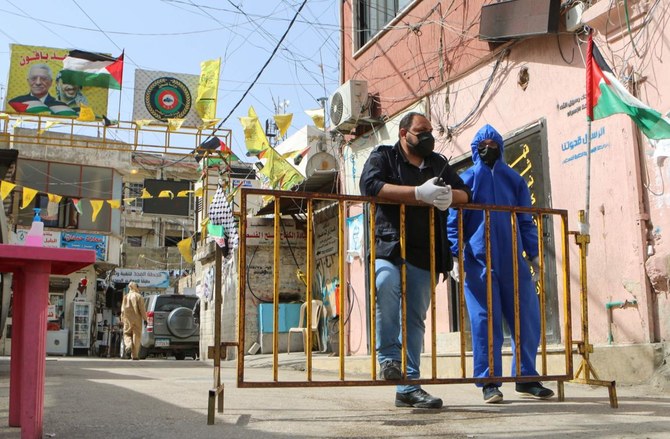
All entrances to Wavel camp in the city of Baalbek, known locally as the Jalil camp, have been closed after coronavirus cases were confirmed there. (AFP)
Short Url
Updated 24 April 2020
Follow

Lebanon tightens security around refugee camp over virus

  • Lebanon is home to more than 1 million Syrian refugees and other Syrians who are residents
  • Camp residents hunkered down at home after being asked to stay indoors

BAALBEK, Lebanon: Authorities closed all entrances to a Palestinian refugee camp in eastern Lebanon on Friday after four more people tested positive for the coronavirus, heightening concerns the virus could further spread among its overcrowded population.
The four infected with the virus are relatives of a woman who tested positive earlier this week and are isolating inside their home, according to a statement from the UN agency for Palestinian refugees. It said they were so far not in need of hospitalization
The Palestinian woman who was taken to a hospital in Beirut this week became the first refugee living in a camp in Lebanon to contract the virus, a finding that triggered a spate of testing in the camp. The five confirmed cases are residents of the Wavel camp in the city of Baalbek, known locally as the Jalil, or Galilee camp.
Lebanon, a tiny country of 5 million people, is home to more than 1 million Syrian refugees and other Syrians who are residents. It is also host to tens of thousands of Palestinian refugees and their descendants, most of them living in squalid camps with no access to public services, with limited employment opportunities and no rights to ownership.
On Friday, Palestinian fighters in charge of the camp security wore face masks as they patrolled the narrow streets and alleyways of the camp with an estimated population of up to 3,000. Posters of the late Palestinian President Yassir Arafat were plastered on the camp walls.
Camp residents hunkered down at home after being asked to stay indoors, while paramedics in protective suits sprayed down the few vehicles that were permitted to enter with disinfectant and took people’s temperatures.
Lack of testing has stoked fears among millions of displaced people around the world packed into refugee camps and informal settlements.
Most people who become infected experience mild to moderate symptoms. But the virus can cause severe illness and lead to death, particularly among older people and those with underlying health problems. It is highly contagious and can be spread by those who appear healthy.
Health Minister Hamad Hassan told reporters that Lebanese authorities were working together with the UN and other agencies “to avoid an outbreak in the coming days.”


A year after Assad fled, his victims struggle to heal

Updated 5 sec ago
Follow

A year after Assad fled, his victims struggle to heal

  • A year ago, Mohammad Marwan found himself stumbling, barefoot and dazed, out of Syria’s notorious Saydnaya prison on the outskirts of Damascus as opposition forces pushing toward the capital threw open its doors to release the prisoners
  • ‘We were in something like a state of death in Saydnaya ... Now we’ve come back to life’


HOMS, Syria: A year ago, Mohammad Marwan found himself stumbling, barefoot and dazed, out of Syria’s notorious Saydnaya prison on the outskirts of Damascus as opposition forces pushing toward the capital threw open its doors to release the prisoners.

Arrested in 2018 for fleeing compulsory military service, the father of three had cycled through four other lockups before landing in Saydnaya, a sprawling complex just north of Damascus that became synonymous with some of the worst atrocities committed under the rule of now-ousted President Bashar Assad.
He recalled guards waiting to welcome new prisoners with a gauntlet of beatings and electric shocks. “They said, ‘You have no rights here, and we’re not calling an ambulance unless we have a dead body,’” Marwan said.
His Dec. 8, 2024, homecoming to a house full of relatives and friends in his village in Homs province was joyful.
But in the year since then, he has struggled to overcome the physical and psychological effects of his six-year imprisonment. He suffered from chest pain and difficulty breathing that turned out to be the result of tuberculosis. He was beset by crippling anxiety and difficulty sleeping.
He’s now undergoing treatment for tuberculosis and attending therapy sessions at a center in Homs focused on rehabilitating former prisoners, and Marwan said his physical and mental situations have gradually improved.
“We were in something like a state of death” in Saydnaya, he said. “Now we’ve come back to life.”
Like Marwan, the country is struggling to heal a year after the Assad dynasty’s repressive 50-year reign came to an end following 14 years of civil war that left an estimated half a million people dead, millions more displaced, and the country battered and divided.
Hassan Abdul Ghani, spokesperson for the Syrian Ministry of Defense, said the opposition and its allies had launched a major organizational overhaul after Assad’s forces regained control of a number of areas in 2019 and 2020.
The offensive in November 2024 was not initially aimed at seizing Damascus but was meant to preempt an expected major offensive by Assad’s forces in opposition-held Idlib intending to “finish the Idlib file,” Abdul Ghani said.
Launching an attack on Aleppo “was a military solution to expand the radius of the battle and thus safeguard the liberated interior areas,” he said.
When the Syrian army’s defenses collapsed, the opposition pressed on, “taking advantage of every golden opportunity,” Abdul Ghani said.
Remnants of the civil war are everywhere. The Mines Advisory Group has reported that at least 590 people have been killed by land mines in Syria since Assad’s fall, including 167 children, putting the country on track to record the world’s highest land mine casualty rate in 2025.
The rebuilding that has taken place has largely been individual owners paying to fix their own damaged houses and businesses.
On the outskirts of Damascus, the once-vibrant Yarmouk Palestinian camp today largely resembles a moonscape. Taken over by a series of militant groups then bombarded by government planes, the camp was all but abandoned after 2018.
Since Assad’s fall, a steady stream of former residents have come back.
The most damaged areas remain largely deserted but on the main street leading into the camp, bit by bit, blasted-out walls have been replaced in the buildings that remain structurally sound. Shops have reopened and families have come back to their apartments. But any larger reconstruction initiative appears to still be far off.
“It’s been a year since the regime fell. I would hope they could remove the old destroyed houses and build towers,” said Maher Al-Homsi, who is fixing his damaged home to move back, although the area doesn’t even have a water connection.
His neighbor, Etab Al-Hawari, was willing to cut the new authorities some slack.
“They inherited an empty country — the banks are empty, the infrastructure was robbed, the homes were robbed,” she said.
Bassam Dimashqi, a dentist from Damascus, said of the country after Assad’s fall, “Of course it’s better, there’s freedom of some sort.”
He added: “The job of the state is to impose security, and once you impose security, everything else will come. The security situation is what encourages investors to come and do projects.”
The UN refugee agency reports that more than 1 million refugees and nearly 2 million internally displaced Syrians have returned to their homes since Assad’s fall. 
Among them is Marwan, the former prisoner, who says the post-Assad situation in Syria is “far better” than before. But he is struggling economically.
Sometimes he picks up labor that pays only 50,000 or 60,000 Syrian pounds daily, the equivalent of about $5.
Once he finishes his tuberculosis treatment, he said, he plans to leave for Lebanon in search of better-paid work.