Kiosks set up in Bangladesh for COVID-19 tests

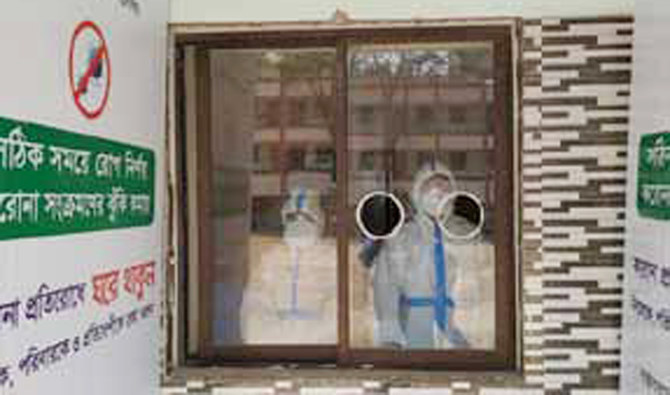
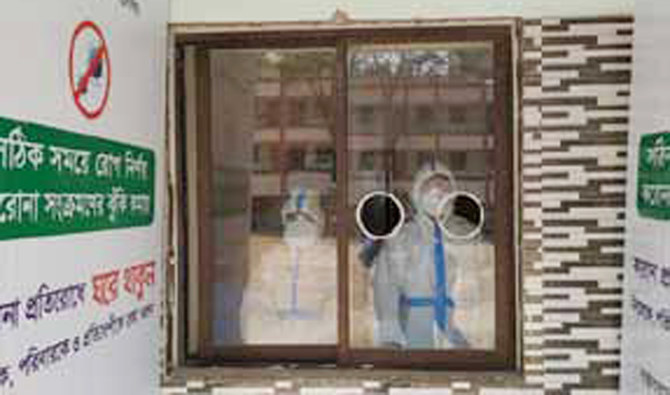
Health professionals at the sample collection booths on Sunday for COVID-19 patients in the Narayangonj area of Bangladesh..(Photo courtesy: JKG Healthcare)
Short Url
Updated 20 April 2020
Follow

Kiosks set up in Bangladesh for COVID-19 tests

  • Health workers in protective gear are stationed at designated booths set up by JKG, with visitors required to submit their national ID or any other valid document for the tests, which are free

DHAKA: Bangladesh on Sunday began setting up kiosks at designated points across the country to collect samples from suspected COVID-19 patients.
This follows in the footsteps of South Korea, which had implemented a similar and highly successful initiative as part of its measures to combat COVID-19.
“Nearly 200 health professionals and technicians collect samples from people who visit these booths and send them to the nearest testing facility,” Humayun Kabir, spokesman for JKG Healthcare, the nongovernmental health care service provider that launched the initiative, told Arab News on Sunday.
He said once completed, all test results are shared with the respective patients “within 24 hours.”
Health workers in protective gear are stationed at designated booths set up by JKG, with visitors required to submit their national ID or any other valid document for the tests, which are free.
“Eight health workers from JKG received training from us and trained more health professionals,” Dr. Khondoker Mahbuba Jamil, a virologist at the Institute of Public Health, told Arab News. “We recommended that they wear a face shield in addition to personal protective equipment.”
Eight booths have been installed at two locations in Narayangonj, a city on the outskirts of the capital Dhaka, and a COVID-19 hotspot in the country. Officials have collected 200 samples since the initiative was launched on April 13.

HIGHLIGHT

Health workers in protective gear are stationed at designated booths set up by JKG, with visitors required to submit their national ID or any other valid document for the tests, which are free.

“The main purpose of these booths is to keep people from moving out of their respective neighborhoods for testing purposes,” Kabir said.
In the first phase of the project, JKG will set up 44 booths at various hotspots nationwide, including in Dhaka, with a total of 320 kiosks to be established as part of the plan.
“On Sunday, we’ll set up 22 booths at eight different locations in Rohingya camps at Cox’s Bazaar. Hopefully, all these booths will be operative from the next day,” Kabir said.
In addition to the JKG kiosks, Bangladesh’s government has installed a testing lab facility at Cox’s Bazaar to facilitate the more than 1.15 million Rohingya refugees living there.
As of Sunday, the total number of confirmed coronavirus cases stood at 2,456, with 91 deaths reported, Health Minister Zahid Maleque said.


France, Algeria to resume security cooperation: minister

Updated 18 February 2026
Follow

France, Algeria to resume security cooperation: minister

  • Algeria plays a key role in the latter, sharing borders with junta-led Niger and Mali, both gripped by terrorist violence

ALGIERS: France and Algeria agreed on Tuesday to restart security cooperation during a visit to Algiers by French Interior Minister Laurent Nunez, marking the first sign of a thaw in diplomatic ties.
After meeting with President Abdelmadjid Tebboune, Nunez said both sides had agreed to “reactivate a high-level security cooperation mechanism.”
The visit took place against a backdrop of thorny relations between France and its former colony, frayed since Paris in 2024 officially backed Moroccan sovereignty over the disputed Western Sahara region, where Algeria supports the pro-independence Polisario Front.
Nunez said Monday had been devoted to working sessions aimed at “restoring normal security relations,” including cooperation in judicial matters, policing and intelligence.
He thanked the Algerian president for instructing his services to work with French authorities to “improve cooperation on readmissions.” Algeria has for months refused to take back its nationals living irregularly in France.
The renewed cooperation is expected to take effect “as quickly as possible” and continue “at a very high level,” Nunez confirmed.
According to images released by Algerian authorities, the talks brought together senior security officials from both countries, including France’s domestic intelligence chief and Algeria’s head of internal security.
Invited by his counterpart Said Sayoud, Nunez’s trip had been planned for months but repeatedly delayed.
Both sides have a backlog of issues to tackle. Before traveling, Nunez said he intended to raise “all security issues,” including drug trafficking and counterterrorism.
Algeria plays a key role in the latter, sharing borders with junta-led Niger and Mali, both gripped by terrorist violence.
Ahead of the trip, Nunez had also mentioned the case of Christophe Gleizes, a French sports journalist serving a seven-year sentence for “glorifying terrorism.”
It is unclear whether the matter was discussed with Tebboune, from whom the journalist’s family has requested a pardon.