


TWITTER POLL: More than 60% say coronavirus was man-made

It is accepted that the virus originated from Wuhan in China. (File/Shutterstock)
Short Url
Updated 19 April 2020
Follow

TWITTER POLL: More than 60% say coronavirus was man-made

  • Virus has claimed more than 160,000 lives globally
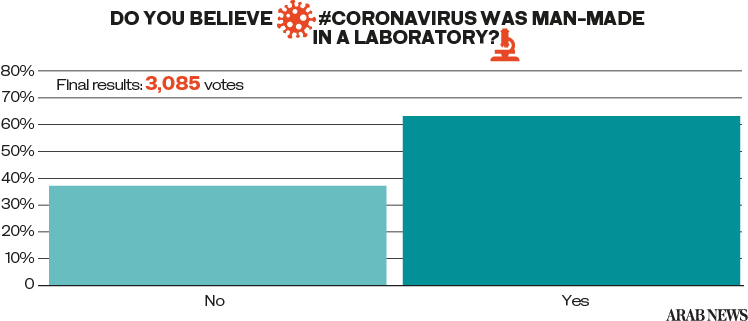
  • The poll found that nearly 62% believed the virus was man-made

DUBAI: Nearly two thirds of people taking part in an Arab News Twitter poll say they believe the coronavirus was man-made.

Of the 3,085 people who voted, 61.9 percent (1,909) said they believed the virus was created in a laboratory, the remaining 38.1 percent (1,176) said they did not.
The coronavirus is known to have started in Wuhan, China, where it was identified in December, 2019.

The scientific community widely believe the virus started organically - however reports say the US is looking into whether it could have leaked accidently from a laboratory in Wuhan, which was studying viruses.

Meanwhile China claims the virus was past to humans at a wet market.

There is believed to have been about 4,000 human lives lost in Wuhan, and more than 50,300 people have been infected – although the exact figures still remain unclear and China has been accused of covering up the actual totals.

Globally the virus has infected 2.33 million people, killing more than 160,950 – but there have also been 598,584 people who have recovered, despite no cure having yet been found.

Many countries – including those in the Middle East – have introduced strict lockdowns, with violators facing tough penalties if caught.

The global economy faces an uncertain future and millions of people have either lost their jobs, or been forced to take leave while the pandemic continues.    


Meta to charge Arab advertisers extra fee for reaching European audiences

Updated 11 March 2026
Follow

Meta to charge Arab advertisers extra fee for reaching European audiences

  • US tech giant told advertisers it will add fees ranging from 2 to 5 percent on image and video ads delivered on its platforms to offset digital service taxes
  • Charges are determined by where the audience is located, not where the advertiser is based

LONDON: Meta will from July 1 impose location-based surcharges on advertisers targeting audiences in six European countries, a move that will directly affect Arab businesses that run campaigns across the continent.

The US tech giant announced it will add fees ranging from 2 to 5 percent on image and video ads delivered on its platforms, including Facebook, Instagram and WhatsApp, to offset digital service taxes imposed by individual governments.

Crucially, the charges are determined by where the audience is located, not where the advertiser is based.

That means Saudi, Emirati, Egyptian or other Arab companies paying to reach consumers in the UK, France or Italy will face the additional costs regardless of their own country’s tax arrangements with Meta.

Fees will apply at 2 percent for ads reaching UK audiences, 3 percent for France, Italy and Spain, and 5 percent for Austria and Turkiye.

“If you deliver $100 in ads to Italy, where there is a 3% location fee, you will be charged $100 (ad delivery), plus $3 (location fee), for $103 total,” the company wrote in an email to an advertiser initially reported by Bloomberg. “Note that any applicable VAT will be calculated on top of the total amount.”

The taxes have been introduced at different points, starting with France in 2019, though not the EU as a bloc.

Many tech companies report substantial sales in Europe and millions of users but pay minimal tax on profits. The goal is to claw back locally derived economic value, Bloomberg reported.

The move follows similar decisions by Google and Amazon, which have also begun passing European digital tax costs on to advertisers.

For Arab brands with growing European footprints, particularly in fashion, travel, hospitality and media, the new fees add another layer of cost to campaigns already subject to currency and targeting complexities.

Digital services taxes, levied as a percentage of revenues earned by major tech platforms in individual countries, have drawn criticism from Washington, which argues they unfairly target US companies.

Meta has been reached for comments.