

Dozens of Pakistanis test positive for virus after returning from Afghanistan 

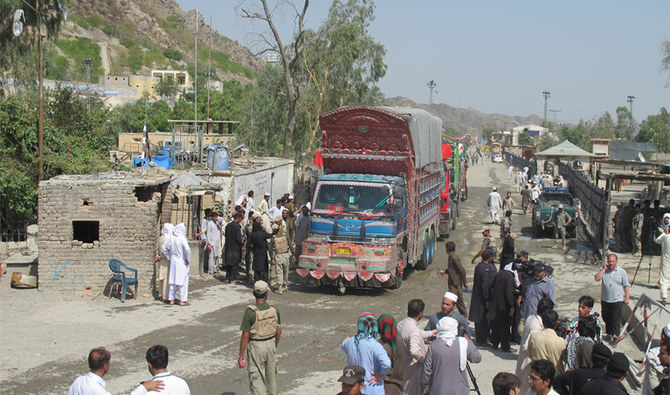
Trucks carrying goods and heading to Afghanistan are seen parked along the Torkham border on July 6, 2019. (AN Photo)
Short Url
Updated 19 April 2020
Follow

Dozens of Pakistanis test positive for virus after returning from Afghanistan 

  • More than 1,500 Pakistani citizens have been stranded in Afghanistan for weeks
  • The border crossing will be open for three days to facilitate the return of nationals who are immediately quarantined

PESHAWAR: Provincial authorities have confirmed 23 Pakistanis who returned from Afghanistan on Friday have tested positive for Covid-19 after being stranded in the neighboring country for weeks.

Pakistan opened its border with Afghanistan on Friday to bring back its nationals from Afghanistan where, according to rough estimates, more than 1,500 Pakistanis have been stranded since the global pandemic hit the region in February.

“Among the total 713 Pakistanis including 177 females who had arrived in Pakistan from Afghanistan on Friday, 23 persons are tested positive for coronavirus,” Deputy Commissioner for Khyber district, Mahmood Aslam Wazir, told Arab News on Sunday. 
The border will be open for three days to allow Pakistani nationals to come home.
“The government decided on Friday to keep the border open for three days to facilitate their return,” Senator Taj Muhammad Afridi, chairman of Senate Standing Committee on States and Frontier Regions, told Arab News on Saturday and added the numbers of stranded Pakistani nationals could be much higher than estimated keeping in mind hundreds of truck drivers and their helpers were grounded across the border.

Last month, Pakistan sealed its western border with Iran and Afghanistan as a precautionary measure to contain the spread of coronavirus amid impassioned appeals sent to the Prime Minister highlighting the plight of stranded citizens.

Islamabad also decided last week to open the Chaman and Torkham border crossing points on “humanitarian grounds” to allow thousands of stranded Afghans to cross over into their country.

“I faced unspeakable problems during the last one month in Afghanistan,” Amjad Khan, a Pakistani dentist from Peshawar who runs his own medical practice in Kunduz, told Arab News after returning to his country on Friday night.

“I had to wait at Torkham border for ten days,” he continued. “When we crossed over, the border authorities shifted us to a quarantine center in Landi Kotal [a town in Khyber district]. People at the center say our blood results may take days to arrive. I feel a bit distressed right now.”

Afridi said that a large number of Pakistanis work in neighboring Afghanistan. Many of them are associated with the transportation industry, but there are several others who work with the health and education sectors. Some of them are also employed by printing corporations and construction businesses.

Just a day before their return to Pakistan, many of those trapped on the other side of the border told Arab News that they were running out of cash and living on charity food.

Mahmood Aslam Wazir said authorities in Torkham had allowed only those Pakistani citizens to enter the country whose names were mentioned in a list provided to them by the country’s diplomatic mission in Afghanistan.

“About 195 passengers and 101 trucks were allowed to enter Pakistan. We sent these individuals to quarantine centers and fumigated their trucks,” Wazir informed.

“We have established seven quarantine facilities with a collective capacity of 1,500,” he added.

Ubaidullah Mohmand, a homeopath who treats patients in Jalalabad, told Arab News he had crossed over via Torkham on Friday night after waiting two weeks for the border to open.

“They brought me to a quarantine center in Landi Kotal,” he said. “This place has all the facilities, such as food, but we want the authorities to share our blood reports soon.”


Over 50 feared dead in Karachi shopping plaza fire, officials say

Updated 19 January 2026
Follow

Over 50 feared dead in Karachi shopping plaza fire, officials say

  • Search teams recover 14 bodies as officials warn toll may rise sharply
  • Traders seek urgent compensation after 1,200 shops destroyed in blaze

ISLAMABAD: Pakistani authorities warned on Monday the death toll from a massive fire at a shopping plaza in Karachi could exceed 50, as recovery operations continued a day after the blaze destroyed over 1,200 shops in one of the city’s busiest commercial districts.

The fire broke out late Saturday at Gul Plaza in Karachi’s Saddar business area and spread rapidly through multiple floors. Firefighters battled for more than 24 hours to bring the blaze under control, which was fully extinguished by Monday, officials said, with cooling and debris removal now underway.

Deadly fires in commercial buildings are a recurring problem in Karachi, a city of more than 20 million people, where overcrowding, outdated infrastructure and weak enforcement of fire safety regulations have repeatedly resulted in mass casualties and economic losses.

During a meeting at the Chief Minister’s House on Monday, officials briefed Sindh Chief Minister Murad Ali Shah that 14 bodies had so far been recovered from the site, while the overall death toll could climb significantly as debris is cleared.

“Estimated fatalities could exceed 50,” the Sindh chief minister’s office said in a statement, quoting officials who briefed Shah on the scale of the disaster.

Shah was told that the shopping plaza, built over roughly 8,000 square yards, housed around 1,200 shops, leaving an equal number of traders suddenly without livelihoods. Shah said all affected shopkeepers would be rehabilitated and announced the formation of a committee to recommend compensation amounts and a recovery plan.

“The Gul Plaza building will be rebuilt, and we want to decide how the affected traders can be given shops immediately so their businesses can resume,” Shah said, according to the statement.

Officials said firefighting operations involved 16 fire tenders and water bowzers, with 50 to 60 firefighters taking part. The Karachi Water Board supplied more than 431,000 gallons of water during the operation, while Rescue 1122 ambulances reached the site within minutes of the first alert.

Authorities said access constraints inside the building, along with intense smoke, hampered rescue efforts in the early stages of the fire. A firefighter was among those killed, officials said, noting that his father had also died in the line of duty years earlier.

The provincial government ordered an immediate forensic investigation to determine the cause of the blaze, directing the chief secretary to notify a fact-finding committee. Shah also instructed that debris removal begin without delay so recovery teams could continue searching for victims.

The tragedy has also heightened anxiety within Karachi’s business community. 

The Karachi Chamber of Commerce and Industry (KCCI) has formed a dedicated committee to document losses, coordinate relief and press the government for compensation, saying preliminary assessments indicate more than 1,000 small and medium-sized businesses were completely destroyed.

Ateeq Mir, a traders’ representative, has estimated losses from the fire at over $10 million.

“There is no compensation for life, but we will try our best that the small businessmen who have suffered losses here are compensated in a transparent manner,” Shah told reporters on Sunday night.

Prime Minister Shehbaz Sharif has offered full federal support to provincial authorities, stressing the need for a “coordinated and effective system” to control fires quickly in densely populated urban areas and prevent similar tragedies in the future.

Battling large fires in Karachi’s congested commercial districts remains notoriously difficult. Many markets and plazas are built with narrow access points, encroachments and illegal extensions that block fire tenders, while buildings often lack functioning fire exits, alarms or sprinkler systems. 

Although safety regulations exist, enforcement is sporadic, allowing hazardous wiring and flammable materials to go unchecked — conditions that enable fires to spread rapidly and magnify human and economic losses.