Iran parades medical gear, not missiles on Army Day as coronavirus deaths hit 4,958

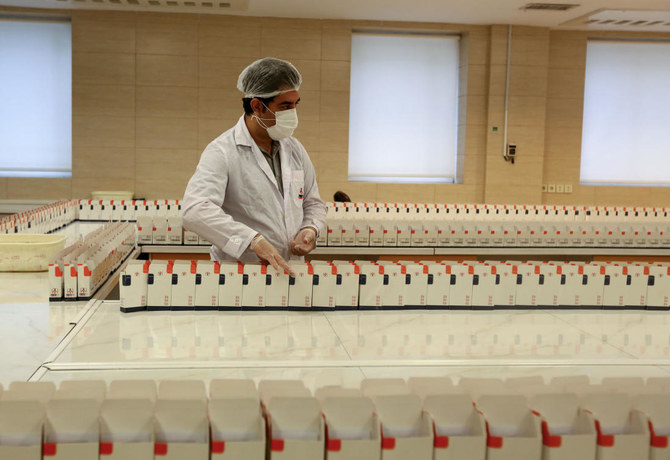
An Iranian member of the medical staff works on the production of COVID-19 test kits at a medical center in Karaj, at the northern Alborz Province, on April 11, 2020. (AFP)
Short Url
Updated 17 April 2020
Follow

Iran parades medical gear, not missiles on Army Day as coronavirus deaths hit 4,958

  • The total number of cases of infection in the Middle East country hardest hit by the pandemic rose to 79,494, of which 3,563 were in critical condition
  • According to a recent opinion poll, 40 percent of residents in the greater Tehran region do not take the coronavirus seriously

DUBAI: Iran on Friday paraded disinfection vehicles, mobile hospitals and other medical equipment to mark its national Army Day as the country’s death toll from the coronavirus outbreak rose by 89 to 4,958.
The total number of cases of infection in the Middle East country hardest hit by the pandemic rose to 79,494, of which 3,563 were in critical condition, health ministry spokesman Kianush Jahanpur said on state television.
A parliamentary report released earlier this week said the coronavirus death toll might be almost double the figures announced by the health ministry, and the number of infections eight to 10 times more given a lack of widespread testing.
Friday’s small “Defenders of the Homeland, Helpers of Health” army parade was held at a training center before a group of commanders in face masks to underscore the military’s role in battling the highly infections COVID-19 lung disease.
It was a far cry from the typical Army Day parades, which normally feature spectacles of infantry, missiles, submarines and armored vehicles, with warplanes flying overhead.
“Due to health and social protocols, it is not possible to hold a parade of soldiers...The enemy now is hidden and doctors and nurses are (instead0 at the frontlines of the battlefield,” President Hassan Rouhani said in a message to soldiers, disseminated by state media.
Army forces chief Major General Abdolrahim Mousavi thanked the more than 11,000 military medical staff fighting to stem the spread of the novel coronavirus in Iran, which has one of the world’s highest death tolls.
Deputy Health Minister Iraj Harirchi warned earlier this week that infections could spread further in autumn.
“We have to get used to living with the virus until an appropriate medication or vaccination is found,” Harirchi said on state TV on Friday. A recent resumption of “low-risk” business activities “doesn’t mean that conditions have returned to normal,” he said, warning that the easing of restrictions could lead to increased infections.
So-called low-risk businesses — including many shops, factories and workshops — resumed operations on April 11 across the country, with the exception of the capital Tehran, where they will reopen from Saturday.
According to a recent opinion poll, 40 percent of residents in the greater Tehran region do not take the coronavirus seriously, the head of the government-led Coronavirus Taskforce of Tehran, Alireza Zali, said on Friday.


Sudan’s war puts charity kitchen workers feeding displaced families at risk

Updated 34 min 41 sec ago
Follow

Sudan’s war puts charity kitchen workers feeding displaced families at risk

  • The real number of workers killed is likely far higher than the estimated 100, he says, but the war has prevented reliable data collection and record-keeping

CAIRO: Enas Arbab fled Sudan’s western region of Darfur after her hometown fell to Sudanese paramilitary forces, taking only her year-old son with her and the memory of her father, who was killed, she said, simply for working at a charity kitchen serving people displaced by the fighting.
The Rapid Support Forces — or RSF, a paramilitary group that has been at war with the Sudanese army since April 2023 — had laid siege on el-Fasher in the western Darfur region, starving people out before it overran the city.
UN officials say several thousand civilians were killed in the RSF takeover of el-Fasher last October. Only 40 percent of the city’s 260,000 residents managed to flee the onslaught, thousands of whom were wounded, the officials said. The fate of the rest remains unknown.
During the fighting, Arbab says RSF fighters took her father, Mohamed ِArbab, from their home after beating him in front of the family, and demanded a ransom. When the family couldn’t pay, they told them they had killed him, she says. To this day, the family doesn’t know where his body is.
When her husband disappeared a month later, Enas Arbab decided to flee north, to Egypt. “We couldn’t stay in el-Fasher,” she said. “It was no longer safe and there was no food or water.”
Her father was one of more than 100 charity kitchen workers who have been killed since the war began, according to workers who spoke with The Associated Press and the Aid Workers Security database, a group that tracks major incidents around the world impacting aid workers.
In areas of intense fighting — especially in Darfur — famine is spreading and food and basic supplies are scarce. The community-led public kitchens have become a lifeline but many working there have been abducted, robbed, arrested, beaten or killed.
Grim numbers in a brutal war
Volunteer Salah Semsaya with the Emergency Response Rooms — a group that emerged as a local initiative and now operates in 13 provinces across Sudan, with 26,000 volunteers — acknowledges the dangers faced by workers in charity kitchens.
The real number of workers killed is likely far higher than the estimated 100, he says, but the war has prevented reliable data collection and record-keeping.
Semsaya shared records showing that 57 percent of the documented killings of charity kitchen workers occurred in Khartoum, mainly while the Sudanese capital was under RSF control, before the army retook it last March. At least 21 percent of the killings were in Darfur.
More than 50 of those killed in Khartoum worked with his group, Semsaya said.
Sudan’s war erupted after tensions between the army and the RSF escalated into fighting that began in Khartoum and spread nationwide, killing thousands and triggering mass displacement, disease outbreaks and severe food insecurity. Aid workers were frequently targeted.
Dan Teng’o, communications chief at the UN office for humanitarian affairs, says it’s unclear whether charity kitchen workers are targeted because of their work or because of their perceived affiliation with one side or other in the war.
The kitchen workers are prominent in their communities because of the work they do, making them obvious targets, activists say. Ransom demands typically range from $2,000 to $5,000, often rising once families make initial payments.
“A clear deterioration in the security context ... has significantly affected local communities, including volunteers supporting community kitchens,” Teng’o said.
Kitchen workers face risks
Farouk Abkar, a 60-year-old from el-Fasher, spent a year handing out sacks of grain at a charity kitchen in Zamzam camp, just 15 kilometers (9 miles) south of the city. He survived drone strikes and remembers the day RSF fighters attacked his kitchen. One of them punched him in the face, knocking some of his teeth out.
Abkar said he fled el-Fasher at night with his daughter, walking for 10 days. Along the way, some RSF fighters fired birdshot, which hit him in the head, leaving a chronic headache.
Now in Egypt, he shares an apartment with at least 10 other Sudanese refugees and can’t afford medical care. The harrowing images from his hometown still haunt him.
“Many things happened in el-Fasher,” he said. “There was death. There was starvation.”
Mustafa Khater, a 28-year-old charity kitchen worker, fled with his pregnant wife to Egypt a few days before el-Fasher fell to the RSF.
During the 18-month siege, some el-Fasher residents collaborated with the RSF, telling the paramilitary fighters who the kitchen workers were, Khater said. Many disappeared.
“They would take you to an area where there is a dry riverbed and kill you there,” Khater said.
A volunteer working with Semsaya’s aid group in Darfur said some of his colleagues were beaten, arrested and interrogated, with their attackers accusing them of receiving “illicit funds” for the kitchen. The volunteer spoke on condition of anonymity for fear of reprisals.
Despite the challenges, many charity kitchens remain the only reliable food source in areas gripped by conflict and a place people can come to and give each other support, Semsaya said.
Struggling to feed thousands
The town of Khazan Jedid in East Darfur province has three charity kitchens feeding about 5,000 people daily, said Haroun Abdelrahman, a spokesperson for the Emergency Response Rooms’ branch in the area.
Abdelrahman says he was once interrogated by RSF fighters, while several of his colleagues have been robbed at knifepoint. Despite the fear and harassment, many kitchen workers are still volunteering and working, he said.
In Kassala in eastern Sudan, military agents questioned a volunteer with the branch there and his colleagues in January 2024, he said, after their kitchen started serving food and providing shelter to people who escaped nearby Wad Madani when RSF seized that town. He also spoke anonymously for fear of reprisals.
Khater, the 28-year-old who fled el-Fasher, said he heard from friends back home that after the RSF takeover, all charity kitchens in the city closed and his colleagues were either “killed or fled.”
Teng’o says the closures in areas of fighting have left “vulnerable households with no viable alternatives” and forced people to shop at local “markets where food prices are unaffordable.”
Arbab, the pregnant 19-year-old who fled with her baby boy, had hoped to rebuild her life in Egypt, her friends and a humanitarian worker said, speaking on condition of anonymity to talk about the young mother.
But while on the road to the northern city of Alexandria last month, she and her son were stopped by Egyptian authorities and deported back to Sudan.