Saudi Arabia faces coronavirus crisis from position of strength: finance minister

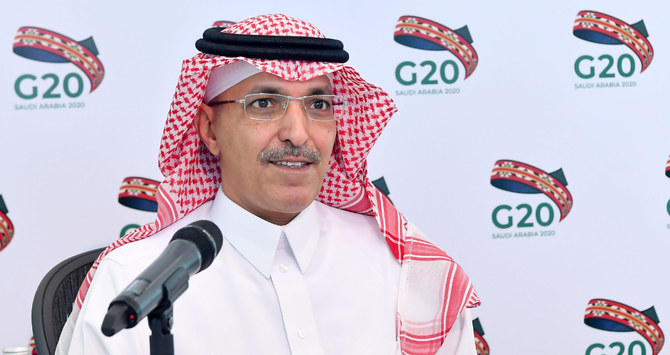
Saudi Finance Minister Mohammed Al-Jadaan. (SPA)
Short Url
Updated 17 April 2020
Follow

Saudi Arabia faces coronavirus crisis from position of strength: finance minister

  • KSA’s huge reserves and low debt allows country to withstand the world economic slowdown

RIYADH: Saudi Finance Minister Mohammed Al-Jadaan has said the Kingdom was facing the current global crisis from a position of strength.

In a statement carried by the Saudi Press Agency early Friday, the minister pointed to the country’s huge reserves and relatively low debt obligations as factors that would allow it to withstand the slowdown of the world economy due to the coronavirus pandemic.

Al-Jadaan made the statement at the virtual G20 Finance Ministers and Central Bank Governors Meeting, which was held remotely on Thursday, the report said.  

He was quoted as saying he expected the world economy to witness the worst recession this year.

"It will be much worse than the previous global financial crisis, especially that coronavirus pandemic has had its toll on humanity,” he said.

Al-Jadaan said the priorities of the Saudi government are aimed at implementing precautionary measures to protect the health of citizens and residents from the coronavirus disease (COVID-19).

He also stressed the need to adapt time-bound and transparent financial and monetary measures that will help lead to a rapid economic recovery and contain financial risks.

Al-Jadaan reiterated the Kingdom’s readiness to provide further support if necessary, saying they are closely monitoring the overall situation.

He urged the International Monetary Fund (IMF) to continue to have flexibility in responding to the needs of members given the uncertainty amid coronavirus outbreak.

The minister said the Kingdom encourages (IMF) to continue its participation and support for the Middle East and North Africa, pointing out that (IMF) has a good position to support its members, with its ability to support $1 trillion in lending.

(With Reuters)


Saudi Arabia’s industrial production jumps 10.4% in January: GASTAT

Updated 18 sec ago
Follow

Saudi Arabia’s industrial production jumps 10.4% in January: GASTAT

RIYADH: Saudi Arabia’s industrial production index rose to 115 in January, up 10.4 percent from a year earlier, driven by higher crude output and stronger mining activity, official data showed. 

The latest report released by the General Authority for Statistics showed that the annual surge was primarily fueled by a 13.3 percent jump in the mining and quarrying sub-index, which includes oil production.  

Saudi Arabia raised crude oil output to 10.1 million barrels per day in January from 8.9 million barrels per day a year earlier, supporting growth in the mining and quarrying sub-index and contributing to the broader expansion in industrial activity. 

The latest IPI figures underscore continued momentum in the Kingdom’s industrial sector as Saudi Arabia pursues economic diversification under its Vision 2030 agenda. 

The manufacturing sector, a key pillar of the Kingdom’s economic diversification efforts, also contributed positively to the annual growth. The manufacturing sub-index rose by 6.8 percent compared to January of the previous year.  

This was underpinned by strong performances in the manufacture of chemicals and chemical products, which grew by 10.6 percent, and the manufacture of coke and refined petroleum products, which increased by 9.1 percent. The food products industry also saw an annual growth of 9.1 percent. 

The water supply, sewerage, and waste management activities recorded the highest annual growth among the major sectors, increasing by 11.7 percent. 

Despite the strong year-on-year performance, the IPI showed a slight contraction on a monthly basis, decreasing by 0.5 percent compared to December 2025. This decline was driven by a 1.4 percent drop in the manufacturing sub-index from the previous month.  

The monthly downturn in manufacturing was largely attributed to decreases in the same sectors that fueled its annual growth, with coke and petroleum products down 1.1 percent and chemicals down 1.2 percent. 

A breakdown by main economic activities shows that the index for oil activities jumped 12.5 percent annually, while non-oil activities also posted a healthy gain of 5.3 percent.  

On a monthly basis, both indices saw minor declines, with oil activities dipping 0.1 percent and non-oil activities falling by 1.5 percent. 

The electricity, gas, and air conditioning supply sub-index was the only major sector to record an annual decrease, falling by 1.3 percent compared to January 2025.