



Long before US special forces caught the world’s most-wanted man, our Southeast Asia bureau chief interviewed him
Summary
On May 2, 2011, a US special forces team stormed a walled compound in the northeastern Pakistani city of Abbottabad and shot dead Osama bin Laden, the leader of Al-Qaeda.
The operation, carried out in the early hours of the morning, brought an end to a 10-year hunt for the world’s most-wanted terrorist, responsible for the Sept. 11 attacks on the US in 2001 and numerous other terrorist outrages.
The following day, an Arab News editorial celebrated the “lifting of a curse” on the Muslim world. Bin Laden and his “twisted version of Islam,” declared the paper, had made the religion “feared and despised among millions upon millions of people” and had been responsible for much of “the spreading tide of international Islamophobia.”
DUBAI: The tall, thin man wore a smoke-colored, ankle-length thobe and bright white turban, and held an AK-74 assault rifle close to his chest. As I stepped into the room and he moved forward and embraced me, the gravity of the moment finally dawned: I was face to face with Osama bin Laden, the most-wanted man in the world.
I had spent a good part of my career over the decades thinking and writing about Bin Laden and the Al-Qaeda militant group that he had turned into a multinational enterprise for the export of militancy.
Key Dates
-
1
Osama bin Laden, son of a wealthy Saudi businessman, forms Al-Qaeda to support Afghan resistance to the Soviet invasion.

-
2
Saudi Arabia revokes bin Laden’s citizenship for his support of Islamic extremism.
-
3
Bin Laden issues a declaration of jihad, pledging to drive US forces from the Arabian Peninsula and overthrow the Saudi government.
-
4
Twin Al-Qaeda truck-bomb attacks on US embassies in Tanzania and Kenya leave 200 dead; the FBI places bin Laden on its most-wanted list.

-
5
Coordinated attacks on the US, masterminded by bin Laden, leave almost 3,000 dead.

-
6
Bin Laden escapes US attack on Al-Qaeda caves and tunnels in the Tora Bora mountains of eastern Afghanistan.
-
7
US Navy SEALs storm bin Laden’s hideout in Abbottabad, Pakistan, shortly after 1 a.m. local time.

Now here I was at his heavily guarded, mud-walled hideaway in southern Afghanistan on June 21, 2001 — less than three months before the attacks on the World Trade Center and the Pentagon on Sept. 11, 2001 would spread the names Al-Qaeda and its founder to every corner of the globe.
I was Asia correspondent with the London-based Middle East Broadcasting Center at the time and had received a phone call three months before inviting me to Afghanistan to meet Bin Laden. So, as we settled down on a mattress on the floor that summer afternoon, my first question was why he had granted me the interview and what message he wanted to send to the world through me.
Moments earlier, Bin Laden had said he would be giving only “limited comments” as he was restrained from talking to the media by his hosts in Afghanistan, the Taliban, who rose to power in the war-ravaged nation largely on the strength of Bin Laden’s aid and, in turn, provided him refuge.
Instead, his aides in the room did much of the talking during the three-hour-long meeting. Notable among them were Mohammed Atif (alias Abu Hafs), Al-Qaeda’s military leader; Ayman Al-Zawahiri, who now heads what remains of the transnational militant group; and Othman, a man assigned to handle logistics for my interview and who identified himself only with a first name.

“President Obama said the remains had been handled in accordance with Islamic custom, which requires speedy burial, and the Pentagon later said the body was placed into the waters of the northern Arabian Sea after adhering to Islamic procedures — including washing the corpse — aboard the aircraft carrier USS Carl Vinson.”
From a front-page Arab News story by Azhar Masood
“In the coming weeks, there will be a big surprise; we are going to hit American and Israeli installations,” Abu Hafs said. “The coffin business will increase in the United States.”
I looked at Bin Laden and asked if this was true; he smiled and nodded.
In an interview with Pamela Constable for The Washington Post the following month, I would reiterate this: “They said there would be attacks against American and Israeli facilities within the next several weeks. I am 100 percent sure of this, and it was absolutely clear they had brought me there to hear this message.”
Two months later, the 9/11 attacks would prove that Bin Laden’s chilling message to me had, indeed, been true.
When the interview ended, Bin Laden’s personal photographer snapped photos of us and filmed me with Al-Zawahiri and the Al-Qaeda founder, who said he would invite me to interview him again.
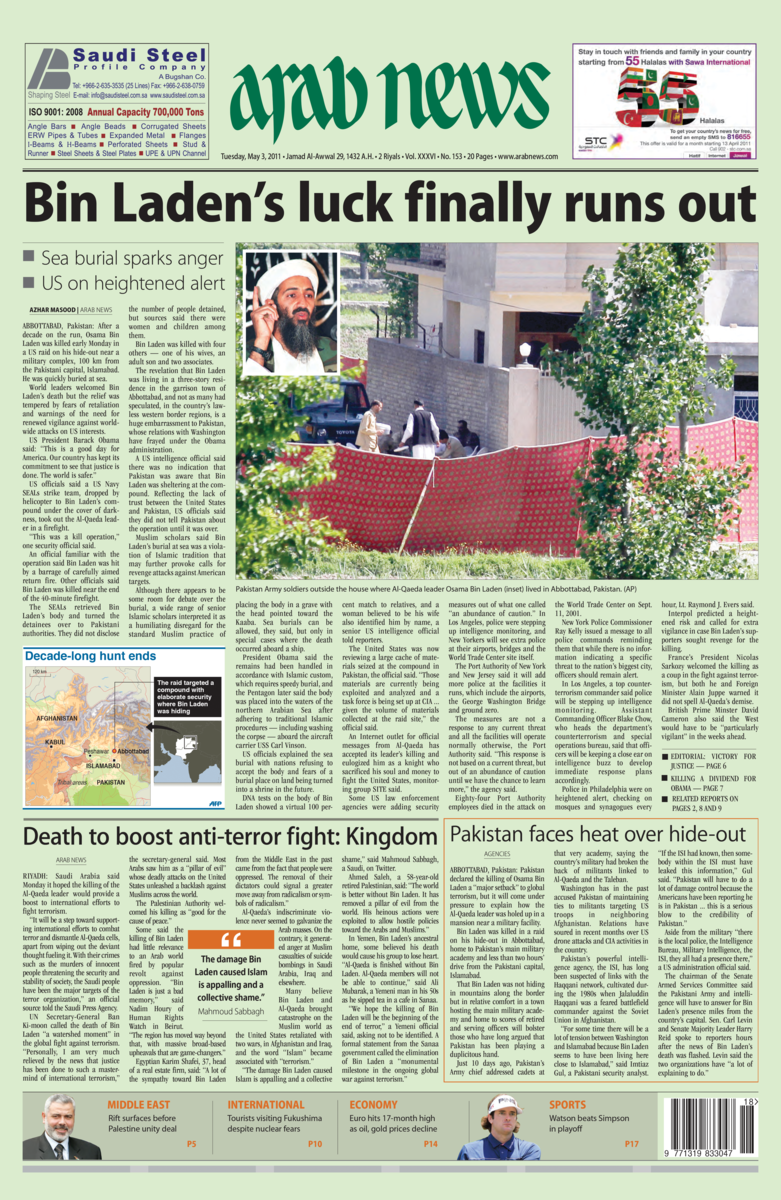
A page from the Arab News archive from May. 3, 2011.
“If something big happens, I will be hiding in the tribal areas of Pakistan,” Bin Laden said as he shook my hand and walked out of the room. “That’s where you can come again to interview me.”
A decade later, at 4 a.m. on May 2, 2011, I was at Islamabad airport ready to board a flight to Dubai when a journalist in Kabul texted, asking if I had heard rumors that Bin Laden had been killed in a US raid in Pakistan. A few hours earlier, a Pakistani journalist had sent me a text about a helicopter crash in the garrison city of Abbottabad.
Suspecting that the two events might be connected and following my reporter’s instinct, I walked up to an airline representative and told him that I was a journalist and needed his help getting my luggage off the flight. The man got excited at the news that Bin Laden may be dead and led me by the hand back through immigration, telling other colleagues to help me because I had to cover one of the biggest stories in modern history.
From the airport, I left directly for Abbottabad, 50 km north of the Pakistani capital of Islamabad, arriving there at 9 a.m. By then, a large group of excited journalists had gathered near the compound where Bin Laden had hidden for years, kept from entering by Pakistani soldiers standing guard.
“Now here I was at his heavily guarded, mud-walled hideaway in southern Afghanistan on June 21, 2001 — less than three months before the attacks on the World Trade Center and the Pentagon on Sept. 11, 2001.”
Baker Atyani
Meanwhile, US President Barack Obama confirmed that Bin Laden had been killed in a night raid by US forces in Abbottabad city, not far from the tribal regions where the militant leader had told me he would flee from Afghanistan. It was the end of a decade-long hunt for the man who had redefined the threat of terrorism for the 21st century.
To date, the US has disclosed few details of the raid. Only a small number of people — a handful of senior administration and military officials and the Navy SEALs who carried out the operation — were privy to the events of May 2, and the US government classified most of the documents relating to the raid. Questions also remain about the
Pakistani government’s role, if any, in allowing Bin Laden to hide in a compound within sight of an elite military academy.
As the years go by, I often think of that meeting at Bin Laden’s desert hideout and whether he could have predicted that after him, Al-Qaeda’s ranks would be hollowed out by relentless American attacks and the rise of Daesh. I also wonder what more he would have had to say if we had met again.
Indeed, in November 2001, barely two months after the 9/11 attacks, Othman, Bin Laden’s logistics aide, called to say “the person” was ready to meet me again.
“Will you come?” he asked.
I never got back to Othman and so my meeting with Bin Laden remains the last time before 9/11 that the Al-Qaeda founder is known to have met and given an interview to a journalist.
- Baker Atyani, head of Arab News’ Southeast Asia bureau, interviewed Osama bin Laden three months before the 9/11 attacks


