

Philippines begins mass COVID-19 testing 

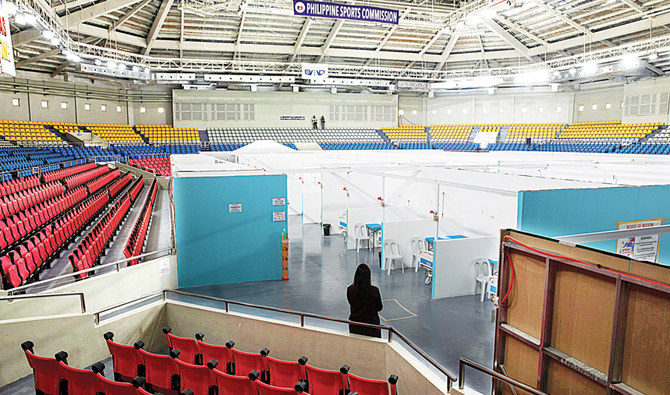
The Ninoy Aquino Stadium in Manila has been temporarily made into a quarantine facility to accommodate coronavirus disease (COVID-19) patients. (Reuters)
Short Url
Updated 15 April 2020
Follow

Philippines begins mass COVID-19 testing 

  • Priority goes to the critically ill and vulnerable, says DoH

MANILA: The Philippines on Tuesday started its mass COVID-19 testing, but not all Filipinos will be covered by the stepped-up screening program.

It is almost a month since President Rodrigo Duterte ordered a lockdown in Luzon, the country’s largest and most populous island that includes the capital, to stop the spread of the deadly coronavirus.
The number of nationwide cases was 5,233 as of Tuesday, with 291 new cases reported by the Department of Health. The death toll is 335, and 295 patients have recovered from the disease.
The department said the expanded testing program would be “progressive” using a risk-based approach.
“Our resources are not yet enough to do this,” said Health Undersecretary Maria Rosario Vergeire in a press conference on Monday, explaining that not all Filipinos would be covered by the mass screening.
She said priority would go to critically ill patients, the elderly, pregnant women, and people with underlying medical conditions, as well as health care workers displaying symptoms of the disease.
Vergeire said the department continued to increase its testing capacity, aiming to conduct 8,000 up to 10,000 tests each day.
Testing coverage would be expanded once there were enough kits and laboratories to include those who had no symptoms but were on the frontlines, those who had possible exposure to the virus, and people with a history of travel and with symptoms, she added.
“So it’s going to be evolving, it’s going to be progressive.”
There are 15 laboratories in the country that can conduct COVID-19 tests. But the department said it was facilitating the approval of 28 institutions that were undergoing a laboratory certification process, while a further 37 had expressed their intent to be certified.

FASTFACT

The Department of Health said there are 15 laboratories in the country that can conduct COVID-19 tests.

In a late night address to the nation on Monday, Duterte ordered the immediate purchase of rapid test kits to increase the country’s capability to detect cases. He gave the directive despite a lack of guidelines and approval from health authorities.
“Unfortunately until now, they are still debating on the efficacy of the rapid tests we would like to buy ... And there’s a rule that we cannot use public funds to buy medical supplies, medicines, without the FDA (Food and Drug Administration) signal,” the president said. “I will take the risk ... I’m clearing the way. I will ask (Health) Secretary (Francisco) Duque to talk to the people in charge, to Secretary (Carlito) Galvez. And they can proceed to buy it immediately,” he added.
Galvez, who leads the National Task Force against COVID-19, said the government also needed to purchase polymerase chain reaction-based (PCR) kits for the confirmatory tests. The government was looking to purchase 2 million rapid test kits and 900,000 PCR kits.
“The PCR that we will be buying (is) worth PHP3.3 billion ($59.28 million) to include the capacitation of more or less 28 accredited private and government hospitals nationwide,” he added.
Senator Win Gatchalian urged Manila to help local government units (LGUs) so they could beat the pandemic.
“With the incidence of new COVID-19 cases growing by the day, LGUs should lead in the fight against the dreaded COVID-19,” Gatchalian said, emphasizing that test, quarantine, and treatment were the steps that units should take to stem the tide.
The units should have greater autonomy in procuring testing kits or setting up testing facilities to fast-track detection of positive cases from every household living in every street within every barangay (village), he added.


EU leaders to reassess US ties despite Trump U-turn on Greenland

Updated 22 January 2026
Follow

EU leaders to reassess US ties despite Trump U-turn on Greenland

  • Diplomats stressed that, although Thursday’s emergency EU talks in Brussels would now lose some of their urgency, the longer-term issue of how to handle the relationship with the US remained

BRUSSELS: EU leaders will rethink their ties with the US at an emergency summit on Thursday after Donald Trump’s threat of tariffs and even military action to ​acquire Greenland badly shook confidence in the transatlantic relationship, diplomats said.
Trump abruptly stepped back on Wednesday from his threat of tariffs on eight European nations, ruled out using force to take Greenland, a semi-autonomous territory of NATO ally Denmark, and suggested a deal was in sight to end the dispute.
German Chancellor Friedrich Merz, welcoming Trump’s U-turn on Greenland, urged Europeans not to be too quick to write off the transatlantic partnership.
But EU governments remain wary of another change of mind by a mercurial president who is increasingly seen as a bully that Europe will have to stand up to, and they are focused on coming up with a longer-term plan on how to deal with the ‌United States under this ‌administration and possibly its successors too.
“Trump crossed the Rubicon. He might do ‌it ⁠again. ​There is no ‌going back to what it was. And leaders will discuss it,” one EU diplomat said, adding that the bloc needed to move away from its heavy reliance on the US in many areas.
“We need to try to keep him (Trump) close while working on becoming more independent from the US It is a process, probably a long one,” the diplomat said.
EU RELIANCE ON US
After decades of relying on the United States for defense within the NATO alliance, the EU lacks the needed intelligence, transport, missile defense and production capabilities to defend itself against a possible Russian attack. This gives the US substantial leverage.
The US ⁠is also Europe’s biggest trading partner, making the EU vulnerable to Trump’s policies of imposing tariffs to reduce Washington’s trade deficit in goods, and, as in ‌the case of Greenland, to achieve other goals.
“We need to discuss where ‍the red lines are, how we deal with this bully ‍across the Atlantic, where our strengths are,” a second EU diplomat said.
“Trump says no tariffs today, but does ‍that mean also no tariffs tomorrow, or will he again quickly change his mind? We need to discuss what to do then,” the second diplomat said.
The EU had been considering a package of retaliatory tariffs on 93 billion euros ($108.74 billion) on US imports or anti-coercive measures if Trump had gone ahead with his own tariffs, while knowing such a step would harm Europe’s economy as well ​as the United States.
WHAT’S THE GREENLAND DEAL?
Several diplomats noted there were still few details of the new plan for Greenland, agreed between Trump and NATO Secretary General Mark Rutte late on ⁠Wednesday on the sidelines of the World Economic Forum in Davos, Switzerland.
“Nothing much changed. We still need to see details of the Greenland deal. We are a bit fed up with all the bullying. And we need to act on a few things: more resiliency, unity, get our things together on internal market, competitiveness. And no more accepting tariff bullying,” a third diplomat said.
Rutte told Reuters in an interview in Davos on Thursday that under the framework deal he reached with Trump the Western allies would have to step up their presence in the Arctic.
He also said talks would continue between Denmark, Greenland and the US on specific issues.
Diplomats stressed that, although Thursday’s emergency EU talks in Brussels would now lose some of their urgency, the longer-term issue of how to handle the relationship with the US remained.
“The approach of a united front in solidarity with Denmark and Greenland while focusing on de-escalation and finding an off-ramp has worked,” a fourth EU diplomat said.
“At the ‌same time it would be good to reflect on the state of the relationship and how we want to shape this going forward, given the experiences of the past week (and year),” he said.