

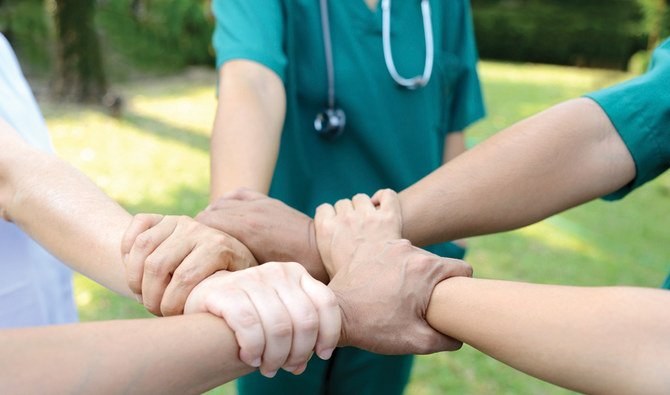

JEDDAH: The Saudi health minister has praised the “noble” and “great” offers of support from more than 100,000 volunteers to help in the Kingdom’s frontline battle against the deadly coronavirus disease (COVID-19).
An army of health specialists and ordinary members of the public have expressed interest in providing health care and support services as part of the country’s efforts to stop the spread of the virus.
In a tweet highlighting the Saudi Health Ministry’s launch of an online platform to receive applications from volunteers wanting to assist in tackling the outbreak, Health Minister Dr. Tawfiq Al-Rabiah said: “Volunteering is a noble act and a great behavior that supports efforts to combat the epidemic. 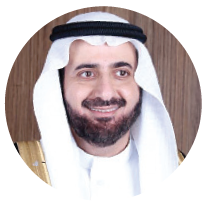
“Thanks to every volunteer who has devoted their time and effort to serving our dear homeland.” The online platform has so far received 100,000 applications.
Thanks to every volunteer who has devoted their time and effort to serving our dear homeland.
Dr. Tawfiq Al-Rabiah, Saudi health minister
Dr. Safar Battar, director general of the ministry’s health volunteering center, said people could offer their services in either health or general volunteering. “On the health volunteering side, we target all medical specialties of physicians, pharmacists, specialists and technicians, as well as students of medical colleges.
“We also have volunteering opportunities for workers in epidemic investigation and health awareness, as well as those qualified to do inspections in neighborhoods where virus cases are recorded,” Battar added. He pointed out that the ministry was also accepting medical practitioners to help in emergency departments and intensive care units, should the need arise.
More than 8,000 medical and support services volunteers are already in the field, and Battar said: “These volunteers have successfully completed the necessary training programs supervised by the Commission for Health Specialties. The other category of volunteers will attend training courses before we can call them to take part in the needed service.”
The volunteer platform is a national window approved by the ministry to allow people to offer their services in the health sector in partnership with different government agencies. Volunteers can register through the Nafaz service using their Absher accounts to log in and will then receive the necessary basic training.
Volunteer applications have been received from professionally licensed health cadres, students specialized in the health field, retired health personnel, and people and organizations experienced in providing a range of support services.
HOW TO APPLY
Steps to register for volunteer training programs:
• https://volunteer.srca.org.sa/ • Complete the basic-information application form.
• Next, an email confirmation message containing a link to online courses will be sent out.
• Applicants can then attend online courses and take exams.
• On successful completion, they will be ready to take part in volunteering initiatives.
Several government bodies are cooperating with the Ministry of Health to ensure the success of the initiative, including the ministries of education, human resources and social development, finance, media, and communication and information technology, along with other bodies such as the King Salman Humanitarian Aid and Relief Center, the Saudi Red Crescent Authority, the Technical and Vocational Training Corporation, and the Saudi Arabian Scouts Association.
Abdullah Al-Mutawa, a Dammam-based senior nursing student, told Arab News that he had completed a training course and was now ready to join the volunteers.
“I attended seven online courses about the nature of COVID-19 and where it came from, a protection awareness course, a course on how to deal with positive cases and people around them, another on virus tracing, one on how to psychologically deal with infected people, and a psychological training course on how health practitioners should serenely deal with all cases.
“Another course was on the proper way of wearing and disposing of personal protective equipment.
All the skills and knowledge I have learned are now at the service of my beloved country to return some of the many favors it has bestowed upon us.
Dalal Al-Harbi, Medical student
“It is an opportunity to show how much we love our country, and I am really excited to have been given this chance to join the volunteer work heroes in helping to protect people living in Saudi Arabia from the pandemic,” Al-Mutawa said.
Medical student Dalal Al-Harbi, from Qassim region, said the world was going through tough times and that she had wanted to show her loyalty to her country through volunteering.
“All the skills and knowledge I have learned are now at the service of my beloved country to return some of the many favors it has bestowed upon us,” she added.
Al-Harbi, who is also a health volunteer working with different organizations, said she was prepared to undertake any task. “Volunteer work is truly a pleasure and only those who have experienced unpaid help know how interesting and joyful it is.
“In fact, another chance has come, and this time, it is for my country, and I will do my best to show the world who we Saudis are. Above all else, it is intended to be for the sake of Allah.”


