

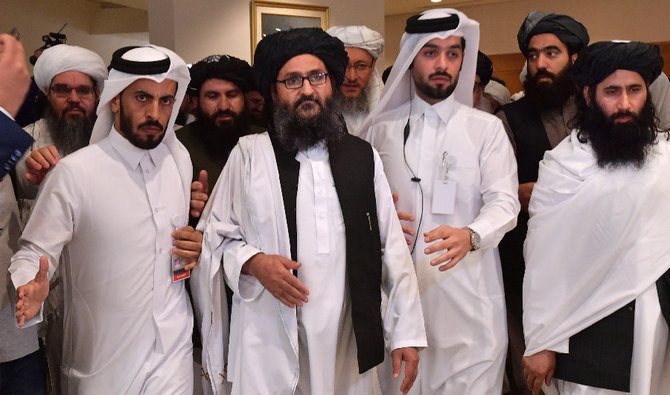

KABUL: The Afghan Taliban on Tuesday said they would be discontinuing all talks with President Ashraf Ghani over a prisoner exchange program, a day after a senior member of his administration said that Kabul would not be releasing 15 senior members of the group for their role in some of the major attacks in the war-torn country.
“We sent a technical team…to Kabul for verification and identification of our prisoners as the release of prisoners was to start as per the signed agreement and the promise made (to us). But, unfortunately, their release has been delayed under one pretext or another... Therefore, our technical team will not participate in fruitless meetings with relevant sides starting from tomorrow,” Suhail Shaheen, the Taliban’s Qatar-based spokesman, said in a series of tweets early on Tuesday.
As part of a historic peace deal struck in Doha, Qatar in February this year, Washington was to facilitate the release of 5,000 Taliban prisoners held by Ghani’s government by March 9, before the start of the first intra-Afghan dialogue. In return, the Taliban would release 1,000 government forces held by the insurgents.
Officials in Ghani’s government refused to comment on the Taliban’s statement which follows Matin Bek, the head of Afghanistan’s Independent Directorate of Local Governance (IDLG), saying on Monday that the delay in releasing the Taliban inmates was due to the group’s “stubborn” insistence to free 15 key leaders who were involved in “big attacks”.
Bek is a confidant of Ghani and a member of the delegation which was formed by the government to hold the intra-Afghan talks with the Taliban.
The development could further throw into doubt the start of a long-awaited intra-Afghan dialogue which had been slotted for March.
It follows weeks of a stand-off between Kabul and the Taliban over the prisoner exchange program, resulting in the two sides holding virtual talks on a Skype video call after the US and Qatar intervened to resolve the matter.
Nearly two weeks ago, a Taliban delegation – with the help of the Red Cross – traveled to Kabul from Qatar to discuss the technical aspect of the program with the Afghan government officials.
Ghani, whose government was secluded from the year and a half of secret talks between the Taliban and Washington, had initially said that the final decision would be taken for the release of the prisoners would be taken by his government and not the US
However, he reversed his decision later to say that the Taliban inmates would be released in phases.
The Taliban’s decision to halt the talks with Kabul comes two days after they said in a statement said Washington had violated parts of the US-Taliban agreement, citing among other issues, the Afghan government’s failure to free Taliban inmates and start talks with the Afghans.
The Taliban warned that continuation of the infringements could damage their trust in Washington and lead to increased attacks which they had scaled back as a pre-condition to the peace deal.
Washington, apparently frustrated by Ghani’s delay in forming a negotiation team for talks with the Taliban, threatened to halt $1 billion in this year’s Afghan aid, last month.
Analysts say all of these developments are signs of a stalemate in future talks.
“The US’ warning to cut aid for Kabul, its “growing frustration with Afghan leaders”...and the government’s failure to swap prisoners, are all clear signs that the Afghan peace process will not start any time soon and there will be some tough times ahead,” Wahidullah Ghazikhail, an analyst, told Arab News kn Tuesday.
He added that it could propel the Taliban to “start their spring offensive after the government failed to free Taliban prisoners.”
“Americans are fed up with Ghani, are planning to pull the troops out and want to reduce by half its aid... We are in serious trouble if leaders fail to realize the sensitivity of the situation,” he said.
Zubair Shafiqi, who runs a prominent newspaper, the Weesa Daily, said there were certain circles within the government that “opposed the start of peace talks with the Taliban and the release of their prisoners,” but added that “Washington will put pressure on Ghani to reverse his decision.”


