

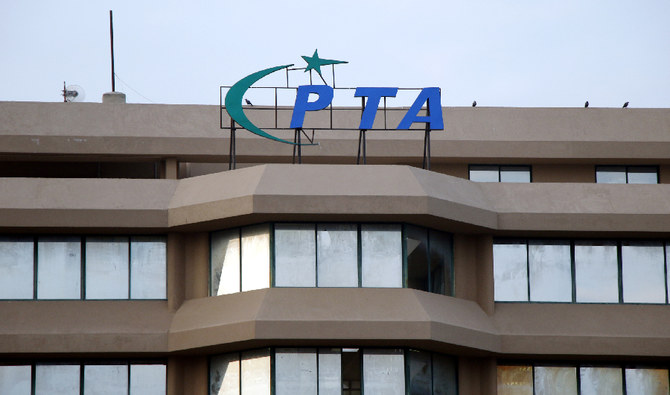

Islamabad: The nationwide lockdown to mitigate the spread of coronavirus pandemic has forced majority of the country into imposed isolation pushing people to work from home impacting the Internet bandwidth which spiked significantly after Pakistan announced shutdowns last month but the bandwidth utilization has stabilized, said the national telecom regulator on Monday.
“The Internet usage touched its peak in the first week of the lockdown and has been stable for last few days,” said Tayyaba Iftikhar, assistant director of public relations for Pakistan Telecommunications Authority (PTA) in an email response to Arab News adding the “on average, our bandwidth utilization has increased between 12 and 15 percent.
Pakistan’s current projected population by United Nations is at 220 million but according to the government’s bureau of statistics census conducted in 2017, it is around 208 million, of which 82.12 million people use some type of Internet connectivity platform, said the PTA official.
Asked if the bandwidth available is parallel or higher than the burgeoning demand as all segments of society, business sectors, educational institutes, and government divisions have augmented their utilization to avoid physical contact or communication, Iftikhar replied: “Pakistan has enough capacity to cater for any projected requirements of telecom subscribers.
“Service providers commission additional bandwidth based upon their needs” and in case of a of undersea cable breakdown, “telecom networks and the international Internet bandwidth providers have sufficient redundancy,” she said.
Internet Service Providers Association of Pakistan (ISPAK), established in 1997, claims on its webpage fact section updated in February, that the country has an Internet bandwidth capacity of more than 2500 Gbps combined from two authorized capacity suppliers — Pakistan Telecommunication Company Limited (PTCL) and Transworld — with five undersea cables connecting the country to the world and four companies providing the domestic fiber backbones.
“In this exceptional situation, all operators have been performing at optimum level without any serious issues so far,” said Iftikhar. “Logistical arrangements have been a major challenge for the operators but that is being managed reasonably despite social distancing and movement restrictions.”
“PTA is maintaining close liaison with all stakeholders to resolve any challenges in this regard,” the official said.
However, complaints over Internet connectivity and slow browsing persist and Pakistan’s President Dr. Arif Alvi took notice on Monday during a briefing “on the issues faced by Internet users, particularly students, due to pressure on existing Internet infrastructure, as people had started working from home and students were getting online education due to corona pandemic,” according to an official statement.
The regulator said that it is continuously monitoring the situation and working with all telecom operators to provide maximum possible facilitation to consumers through special Internet packages.
Iftikhar said: “All possible measures were being taken to facilitate operators and IT enabled companies to keep their networks and connectivity up and running.”
Responding on the question concerning restrictions on virtual private networks, voice over Internet protocol, video conferencing applications raised by ISPAK as these arguably secure means of communication are the most commonly used by people working from home, the PTA official refuted the claim and said, “PTA has not blocked legal VPN, VoIP and video conferencing applications.”
“Action is only taken against such traffic which is used by unlicensed operators terminating illegal calls on licensed PSTN (public switched telephone) networks. Therefore, no issue is being faced in terms of those working from home.”




