


CAIRO: Measures taken by Egypt to prevent the spread of the coronavirus disease (COVID-19) have affected preparations for Ramadan, which starts later this month, as well as public prayers and gatherings.
The government has imposed a nighttime curfew from 7 p.m. to 6 a.m., the closure of all shops, restaurants, cafeterias and malls starting at 5 p.m., and a complete shutdown on Thursdays and Fridays.
Last Friday the Health Ministry said the number of cases in Egypt stood at 985 and that the total number of deaths was 66, Reuters news agency reported.
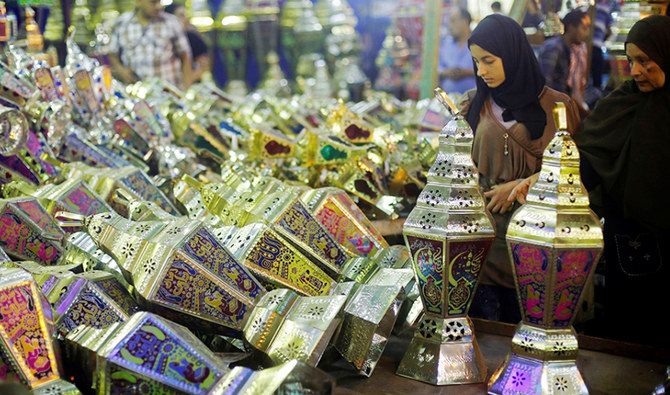
The government restrictions have affected the flow of trade in Cairo’s Taht Al-Raba area, which usually draws big crowds during and prior to Ramadan with its distinctive lantern displays.
“There are barely any sales taking place,” Sayed Al-Kilani, a vendor at Taht Al-Raba, told Arab News. “People are afraid to come here. They are afraid to deal with sellers, and they are afraid to touch the lanterns, thinking they might be a carrier of the virus. We are mainly lantern dealers, and our work begins about 45 days before Ramadan starts, and ends with the end of the holy month, but coronavirus has erased the season in which our business booms.”
The vendor was abiding by government rules, shutting up shop at 5 p.m. every day and staying closed on Thursdays and Fridays. Although sales have come to almost a complete halt, he and other lantern vendors insisted on showcasing their goods.
“What can we do? I hope we return to our normal lives,” Al-Kilani added. “We adhere to the government’s decisions, and there is no one in the market who violates them. We hope that the matter ends in peace.”
University student Hala Galal stood in front of a lantern vendor, flipping through goods while wearing gloves.
“I set aside half an hour to buy lanterns for my younger siblings, as well as Ramadan linens with cartoon drawings that reflect the Ramadan spirit such as Fatuta, Bouji, Tamtam,” she told Arab News.
She lives near the Taht Al-Raba neighborhood and said her decision to buy lanterns was not easy, especially in the current climate.
“I used to buy Ramadan decorations from this area because it is the main market. The pandemic has made my family and I fear leaving our homes especially after the imposition of the curfew. But I had to do it since this is my annual visit. Ramadan without lanterns and decorations isn’t the same. Depriving people of them will prevent them from feeling the Ramadan spirit. Prices are almost the same as the last season, given the recession in the market.”
At one popular Cairo supermarket salesman Mohamed Zainhom was standing in front of a display of yamish (dates, licorice and other dried fruit).
HIGHLIGHTS
• Trade of traditional Ramadan items like lanterns has been badly hit.
• Iftar gatherings including public meals during Ramadan have also been banned to check the spread of the virus.
He expressed his surprise at the large crowds forming over basic commodities in comparison with the few people who were buying yamish.
“At this time of the year, I usually need two helpers to meet the needs of customers, but these days I barely get a customer or two a day,” he told Arab News.
Zainhom said he did not think there was a difference between buying basic commodities and buying yamish, but that this year’s Ramadan spirit may be dampened because of coronavirus.
“I expected that there would be some kind of dates named after the virus, and I expected that there would be a lantern in the form of a virus, but this did not happen,” he added.
The meal at the end of the fasting day, iftar, is a time for families and friends to come together and eat. Duck is usually served in Egypt for this evening meal. In a market near the center of the capital Hajj Jalal, who owns one of the most famous poultry shops in the area, was busy selling his wares. There were crowds in front of poultry markets, unlike the lantern shops and yamish stalls.
“People have not stopped coming since the imposition of the curfew,” Jalal told Arab News. “Customers are telling me that they are trying to buy their needs before the month of Ramadan.”
Ramadan sees the country’s mosques packed with worshippers but Minister of Awqaf Muhammad Mukhtar Jumaa said mosques would not reopen during Ramadan unless no more cases of the virus were recorded.
Mosques and churches have been closed in Egypt for the last few weeks because of the pandemic.
The Central Operations Room at the Ministry of Awqaf confirmed that all religious gatherings in Ramadan were canceled due to the pandemic, including group, Friday and taraweeh prayers.
They also banned iftar gatherings including public meals during Ramadan, in which tables and chairs are set up on sidewalks with meals prepared by charities mainly in low-income neighborhoods.


