

Pakistani charity with donors in Middle East takes lead in coronavirus support

1 / 8
The collage shows Alkhidmat Foundation volunteers at work. (Photos by Alkhidmat Foundation)
2 / 8
Flour sacks being stacked at an Alkhidmat storage facility in Peshawar prior to distribution along with other food items on March 20, 2020. (Photo courtesy: Alkhidmat Foundation)
3 / 8
Two volunteers of the Alkhidmat Foundation in protective outfits spraying disinfectants at the historic Masjid Muhabat Khan in the walled city of Peshawar on March 22, 2020. (Photo courtesy: Alkhidmat Foundation)
4 / 8
Alkhidmat Foundation volunteers carrying ready-to-eat food parcels for quarantined families in Shabqadar near Peshawar on March 24, 2020. (Photo courtesy: Alkhidmat Foundation)
5 / 8
Volunteers delivering food ration to the family of a Covid-19 positive patient in Manga, Mardan on March 24, 2020. (Photo courtesy: Alkhidmat Foundation)
6 / 8
A rickshaw driver gets a free face mask from an Alkhidmat volunteer in Peshawar on March 26, 2020. (Photo courtesy: Alkhidmat Foundation)
7 / 8
Volunteers of Alkhidmat Foundation clean a mosque with disinfectant liquid days before the lockdown in Peshawar on March 22, 2020. (Photo courtesy: Alkhidmat Foundation)
8 / 8
Food rations are carefully packed by Alkhidmat volunteers in Peshawar before distribution in different areas in the province on March 20, 2020. (Photo courtesy: Alkhidmat Foundation)
Short Url
Updated 04 April 2020
Follow

Pakistani charity with donors in Middle East takes lead in coronavirus support

  • With volunteer force of 20,000, organization has distributed hundreds of thousands of meals, sanitisers and face masks
  • Upgraded hospitals and schools are being offered to the government to use as treatment and quarantine centers

PESHAWAR: As local charities around Pakistan spring into action to deal with the fallout of coronavirus lockdowns on the poorest populations, one of the country’s largest charity organizations which is heavily funded by expat donors in the gulf countries, has taken the lead in countering the outbreak.
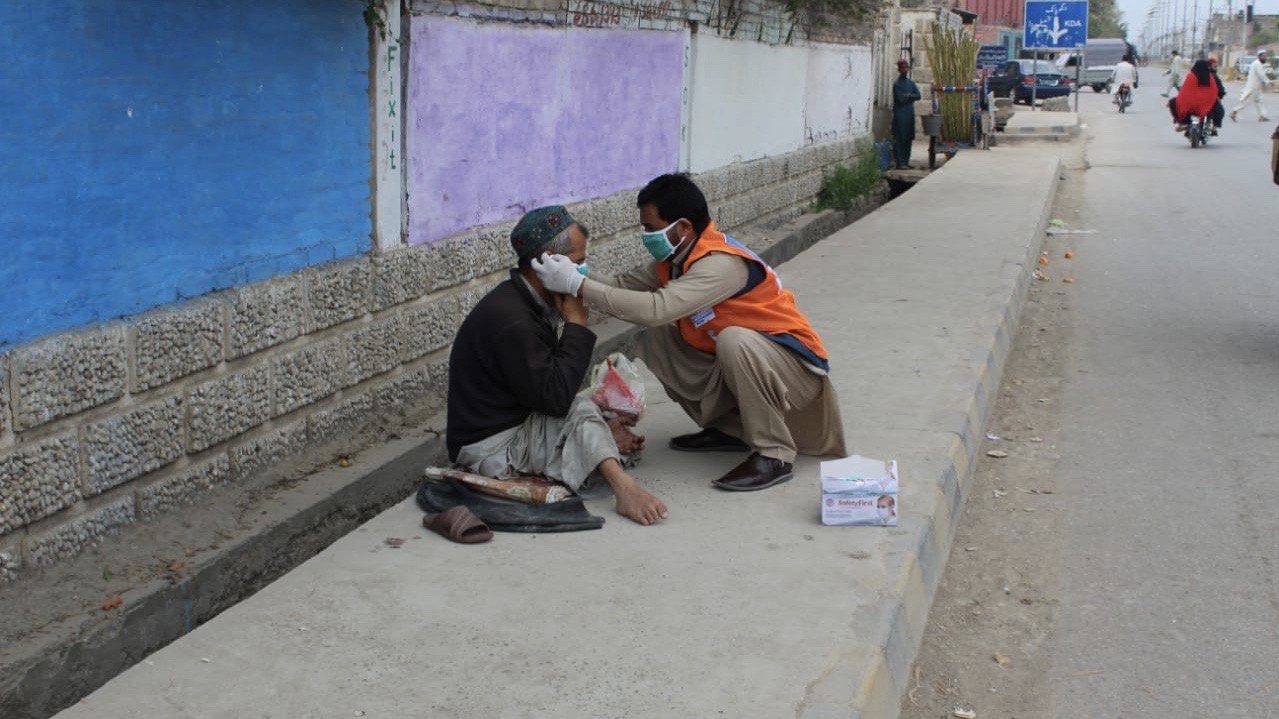


A volunteer helps a physically challenged man with his face mask in Peshawar on April 24, 2020. (Photo courtesy: Alkhidmat Foundation) 

The Alkhidmat Foundation is a non-profit, non-government organization providing humanitarian services around the country, with international operations in Bangladesh, Syria, Indonesia, Malaysia, Nepal and Myanmar. The organization receives large donations from Pakistani expats abroad-- a large number of who reside in the gulf countries.
“Our quality services regardless of color, race and religion have established great trust in our donors. Besides expats in the Middle East, Europe and the West, we have a large number of generous donors from the Kingdom of Saudia Arabia, Kuwait, UAE and other gulf countries that help in the smooth running of our assistance services round the year,” said Khalid Waqas, president of Alkhidmat Foundation’s provincial chapter in northwestern Khyber Pakhtunkhwa province.
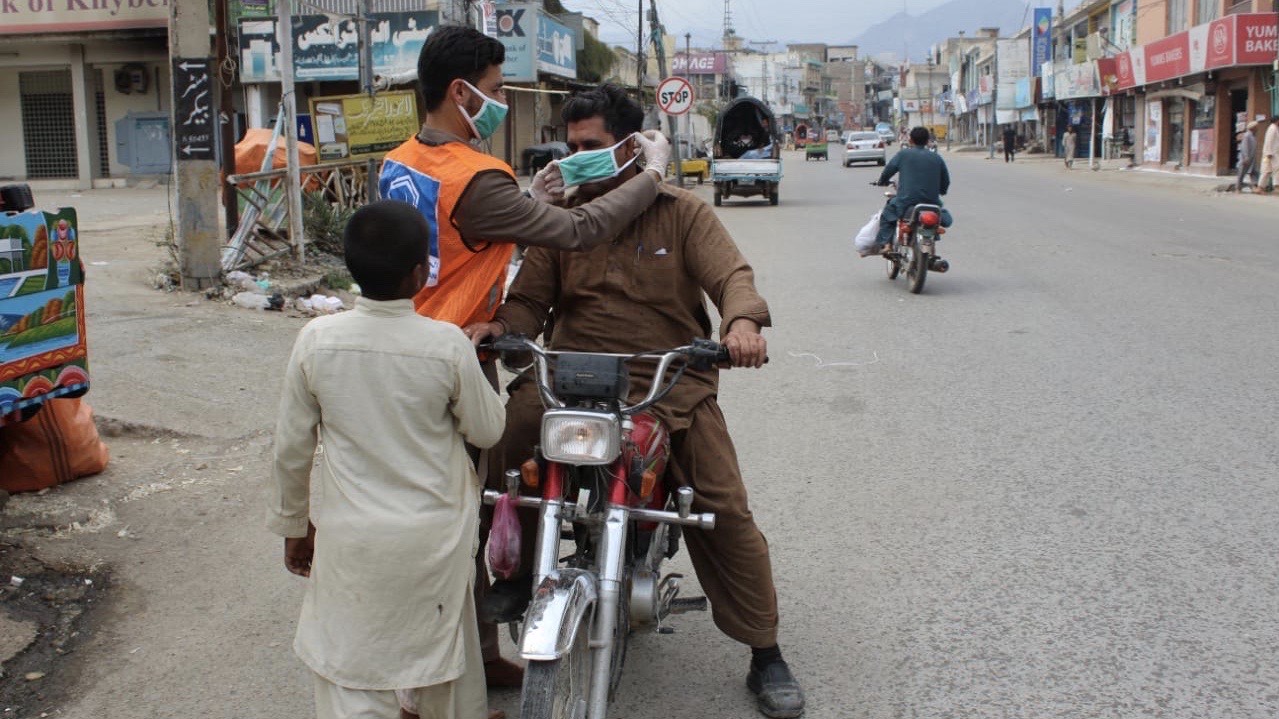


A volunteer is helping a motorcycle rider in putting on a face mask. The Alkhidmat Foundation provided 400,000 free masks in different areas of Pakistan on March 23, 2020. (Photo courtesy: Alkhidmat Foundation)

After the first cases of coronavirus were confirmed in Pakistan, he said the organization canceled all its routine activities and shifted focus primarily on countering the outbreak. Currently, there are over 2,700 cases reported with a fatality count of 41 people.
“All provincial teams were activated and three task forces were formed to oversee the main activities of awareness, prevention and providing mutual support to the government of Pakistan,” he said.
Since the organization’s humanitarian services for coronavirus began on March 18 at the police services hospital in Peshawar, Alkhidmat’s work has greatly increased over recent weeks especially as lockdowns are enforced across the country.
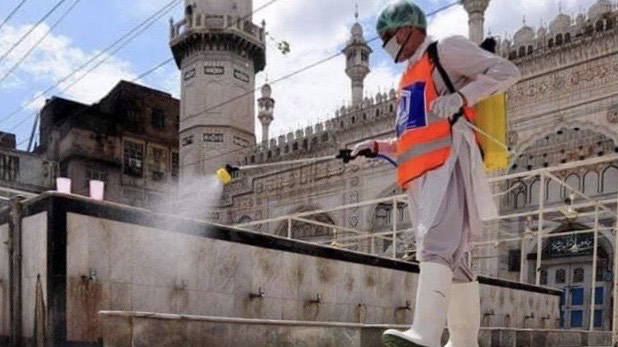


A volunteer sprays disinfectant in the historical Masjid Muhabat Khan before the lockdown in Peshawar on March 22, 2020. (Photo courtesy: Alkhidmat Foundation) 

Until the end of last month,100,000 ready-to-eat food packages, including 27,650 in KP alone, were distributed to families of quarantined Covid-19 patients across Pakistan.
“Ration packs, each costing an average of Rs3000 ($18) were distributed among 105,000 families across the country. Each package could provide food for a family of eight persons for 15 days,” Waqas said.
Besides food assistance, Alkhidmat Foundation has also provided 400,000 face masks and 200,000 hand sanitizers through a huge volunteer force of more than 20,000 people, he added.
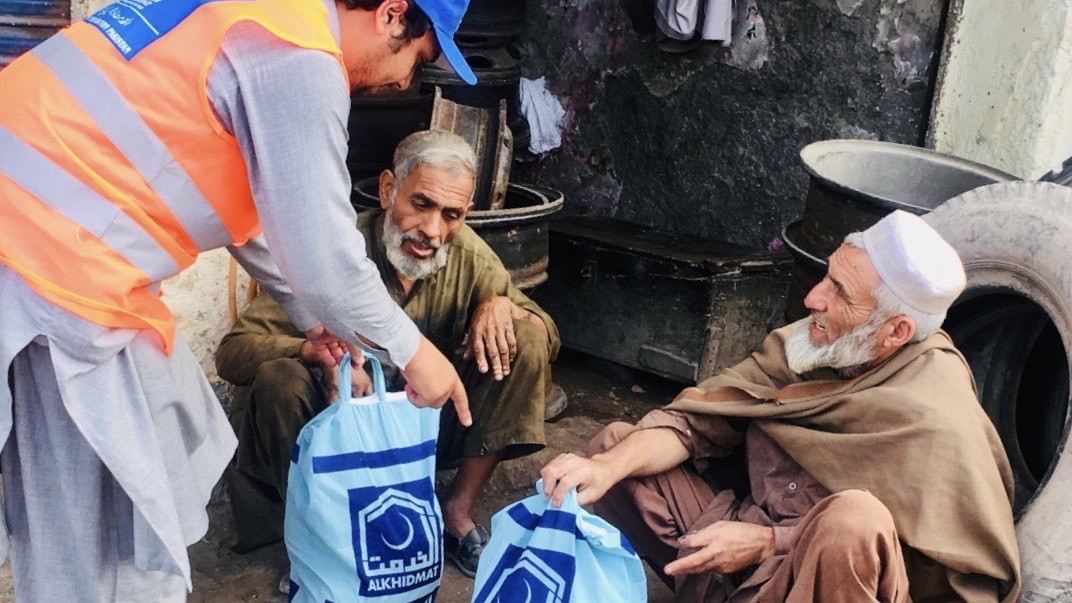


Alkhidmat Foundation volunteer giving ration packs to two elderly daily wagers in a Peshawar suburb on March 24, 2020. (Photo courtesy: Alkhidmat Foundation)

Furthermore, he said, 1,650 mosques, churches, mandirs and gurdwaras were sprayed with disinfectants and provided with soaps. The total cost of these operations has been Rs450 million, and have directly benefited 1.8 million people in the province.
Founded in 1990, the Alkhidmat Foundation works in different humanitarian sectors with hospitals, orphanages and schools and has offered the Pakistan government free use of its infrastructure facilities across the country.
“We upgraded our three hospitals in Peshawar, Mardan and Charsadda by installing 15 additional ventilators and other medical equipment for monitoring coronavirus patients,” Waqas said.
“These hospitals and five orphanages, by the name of Aghosh centers, providing 860-bed capacity are offered to the government for use as treatment and quarantine centers.”


Pakistan’s JF-17 fighter jet draws ‘strong interest’ at Riyadh defense exhibition

Updated 29 min 30 sec ago
Follow

Pakistan’s JF-17 fighter jet draws ‘strong interest’ at Riyadh defense exhibition

  • Jets showcased as Pakistan seeks to expand defense exports
  • Interest in JF-17 has heightened after May 2025 conflict with India 

ISLAMABAD: Pakistan’s JF-17 Thunder fighter jet has drawn “strong interest” at the World Defense Exhibition in Riyadh, Pakistan’s state broadcaster said on Sunday, as Islamabad promotes the aircraft to international buyers at one of the region’s largest defense industry events.

The exhibition brings together defense officials, manufacturers and military delegations from dozens of countries, offering a platform for arms exporters to showcase equipment and pursue new contracts amid heightened global and regional security concerns.

Saudi Arabia has sought to position Riyadh as a regional hub for defense and aerospace exhibitions, using such events to foster partnerships and attract international manufacturers as part of broader diversification efforts. 

Last year Islamabad signed a mutual defense pact with Riyadh and is reportedly discussing another defense agreement involving Saudi Arabia and Turkiye, although details have not been made public.

“At the World Defense Exhibition in Riyadh, the Pakistan Air Force’s JF-17 Thunder has attracted strong interest from visitors and defense experts, standing out among fighter jets displayed by the US, Saudi Arabia and other countries,” state broadcaster Pakistan Television reported.

Islamabad is attending the exhibition in the backdrop of talks with at least 13 countries, six to eight of which are in an advanced stage, for deals involving JF-17 jets made jointly with China as well as training aircraft, drones, and weapons systems, according to recent media reports. 

Interest in the JF-17 jets has been bolstered by its operational visibility following the Pakistan-India military confrontation in May 2025, which Pakistani officials and defense analysts have cited as reinforcing the aircraft’s combat credibility.

Islamabad has increasingly positioned the JF-17 as a cost-effective multirole combat aircraft for countries seeking alternatives to high-end Western fighter jets. The aircraft is already in service with several foreign air forces and remains central to Islamabad’s defense export strategy.

Countries engaged in talks include Sudan, Saudi Arabia, Indonesia, Morocco, Ethiopia, and Nigeria as well as the government in eastern Libya led by Khalifa Haftar. Discussions on JF-17s and other weapons with Bangladesh and Iraq have been publicly acknowledged by Pakistan’s military, although more details have not been made public.

Almost all the potential buyers are Muslim-majority nations, like Pakistan. Many are from the predominantly Muslim Middle East, where Pakistan has historically been a security provider.

Separately, Pakistan’s Defense Minister Khawaja Asif met his Saudi counterpart, Khalid bin Salman bin Abdulaziz Al Saud, at the sidelines of the event. 

Asif congratulated the Saudi leadership and the defense minister on the “successful and splendid” organization of the World Defense Show, state broadcaster Radio Pakistan reported. 

“He described this global defense event as an important milestone in promoting defense cooperation in the region,” Radio Pakistan said.