

Pakistani charity with donors in Middle East takes lead in coronavirus support

1 / 8
The collage shows Alkhidmat Foundation volunteers at work. (Photos by Alkhidmat Foundation)
2 / 8
Flour sacks being stacked at an Alkhidmat storage facility in Peshawar prior to distribution along with other food items on March 20, 2020. (Photo courtesy: Alkhidmat Foundation)
3 / 8
Two volunteers of the Alkhidmat Foundation in protective outfits spraying disinfectants at the historic Masjid Muhabat Khan in the walled city of Peshawar on March 22, 2020. (Photo courtesy: Alkhidmat Foundation)
4 / 8
Alkhidmat Foundation volunteers carrying ready-to-eat food parcels for quarantined families in Shabqadar near Peshawar on March 24, 2020. (Photo courtesy: Alkhidmat Foundation)
5 / 8
Volunteers delivering food ration to the family of a Covid-19 positive patient in Manga, Mardan on March 24, 2020. (Photo courtesy: Alkhidmat Foundation)
6 / 8
A rickshaw driver gets a free face mask from an Alkhidmat volunteer in Peshawar on March 26, 2020. (Photo courtesy: Alkhidmat Foundation)
7 / 8
Volunteers of Alkhidmat Foundation clean a mosque with disinfectant liquid days before the lockdown in Peshawar on March 22, 2020. (Photo courtesy: Alkhidmat Foundation)
8 / 8
Food rations are carefully packed by Alkhidmat volunteers in Peshawar before distribution in different areas in the province on March 20, 2020. (Photo courtesy: Alkhidmat Foundation)
Short Url
Updated 04 April 2020
Follow

Pakistani charity with donors in Middle East takes lead in coronavirus support

  • With volunteer force of 20,000, organization has distributed hundreds of thousands of meals, sanitisers and face masks
  • Upgraded hospitals and schools are being offered to the government to use as treatment and quarantine centers

PESHAWAR: As local charities around Pakistan spring into action to deal with the fallout of coronavirus lockdowns on the poorest populations, one of the country’s largest charity organizations which is heavily funded by expat donors in the gulf countries, has taken the lead in countering the outbreak.
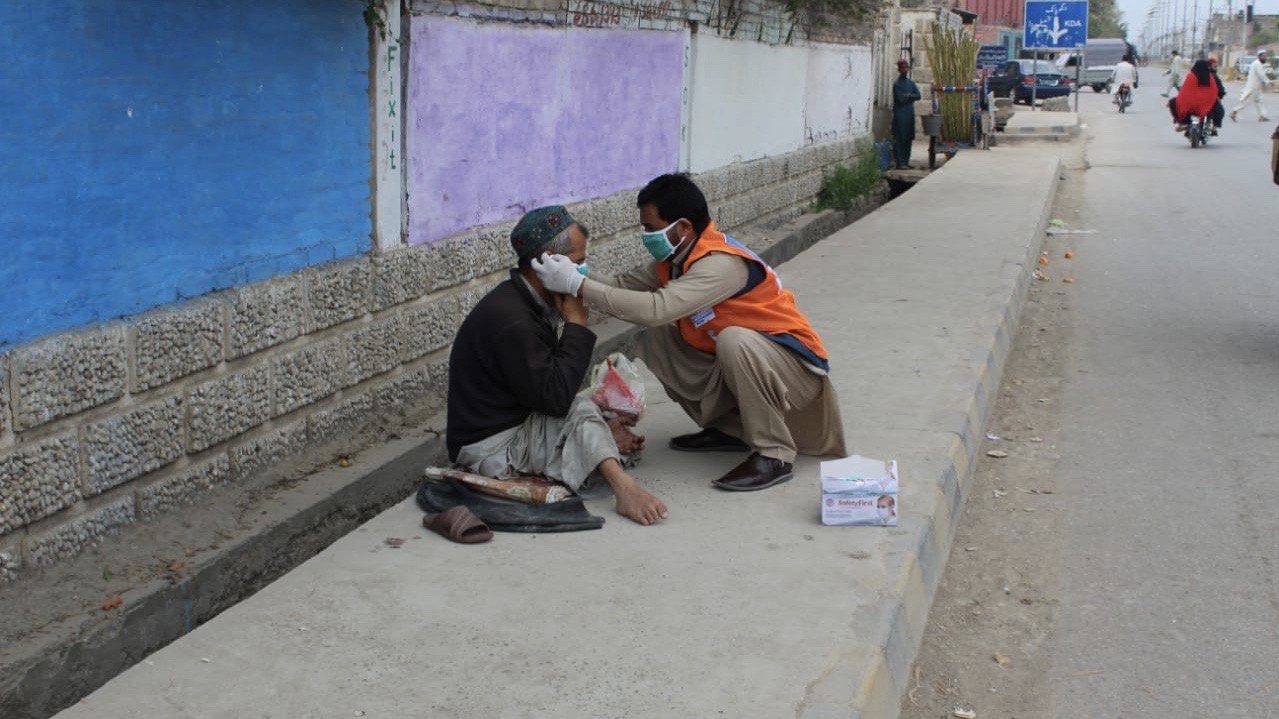


A volunteer helps a physically challenged man with his face mask in Peshawar on April 24, 2020. (Photo courtesy: Alkhidmat Foundation) 

The Alkhidmat Foundation is a non-profit, non-government organization providing humanitarian services around the country, with international operations in Bangladesh, Syria, Indonesia, Malaysia, Nepal and Myanmar. The organization receives large donations from Pakistani expats abroad-- a large number of who reside in the gulf countries.
“Our quality services regardless of color, race and religion have established great trust in our donors. Besides expats in the Middle East, Europe and the West, we have a large number of generous donors from the Kingdom of Saudia Arabia, Kuwait, UAE and other gulf countries that help in the smooth running of our assistance services round the year,” said Khalid Waqas, president of Alkhidmat Foundation’s provincial chapter in northwestern Khyber Pakhtunkhwa province.
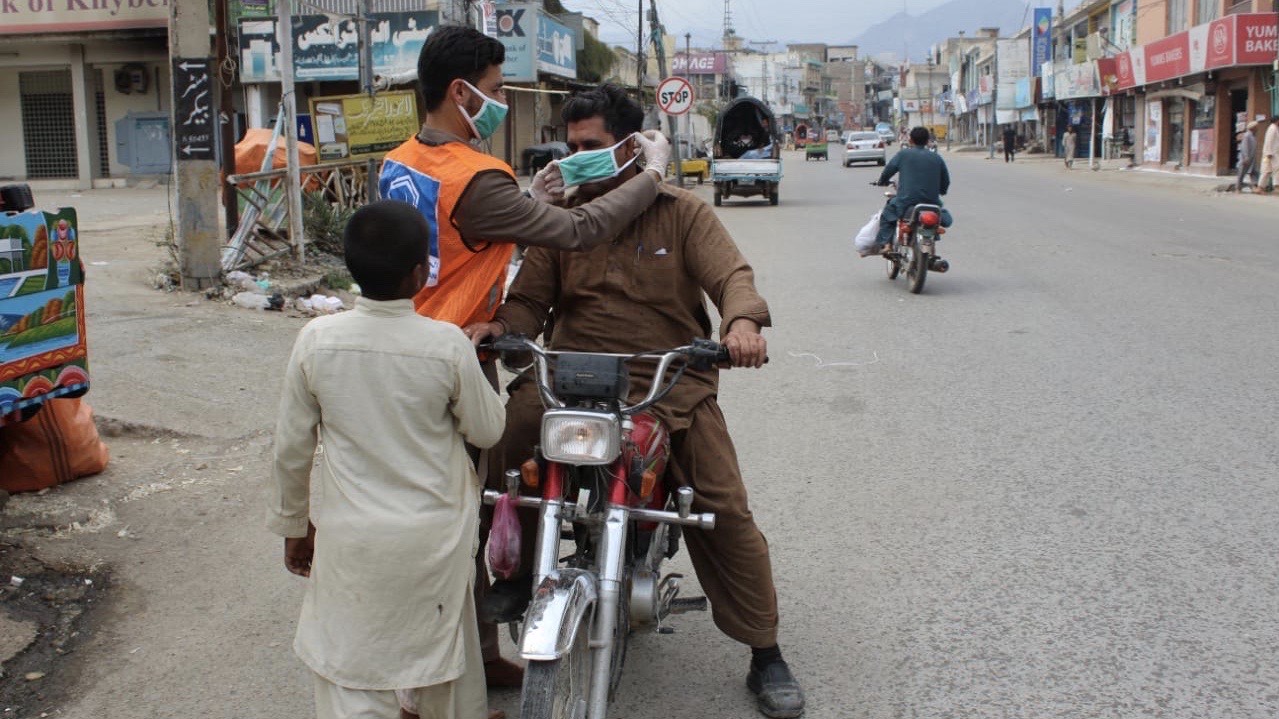


A volunteer is helping a motorcycle rider in putting on a face mask. The Alkhidmat Foundation provided 400,000 free masks in different areas of Pakistan on March 23, 2020. (Photo courtesy: Alkhidmat Foundation)

After the first cases of coronavirus were confirmed in Pakistan, he said the organization canceled all its routine activities and shifted focus primarily on countering the outbreak. Currently, there are over 2,700 cases reported with a fatality count of 41 people.
“All provincial teams were activated and three task forces were formed to oversee the main activities of awareness, prevention and providing mutual support to the government of Pakistan,” he said.
Since the organization’s humanitarian services for coronavirus began on March 18 at the police services hospital in Peshawar, Alkhidmat’s work has greatly increased over recent weeks especially as lockdowns are enforced across the country.
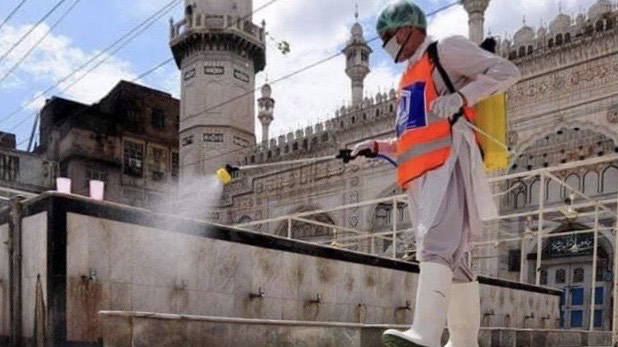


A volunteer sprays disinfectant in the historical Masjid Muhabat Khan before the lockdown in Peshawar on March 22, 2020. (Photo courtesy: Alkhidmat Foundation) 

Until the end of last month,100,000 ready-to-eat food packages, including 27,650 in KP alone, were distributed to families of quarantined Covid-19 patients across Pakistan.
“Ration packs, each costing an average of Rs3000 ($18) were distributed among 105,000 families across the country. Each package could provide food for a family of eight persons for 15 days,” Waqas said.
Besides food assistance, Alkhidmat Foundation has also provided 400,000 face masks and 200,000 hand sanitizers through a huge volunteer force of more than 20,000 people, he added.
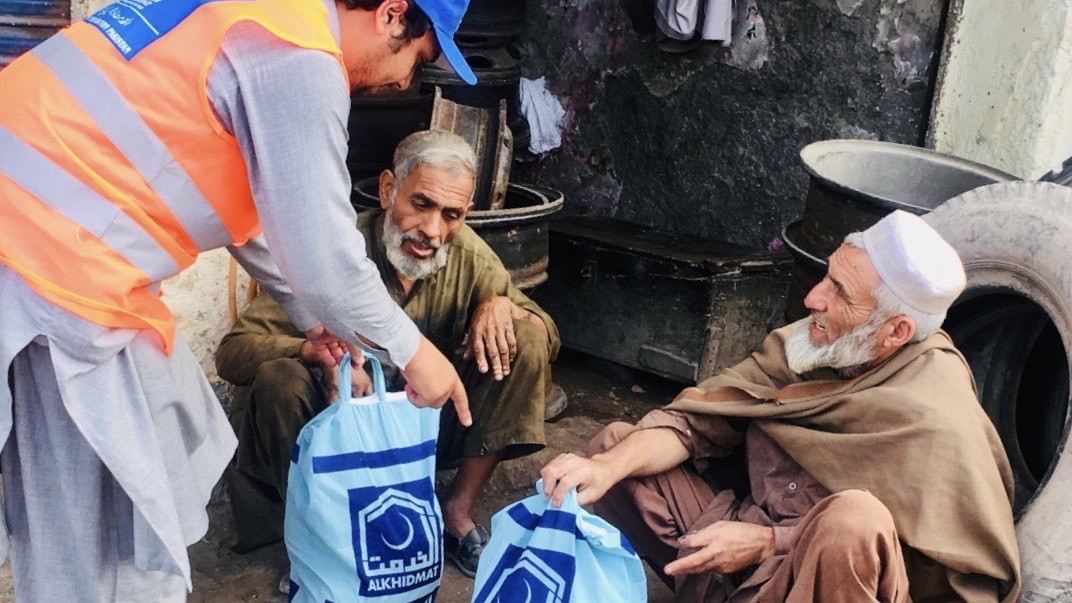


Alkhidmat Foundation volunteer giving ration packs to two elderly daily wagers in a Peshawar suburb on March 24, 2020. (Photo courtesy: Alkhidmat Foundation)

Furthermore, he said, 1,650 mosques, churches, mandirs and gurdwaras were sprayed with disinfectants and provided with soaps. The total cost of these operations has been Rs450 million, and have directly benefited 1.8 million people in the province.
Founded in 1990, the Alkhidmat Foundation works in different humanitarian sectors with hospitals, orphanages and schools and has offered the Pakistan government free use of its infrastructure facilities across the country.
“We upgraded our three hospitals in Peshawar, Mardan and Charsadda by installing 15 additional ventilators and other medical equipment for monitoring coronavirus patients,” Waqas said.
“These hospitals and five orphanages, by the name of Aghosh centers, providing 860-bed capacity are offered to the government for use as treatment and quarantine centers.”


Pakistan highlights economic reforms at Davos, eyes cooperation in AI, IT and minerals

Updated 6 sec ago
Follow

Pakistan highlights economic reforms at Davos, eyes cooperation in AI, IT and minerals

  • Prime Minister Shehbaz Sharif speaks at breakfast event in Davos at sidelines of World Economic Forum summit
  • Pakistan, rich in gold, copper reserves, has sought cooperation with China, US, Gulf countries in its mineral sector

ISLAMABAD: Prime Minister Shehbaz Sharif highlighted Pakistan’s recent economic reforms during the sidelines of the ongoing World Economic Forum (WEF) summit in Davos on Wednesday, saying that his country was eyeing greater cooperation in mines and minerals, information technology, cryptocurrency and artificial intelligence with other states. 

The Pakistani prime minister was speaking at the Pakistan Pavilion in Davos on the sidelines of the WEF summit at a breakfast event. Sharif arrived in Switzerland on Tuesday to attend the 56th annual meeting of the WEF, which brings together global business leaders, policymakers and politicians to speak on social, economic and political challenges. 

Pakistan has recently undertaken several economic reforms, which include removing subsidies on energy and food, privatization of loss-making state-owned enterprises and expanding its tax base. Islamabad took the measures as part of reforms it agreed with the International Monetary Fund (IMF) in exchange for a financial bailout package. 

“We are now into mines and minerals business in a big way,” Sharif said at the event. “We have signed agreements with American companies and Chinese companies.”

Islamabad has sought to attract foreign investment in its critical minerals sector in recent months. In April 2025, Pakistan hosted an international minerals summit where top companies and government officials from the US, Saudi Arabia, China, Türkiye, the UK, Azerbaijan, and other nations attended.

Pakistan is rich in gold, copper and lithium reserves as well as other minerals, yet its mineral sector contributes only 3.2 percent to the countrys GDP and 0.1 percent to global exports, according to official figures.

Sharif said Pakistan has been blessed with infinite natural resources which are buried in its mountains in the northern Gilgit-Baltistan, Khyber Pakhtunkhwa, Azad Kashmir and southwestern Balochistan regions. 

“But we have now decided to go forward at lightning speed,” he said. “And we are also moving speedily in the field of crypto, AI, IT.”

He said the government’s fiscal and economic measures have reduced inflation from nearly 30 percent a few years ago to single-digit figures, adding that its tax-to-GDP ratio had also increased from 9 to 10.5 percent. 

The prime minister admitted Pakistan’s exports face different kinds of challenges collectively, saying the country’s social indicators needed to improve. 

“But the way forward is very clear: that Pakistan has to have an export-led growth,” he said. 

Sharif will take part in an informal meeting of world leaders this year themed ‘The Importance of Dialogue in a Divided Global Landscape,’ his office said in an earlier statement. 

Pakistan’s participation at the WEF comes as Islamabad seeks to sustain recent economic stabilization and attract investment by engaging directly with policymakers, business leaders and international institutions at the annual gathering.