


MONZA: Dr. Manzoor Ahmed Chaudhry’s phone has been ringing off the hook since February when a novel coronavirus outbreak that has killed over 13,000 people in Italy first broke out.
As the counsel general of Pakistan in Milan, Chaudhry has become the de facto contact person for Italy’s 100,000 Pakistanis, struggling under strict curbs on movement and business activities introduced nationwide on March 9 and expected to remain in place until at least the Easter holidays in mid-April.
“Either the phone rings all day, or I am on social media, answering questions, making clarifications,” Chaudhry told Arab News this week.
Some people call wanting to know how they can flee Italy, the diplomat said; others plead to be ‘rescued’ from Italian towns as far as the border with Austria. There are so many calls that Chaudhry has at times asked his wife to speak to distressed callers and calm them down.
The Western European country accounts for around 30 percent of all global deaths from the highly infectious respiratory disease, with fatalities climbing by 760 to 13,915 on Thursday, the Civil Protection Agency said.
Chaudhry said he could not provide an official number for how many Pakistanis had been killed in Italy but estimated that 150 were infected and 10 had died due to coronavirus.
Last month, the Pakistan foreign office said one Pakistani national had passed away from the virus in Brescia, about 100 kilometers from Milan. There have been no subsequent statements from the foreign office on Pakistanis infected or killed by the illness.
But as the virus continues to ravage Italy, many Pakistanis have sprung into action to collect donations, distribute food and raise awareness through online campaigns.
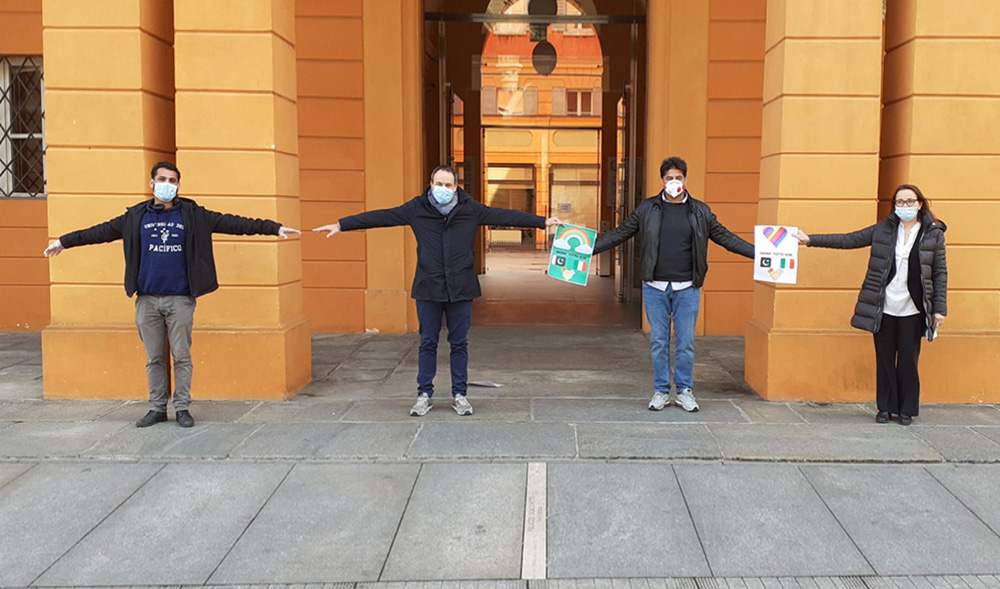
Pakistani community of Carpi donates money to the local hospital, Capri March 30, 2020. (Supplied by Comune Di Carpi)
Chaudhry Shahid Nazeer Gujjar, a prominent Pakistani-Italian, has set up a 250-member strong Whatsapp group to keep community members informed during the outbreak and coordinate relief efforts. With the economy in lockdown, he now connects affluent and enterprising Pakistanis with more vulnerable members of the community. Money is transferred to the needy online or through agencies like Western Union, Gujjar said.
The lockdown has also seen social media pages come alive with videos by Pakistanis that offer advice on everything from how to save money on groceries to studying for driving tests from home. Live broadcasts by good samaritans take questions about how to get the authorization forms needed to leave home under lockdown rules, how to receive a bonus from the government and how to qualify for food vouchers.
Younger Pakistanis have been at the forefront of the community’s response efforts. Saad Alam, originally from Nowshera and a student and part time model in Turin, has been active with an association in the Piemonte region that has been reaching out to community members in the Pashto and Urdu languages, and keeping Pakistanis up to date about changes in the law. Mosques and various Pakistani associations have also stepped in to deliver food directly to people’s homes.
But Pakistanis are not only helping their own. Irfan Hayat Ranjha, a well-connected Pakistani, said he was approached by a group of young Pakistanis from a small town called Carpi who wanted to donate funds to a local hospital.
“Within six days of launching an appeal among our people, we collected over 10,000 euros that we have now donated to a hospital in Carpi,” Ranjha said. The local paper carried a picture of the young Pakistanis wearing masks and standing with the mayor of Carpi, handing the donation over to the hospital.
Indeed, for many Pakistanis, reasserting a new identity as responsible members of society is part of the motivation for lending a helping hand.
“This was our way of changing the headlines and seeing the words ‘comunità Pakistana’ [Pakistani community] being written with pride,” Ranjha said.
It was in this spirit that Iram Tahir, the first Pakistani woman elected as a town councilor in the Brescia area, wrote to the Pakistani prime minister and requested that doctors and nurses be sent to Italy as a gesture of goodwill.
In a statement on its website last week, the Italian foreign affairs ministry said Pakistan would donate 500,000 tablets of chloroquine, a medicine which has helped alleviate coronavirus symptoms in some patients.
“The situation there [in Pakistan] is not as bad as here,” Tahir said. “In Brescia alone, 300 doctors have been infected. This is a country in need. They will never forget who helped in this tough time.”


