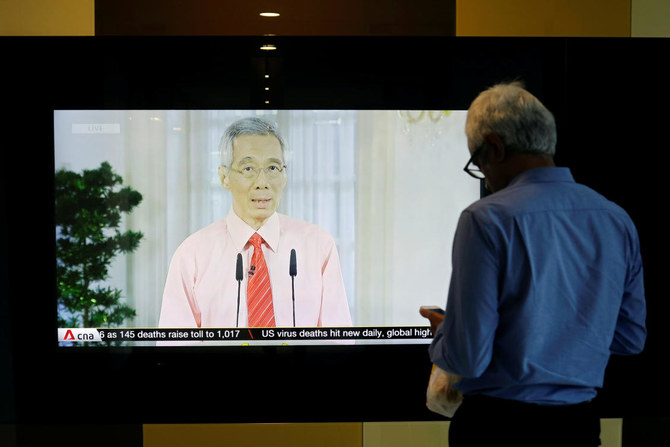
SINGAPORE: Singapore will close schools and most workplaces, except for essential services and key economic sectors, for a month, Prime Minister Lee Hsien Loong said on Friday, as part of stricter measures to stop the spread of the coronavirus.
Singapore’s infections, both imported and domestic, have been rising sharply in recent weeks and topped 1,000 this week. It reported its fifth death on Friday.
“We have decided that instead of tightening incrementally over the next few weeks, we should make a decisive move now, to pre-empt escalating infections,” Lee said in a speech.
Food establishments, markets and supermarkets, clinics, hospitals, utilities, transport and key banking services will remain open. The city-state will also move to full home-based learning in its schools and universities.
Lee urged everyone to stay home as much as possible and to avoid socialising with others beyond their own household.
He said the country had enough food supplies to last through this period and beyond.
The city-state will also announce additional support for households and businesses on Monday, he added.
The Southeast Asian nation has adopted some social distancing measures to curb the spread of the virus, but had let schools, offices and restaurants remain open.

Singapore closing workplaces, schools in latest coronavirus measures
https://arab.news/g6fe9
Singapore closing workplaces, schools in latest coronavirus measures
- Singapore’s infections, both imported and domestic, have been rising sharply in recent weeks and topped 1,000 this week
Bangladesh’s religio-political party open to unity govt
- Opinion polls suggest that Jamaat-e-Islami will finish a close second to the Bangladesh Nationalist Party in the first election it has contested in nearly 17 years
DHAKA: A once-banned Bangladeshi religio-political party, poised for its strongest electoral showing in February’s parliamentary vote, is open to joining a unity government and has held talks with several parties, its chief said.
Opinion polls suggest that Jamaat-e-Islami will finish a close second to the Bangladesh Nationalist Party in the first election it has contested in nearly 17 years as it marks a return to mainstream politics in the predominantly Muslim nation of 175 million.
Jamaat last held power between 2001 and 2006 as a junior coalition partner with the BNP and is open to working with it again.
“We want to see a stable nation for at least five years. If the parties come together, we’ll run the government together,” Jamaat chief Shafiqur Rahman said in an interview at his office in a residential area in Dhaka, days after the party created a buzz by securing a tie-up with a Gen-Z party.
Rahman said anti-corruption must be a shared agenda for any unity government.
The prime minister will come from the party winning the most seats in the Feb. 12 election, he added. If Jamaat wins the most seats, the party will decide whether he himself would be a candidate, Rahman said.
The party’s resurgence follows the ousting of long-time Prime Minister Sheikh Hasina in a youth-led uprising in August 2024.
Rahman said Hasina’s continued stay in India after fleeing Dhaka was a concern, as ties between the two countries have hit their lowest point in decades since her downfall.
Asked about Jamaat’s historical closeness to Pakistan, Rahman said: “We maintain relations in a balanced way with all.”
He said any government that includes Jamaat would “not feel comfortable” with President Mohammed Shahabuddin, who was elected unopposed with the Awami League’s backing in 2023.


