

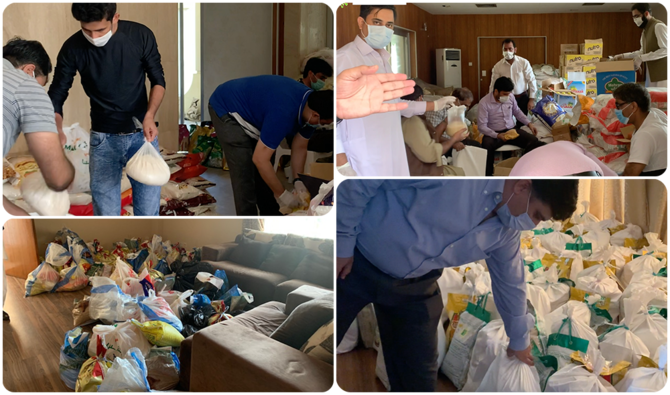

DUBAI: Pakistani community members, who are facing financial hardships due to the ongoing lockdown in the United Arab Emirates, have been regularly receiving ration bags from the Pakistani consulate for nearly a week now.
A community-driven initiative that is supported by the country’s diplomatic mission, the bags are filled with essential food items, such as rice, milk, flour, biscuits and oil, which are separately packed for families and individuals who are either stuck in the gulf state due to flight closures or facing financial crunch after being laid off.
“More than 1,700 packets have been given to people since we started this welfare service five days ago,” Ahmed Amjad Ali, Pakistan’s Consul General to the UAE, told Arab News on Wednesday.
“In the beginning, we received contributions from three or four philanthropists, but now nearly 50 community members are donating the foodstuff,” he said. “We are also contributing from our end, though we are not accepting any cash.”
The family packs weigh around 20 kilograms and the ration is enough to last for 10 to 15 days.
“We have so much stock available now that we can help people for another two weeks,” he added.
The family ration packs have also been distributed in the Northern Emirates, including Sharjah, Ras Al Khaimah, Ajman and Fujairah.
“Since the situation is troubling and people are in need, we are trying to help as much as possible,” he said.
#Pakistan Consul General in Dubai gives #ArabNewsPK a visual account of relief activities taking place at the consulate for needy expats impacted by #Covid_19 outbreak.
-
Follow our coverage of #CoronavirusInPakistan: https://t.co/FvSfxSMzAm
-@uaeembassyisb @ForeignOfficePk pic.twitter.com/dW2t4WAwbg— Arab News Pakistan (@arabnewspk) April 2, 2020
For families that cannot come to the consulate, the packets have also been distributed among those in Sharjah and Ajman.
“We follow our criteria to see if families are indeed needy or not,” said Ali. “We ask them to show us a proof of their passport. Other than that, people who have letters showing that they have been recently laid off are also given preference.”
The consulate staff has undertaken the responsibility of packing foodstuff with different teams.
“This is really a state of emergency, I would say, and people are helping and coming to us because they trust that the consulate is giving to the needy. Everything is going very smoothly and we hope to do more home deliveries over the weekend,” he said.
Every day the consulate teams go to different cities, a process that the diplomatic mission hopes to continue until the difficult situation lasts.
“We are also trying arrange special flights for the stranded people who want to go back to Pakistan. We have also approached the UAE government to look into the exemption of fines for visit visa holders,” he added.
Meanwhile, the Pakistan Association in Dubai has called for volunteers to assist the authorities in the gulf state in their ongoing battle against the coronavirus.
“We already have doctors and nurses working at isolation and quarantine facilities, but we need general volunteers to help the Dubai Police with the distribution of food and ration and help with the general work in the quarantine areas,” the association’s president, Dr Feisal Ikram, told Arab News.


