

Erdogan ‘risks lives’ blocking water supply to Kurds

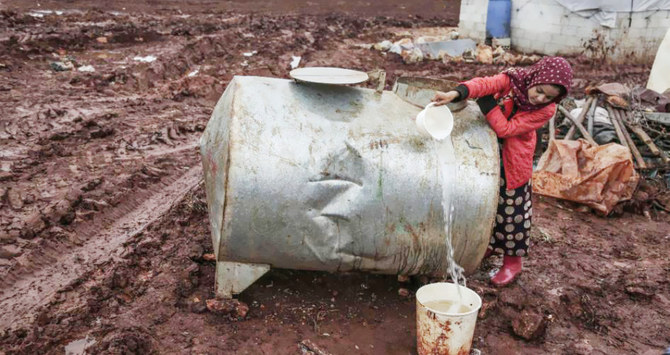
A displaced Syrian girl fills water from a cistern at a refugee camp in the northern countryside of Idlib. (AP)
Short Url
Updated 02 April 2020
Follow

Erdogan ‘risks lives’ blocking water supply to Kurds

ISTANBUL: Turkish President Recep Tayyip Erdogan was accused by aid and rights groups on Wednesday of risking lives during the coronavirus pandemic by restricting water supplies to nearly half-a-million Kurds in northeast Syria.

The restriction compromises humanitarian workers’ efforts to protect local communities against COVID-19, especially in terms of handwashing practices and personal hygiene, Human Rights Watch said.

On March 29, Turkey blocked the flow of water through Allouk pumping station near the Syrian town of Ras Al-Ain.  The station has been controlled by Turkey and allied Syrian forces since October 2019, when Ankara launched an offensive against Syrian-Kurdish forces.

“A water shortage would certainly make a coronavirus outbreak less controllable in Syria, and drive individuals to escape to where they can get treatment and be protected, and the likely target would be neighboring countries, including Turkey,” Sara Kayyali, a Syria researcher at Human Rights Watch, told Arab News.

Allouk had been providing water to about 460,000 people in Syria’s Al-Hasakeh governorate, including those living in displacement camps such as Al-Hol and Areesheh.

UNICEF warned that the “interruption of water supply during the current efforts to curb the spread of the coronavirus disease puts children and families at unacceptable risk.”

Human Rights Watch said:
“The Turkish authorities should do everything they can to immediately resume supply to these
communities.”

The group is concerned that the water shortage may lead to a greater risk of coronavirus contagion in the region.

Faruk Logoglu, a retired Turkish diplomat, called for the introduction of “corona diplomacy” by Ankara in its relations with Syria, which does not have enough hospitals, ventilators, medicines and medical equipment. “Contacts should be initiated” by Turkey with the Syrian government “to develop a joint plan of action to fight the pandemic,” he said.

Some regions of Syria, especially opposition-held Idlib province, are a ticking time bomb, with an insufficient number of coronavirus
test kits.


Trial opens in Tunisia of NGO workers accused of aiding migrants

Updated 15 December 2025
Follow

Trial opens in Tunisia of NGO workers accused of aiding migrants

  • Aid workers accused of assisting irregular migration to Tunisia went on trial on Monday, as Amnesty International criticized what it called “the relentless criminalization of civil society”

TUNIS: Aid workers accused of assisting irregular migration to Tunisia went on trial on Monday, as Amnesty International criticized what it called “the relentless criminalization of civil society” in the country.
Six staff members of the Tunisian branch of the France Terre d’Asile aid group, along with 17 municipal workers from the eastern city of Sousse, face charges of sheltering migrants and facilitating their “illegal entry and residence.”
If convicted, they face up to 10 years in prison.
Migration is a sensitive issue in Tunisia, a key transit point for tens of thousands of people seeking to reach Europe each year.
A former head of Terre d’Asile Tunisie, Sherifa Riahi, is among the accused and has been detained for more than 19 months, according to her lawyer Abdellah Ben Meftah.
He told AFP that the accused had carried out their work as part of a project approved by the state and in “direct coordination” with the government.
Amnesty denounced what it described as a “bogus criminal trial” and called on Tunisian authorities to drop the charges.
“They are being prosecuted simply for their legitimate work providing vital assistance and protection to refugees, asylum seekers and migrants in precarious situations,” Sara Hashash, Amnesty’s deputy MENA chief, said in the statement.
The defendants were arrested in May 2024 along with about a dozen humanitarian workers, including anti-racism pioneer Saadia Mosbah, whose trial is set to start later this month.
In February 2023, President Kais Saied said “hordes of illegal migrants,” many from sub-Saharan Africa, posed a demographic threat to the Arab-majority country.
His speech triggered a series of racially motivated attacks as thousands of sub-Saharan African migrants in Tunisia were pushed out of their homes and jobs.
Thousands were repatriated or attempted to cross the Mediterranean, while others were expelled to the desert borders with Algeria and Libya, where at least a hundred died that summer.
This came as the European Union boosted efforts to curb arrivals on its southern shores, including a 255-million-euro ($290-million) deal with Tunis.