

Tokyo Olympics rescheduled for July 23-Aug. 8 in 2021

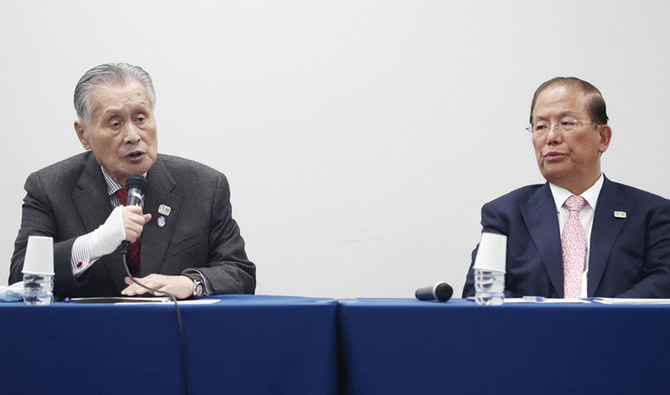
Tokyo 2020 President Yoshiro Mori Tokyo 2020 Olympics CEO Toshiro Muto during a press conference in Tokyo on Monday. (AFP)
Short Url
Updated 31 March 2020
Follow

Tokyo Olympics rescheduled for July 23-Aug. 8 in 2021

  • Organizers wanted to have more room for the athletes to qualify, after many qualifying events were postponed

TOKYO: The Tokyo Olympics will open next year in the same time slot scheduled for this year’s Games.

Tokyo organizers said Monday the opening ceremony will take place on July 23, 2021 — almost exactly one year after the Games were due to start this year.
“The schedule for the Games is key to preparing for the Games,” Tokyo organizing committee President Yoshiro Mori said. “This will only accelerate our progress.”
Last week, the IOC and Japanese organizers postponed the Olympics until 2021 because of the coronavirus pandemic.
This year’s Games were scheduled to open on July 24 and close on Aug. 9. But the near exact one-year delay will see the rescheduled closing ceremony on Aug. 8.
There had been talk of switching the Olympics to spring, a move that would coincide with the blooming of Japan’s famous cherry blossoms. But it would also clash with European soccer and North American sports leagues.
Mori said a spring Olympics was considered but holding the Games later gives more space to complete the many qualifying events that have been postponed by the virus outbreak.
“We wanted to have more room for the athletes to qualify,” Mori said.
After holding out for weeks, local organizers and the IOC last week postponed the Tokyo Games under pressure from athletes, national Olympic bodies and sports federations. It’s the first postponement in Olympic history, though there were several cancellations during wartime. The Paralympics were rescheduled to Aug. 24-Sept. 5.
The new Olympic dates will conflict with the scheduled world championships in track and swimming, but those events are now expected to also be pushed back.
“The IOC has had close discussions with the relevant international federations,” Mori said. “I believe the IFs have accepted the Games being held in the summer.”
Both Mori and CEO Toshiro Muto have said the cost of rescheduling the Olympics will be “massive” — local reports estimate billions of dollars — with most of the expenses borne by Japanese taxpayers.

HIGHLIGHTS

• Spring Olympics was considered but holding the Games later gives more space to complete the many qualifying events.

• The new Olympic dates will conflict with the scheduled world championships in track and swimming, but those events are now expected to also be pushed back.

• The cost of rescheduling the Olympics will be ‘massive’ — local reports estimate billions of dollars — with most of the expenses borne by Japanese taxpayers.

Muto promised transparency in calculating the costs, and testing times deciding how they are divided up.
“Since it (the Olympics) were scheduled for this summer, all the venues had given up hosting any other events during this time, so how do we approach that?” Muto asked.
“In addition, there will need to be guarantees when we book the new dates, and there is a possibility this will incur rent payments. So there will be costs incurred and we will need to consider them one by one. I think that will be the tougher process.”
Katsuhiro Miyamoto, an emeritus professor of sports economics at Kansai University, puts the costs as high as $4 billion. That would cover the price of maintaining stadiums, refitting them, paying rentals, penalties and other expenses.
Japan is officially spending $12.6 billion to organize the Olympics. However, an audit bureau of the Japanese government says the costs are twice that much. All of the spending is public money except $5.6 billion from a privately funded operating budget.
The Switzerland-based International Olympic Committee is contributing $1.3 billion, according to organizing committee documents. The IOC’s contribution goes into the operating budget.
IOC President Thomas Bach has repeatedly called the Tokyo Olympics the best prepared in history. However, Deputy Prime Minister Taro Aso also termed them “cursed.” Aso competed in shooting in the 1976 Olympics, and was born in 1940.
The Olympics planned for 1940 in Tokyo were canceled because of World War II.
The run-up to the Olympics also saw IOC member Tsunekazu Takeda, who also headed the Japanese Olympic Committee, forced to resign last year amid a bribery scandal.

Humbert stuns Tsitsipas as defending champion exits Dubai in first round

Updated 25 February 2026
Follow

Humbert stuns Tsitsipas as defending champion exits Dubai in first round

  • Last year’s winner lost in straight sets to the 2024 champion
  • Ugo Humbert will now play the 2022 champion, Andrey Rublev, on Wednesday

DUBAI: Defending champion Stefanos Tsitsipas crashed out of the Dubai Duty Free Tennis Championships on Tuesday night, falling in the first round to 2024 title-winner Ugo Humbert under the bright lights of the center court.

The 4-6, 5-7 defeat at the Dubai Duty Free Tennis Stadium means the 27-year-old Greek, who left the court with his head bowed, will drop outside the world top 40 for the first time in almost eight years.

The first-round meeting between the two unseeded Dubai champions caught the eye as soon as the main draw took place on Saturday for this week’s ATP 500 tournament. Only seven world ranking places separated the pair and the lower-ranked Humbert, at No. 37, edged the pre-match head-to-head record at 3-1. Tsitsipas has not yet progressed beyond the quarterfinals across five events since the start of the year.

“It was a funny first round — the two last winners of the tournament,” said Humbert, who beat Alexander Bublik in the final here two years ago. “It’s so good to be back where I won the tournament. I have such good memories, and it was a tough battle tonight.”

From the first exchanges, both players dominated their service games with remarkable ease. Tsitsipas only conceded two points in his first four, while Humbert was forced to deuce in just one game. Yet as the scoreline progressed in undramatic fashion to 5-4 to Humbert, and with Tsitsipas’ majestic topspin backhand starting to purr, the Greek’s serve deserted him when he needed it most.

Fewer than 24 hours after he had enjoyed a Ramadan cultural experience that saw him don a dark blue kandura to eat the fast-breaking iftar meal, Tsitsipas demonstrated the season’s spirit of generosity by gifting Humbert a pair of double-faults, an unforced error and, ultimately, the opening set.

The second set followed a similar pattern, with Tsitsipas unable to change the course of the match. Humbert conceded two break points in the first game yet found the resolve to dig deep and hold on. The set stayed on serve for 11 consecutive games until, with Humbert 6-5 up and Tsitsipas serving to stay in the tournament, another two wasteful forehands by the three-time finalist handed Humbert two match points.

The Frenchman took the victory at the first opportunity as Tsitsipas’ third unforced forehand error in sequential points sealed his fate.

“I think today, it was a big battle,” said Humbert. “We both served very well, and I had just a few opportunities and I did it, so I’m super happy. It’s nice to come back to play again on this beautiful court. I have such a nice feeling when I play here and it’s nice to be in (the) second round.”

Next up for Humbert is 2022 champion Andrey Rublev, who eased past France’s Valentin Royer 6-3, 6-4. The energetic Muscovite shuttled around Center Court like a man incapable of letting a ball past him, with more than one seemingly impossible return sent safely back by the 28-year-old.

Royer saved eight second-set break points by the time he levelled the set at 2-2, but Rublev’s serving was at times unplayable. His shot selection must have left his opponent bewildered as he mixed impudent drop shots with returnable volleys at the net.

“It was a great win for me because I knew very well in our first meeting, I lost,” said Rublev. “[Royer’s] a great fighter, and I’m really happy that I was able to take that challenge and go through in straight sets. When you play so late, to have some time to recover before the next match is so important.”

On facing Humbert, he added: “It’s going to be great for me to see my level because Ugo is a great player. He’s hitting the ball really hard; he’s getting better and better, and always fights until the end, playing super aggressive and hitting bombs from all over the place. He’s won here in the past too, so it’s going to be an interesting fight.”

Earlier in the day, eighth seed Jiri Lehecka survived losing the first set to Lucky Loser Luca Nardi — a late injury replacement for France’s Arthur Fils — by recovering to win 4-6, 6-4, 6-2. The Czech world No. 22 will face Spaniard Pablo Carreno Busta on Wednesday after the qualifier disposed of Canada’s Denis Shapovalov 6-2, 6-4.

In the final game on New Court 1, sixth seed Jakub Mensik edged past Hubert Hurkacz of Poland 6-4, 7-6 (7). Mensik will face Australia’s Alexei Popyrin, the world No. 47, who narrowly edged out Poland’s Kamil Majchrzak 3-6, 6-3, 7-6.

Meanwhile on Court 2, world No. 25 Tallon Griekspoor of the Netherlands — the highest-ranked player not seeded in Dubai this week — defeated Finnish qualifier Otto Virtanen 6-3, 6-4 to set-up a mouthwatering second round match against second seed Alexander Bublik.

Elsewhere, Arthur Rinderknech also lost the first set en route to defeating Hungary’s Fabian Marozsan 3-6, 6-3, 6-4.

The imposing Frenchman will play British fourth seed Jack Draper in the next round. The USA’s Jenson Brooksby, the world No. 49, dispatched Belgium’s Zizou Bergs 6-3, 6-4 to seal a last-16 tie against seventh seed Karen Khachanov, who required three sets to eliminate Lucky Loser Alexander Shevchenko of Kazakhstan 6-7 (5), 6-2, 6-3.