VIENNA: The Swiss government could increase a 20 billion Swiss francs ($21 billion) loan program to help keep companies afloat and safe jobs amidst the coronavirus crisis, the finance minister told weekly Sonntagsblick.
Like other European countries, Switzerland is pumping money into its crisis-hit economy. The government has signed off on a 20-billion-Swiss-franc emergency scheme under which companies can get state-backed, no-interest loans of up to 500,000 Swiss francs via their banks.
“It is possible that we might have to step this up,” Ueli Maurer said in an interview published on Sunday. “The 20 billion are tight.”
More than 30,000 loan applications have been submitted already, and guarantees worth more than 4 billion francs have been given on Thursday and Friday alone, the finance minister said.
Asked how much money the state was ready to provide, he said: “As much as is needed. We are borrowing to safe jobs.”
“If we do not pump money into the economy quickly, we will have tens of thousands of unemployed within weeks.”
Maurer had pointed out on Saturday that the government was happy to help with loans, but that the money must be paid back and could not cover income losses.
More than 13,000 coronavirus cases and 235 related deaths have been confirmed in the Alpine country of 8.6 million people.
The government has urged people to stay at home, imposed strict border controls and banned gatherings of more than five people to curb the epidemic’s spread.
Maurer said it was important to prepare now for how best to begin to ease the restrictions in public life. “The current situation is not sustainable in the long term, neither mentally nor economically.”

Switzerland might increase 20bn franc emergency scheme: Finance minister
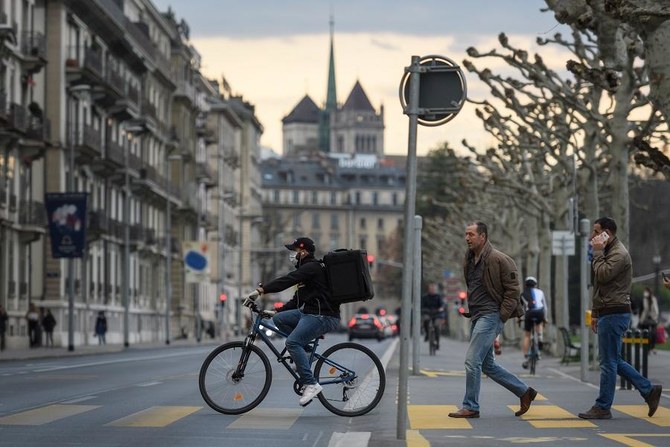
- The government has signed off on a 20-billion-Swiss-franc emergency scheme
- The government has urged people to stay at home, imposed strict border controls and banned gatherings of more than five people
Israel defends Somaliland move at UN amid concerns over Gaza motives
- Some states question if recognition part of a bid to relocate Palestinians or establish military bases
- US President Donald Trump's peace plan for Gaza states: "No one will be forced to leave Gaza, and those who wish to leave will be free to do so and free to return"
- US accuses Security Council of double standards after Western countries recognized Palestinian state
UNITED NATIONS: Israel defended on Monday its formal recognition of the self-declared Republic of Somaliland, but several countries at the United Nations questioned whether the move aimed to relocate Palestinians from Gaza or to establish military bases.
Israel became the first country to recognize Somaliland as an independent and sovereign state on Friday.
The 22-member Arab League, a regional organization of Arab states in the Middle East and parts of Africa, rejects “any measures arising from this illegitimate recognition aimed at facilitating forced displacement of the Palestinian people or exploiting northern Somali ports to establish military bases,” Arab League UN Ambassador Maged Abdelfattah Abdelaziz told the UN Security Council.
“Against the backdrop of Israel’s previous references to Somaliland of the Federal Republic of Somalia as a destination for the deportation of Palestinian people, especially from Gaza, its unlawful recognition of Somaliland region of Somalia is deeply troubling,” Pakistan’s Deputy UN Ambassador Muhammad Usman Iqbal Jadoon told the council.
Israel’s UN mission did not immediately respond to a request for comment on the remarks or address any of them in its statement at the council meeting. In March, the foreign ministers of Somalia and Somaliland said they had not received any proposal to resettle Palestinians from Gaza.
US President Donald Trump’s peace plan for Gaza states: “No one will be forced to leave Gaza, and those who wish to leave will be free to do so and free to return.”
Israel’s coalition government, the most right-wing and religiously conservative in its history, includes far-right politicians who advocate the annexation of both Gaza and the West Bank and encouraging Palestinians to leave their homeland.
Somalia’s UN Ambassador Abukar Dahir Osman said council members Algeria, Guyana, Sierra Leone and Somalia “unequivocally reject any steps aimed at advancing this objective, including any attempt by Israel to relocate the Palestinian population from Gaza to the northwestern region of Somalia.”
SOMALILAND VS PALESTINIAN STATE
Somaliland has enjoyed effective autonomy — and relative peace and stability — since 1991 when Somalia descended into civil war, but the breakaway region has failed to receive recognition from any other country.
“It is not a hostile step toward Somalia, nor does it preclude future dialogue between the parties. Recognition is not an act of defiance. It is an opportunity,” Israel’s Deputy UN Ambassador Jonathan Miller told the council.
In September, several Western states, including France, Britain, Canada and Australia announced they would recognize a Palestinian state, joining more than three-quarters of the 193 UN members who already do so.
Deputy US Ambassador to the UN Tammy Bruce said: “This council’s persistent double standards and misdirection of focus distract from its mission of maintaining international peace and security.”
Slovenia’s UN Ambassador Samuel Zbogar disputed her argument, saying: “Palestine is not part of any state. It is illegally occupied territory ... Palestine is also an observer state in this organization.”
He added: “Somaliland, on the other hand, is a part of a UN member state and recognizing it goes against ... the UN Charter.”
Israel said last week that it would seek immediate cooperation with Somaliland in agriculture, health, technology and the economy. The former British protectorate hopes Israeli recognition will encourage other nations to follow suit, increasing its diplomatic heft and access to global markets.


