

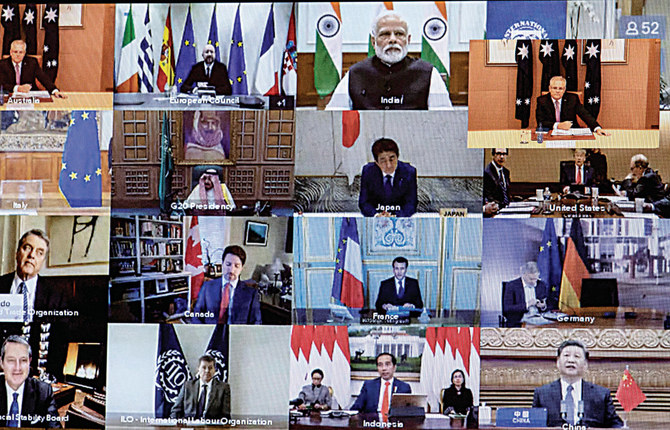

DUBAI: It is a good sign when the G20 produces its traditional communique within minutes of the formal close of a summit of world leaders.
It means there was genuine and broad agreement on the issues under discussion, and that there were no tricky last-minute “accommodations” to be made to the text, which is intended to signify unity and consensus.
So it was at the extraordinary virtual G20 held under the auspices of the Saudi Arabian presidency on Thursday. Within minutes of King Salman officially closing the 90-minute meeting, the communique was ready to show the world that the leaders of the most powerful countries on earth were determined and united in their efforts to tackle the coronavirus and mitigate its impact on the global economy.
The summit was extraordinary in several respects. It was called by Saudi Arabia at short notice and months ahead of the scheduled event, slated for Riyadh in November. Only twice before — in the two years at the height of the global financial crisis — have there been more than one G20 summit in a year.
It was extraordinary, too, because it was conducted via digital technology, rather than the big physical stage events of all past G20s. In a sign of the times, the technicalities of connecting 20 global leaders online proved less challenging than physically flying them to one place. The virus is proving the value of the digital age.
But it was also extraordinary in a more fundamental sense, because it sought to address a situation that would have been unthinkable just a few weeks ago. The fact of tens of thousands of deaths, and the fastest economic decline in in modern history, has concentrated minds in an extraordinary way.
There was no formal agenda for the summit, but with the pressing medical and economic challenges in the world, there was no need for one. The leaders focused exclusively on these two issues.
On the health emergency, there was understandable consensus around the need to do “whatever it takes” to combat the virus, which the G20 said was its “absolute priority.”
There was also enthusiastic agreement that only international cooperation could achieve this, with full backing given to the World Health Organization, the Coalition for Epidemic Preparedness and Innovation, and Gavi, the vaccine alliance, as the front-line agencies against the virus. “The virus respects no borders,” the G20 said, in a reaffirmation of the globalist ethos that has been under real challenge in recent years.
On the economic effects, the headline grabbing number was $5 trillion — the amount pledged by G20 members so far as an injection into the global economy via fiscal, economic and credit initiatives to counteract the recession into which the world has been plunged.
The hope is that this injection — and whatever extra may come in future injections — will prevent the recession from turning into a 1930s-style depression with all the profound human, social, and geopolitical ramifications that would bring. Time — and the financial markets — will tell whether this will be enough.
Given that the virtual summit was organized by Saudi Arabia, some geopoliticians had hoped that the leaders would also be able to agree an energy policy for the world at a time of acute stress in oil and gas markets. The pressure had been building from the US before the event to have some resolution on energy in the final communique.
The leaders resisted this pressure. In the end the words “oil” and “energy” were nowhere to be found in the 1,500-word document. Some concerned energy experts took comfort from a general commitment by the G20 to “work to resolve disruptions to the global supply chains,” though that was the least that could be expected.
When the leaders pressed the “leave meeting” buttons on their screens, they could reflect on a job well done. The world wanted reassurance and unity from the G20 leaders. That is what it got.


