Pandemic response: Medical equipment to reach Pakistan on Thursday, says health ministry

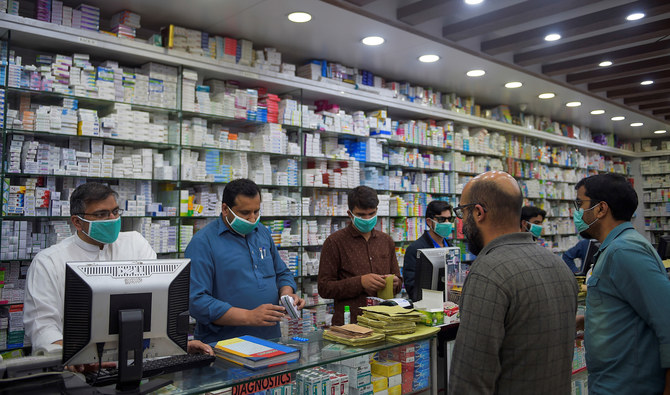
Pharmacy employees wearing facemasks as a preventive measure against the COVID-19 coronavirus attend to customers in Islamabad on March 23, 2020. (AFP)
Short Url
Updated 25 March 2020
Follow

Pandemic response: Medical equipment to reach Pakistan on Thursday, says health ministry

  • Health director general says 2 million test kits from China will arrive by the end of month
  • Ministry of Planning allocated $238 million from the World Bank for COVID-19 emergency response

ISLAMABAD: A major shipment of clinical and diagnostic equipment to deal with the coronavirus pandemic is going to arrive in Pakistan on Thursday, a senior health official told Arab News.
“This procurement of medical equipment was done through UNICEF in coordination with the Ministry of Health. We have focused not only on clinical but also diagnostic equipment for our medical teams,” Malik Muhammad Safi, director general for health, told Arab News on Wednesday. He added that personal safety equipment such as N-95 masks and protective wear for medical workers have also been purchased.
The Ministry of Planning allocated $238 million from the World Bank for COVID-19 emergency response and to address the socio-economic disruption the outbreak has caused.
“This amount of $238 million from the World Bank is a soft loan and to be utilized through UNICEF,” Safi said.
“We have also ordered medical equipment like ventilators and testing lab kits. Once this consignment will be delivered to us by UNICEF, we will use it to establish 42 testing labs at each divisional headquarters of Pakistan,” he said, adding that the ministry has already established testing labs in Peshawar, Gilgit, Quetta, Taftan, Lahore, and Karachi.
Meanwhile, the National Institute of Health (NIH) is developing locally made testing kits.
“We have acquired sufficient quantity of testing kits and NIH has sent 2,000 kits to Punjab and 1,000 to Gilgit-Baltistan on Tuesday. One kit can take around 96 tests. We have also procured another 2 million kits from China, which will arrive by the end of month,” Safi said.
The National Disaster Risk Management Fund (NDRMF) granted $50 million to the National Disaster Management Authority (NDMA) on Wednesday to deal with the health crisis.
“This funding is for six months duration with an objective to effectively respond to minimize impact of coronavirus, through surveillance strengthening, case management, infection prevention and protection of medical and para medical staff through provision of personal protective equipment (PPE) and other materials for COVID-19 response,” the NDMA said in a statement.
The World Bank, Asian Development Bank (ADB) and International Money Fund (IMF) have announced $14 billion, $6.5 billion and $50 billion respectively in initial packages to support companies and countries in their efforts to prevent, detect and respond to the rapid spread of COVID-19.


Pakistani, Bangladeshi officials discuss trade, investment and aviation as ties thaw

Updated 28 December 2025
Follow

Pakistani, Bangladeshi officials discuss trade, investment and aviation as ties thaw

  • Pakistan and Bangladesh were once one nation, but they split in 1971 as a result of a bloody civil war
  • Ties between Pakistan, Bangladesh have warmed up since last year and both nations have resumed sea trade

ISLAMABAD: Pakistan's High Commissioner to Bangladesh Imran Haider on Sunday met Chief Adviser Muhammad Yunus in Dhaka, the latter's office said on, with the two figures discussing trade, investment and aviation.

Pakistan and Bangladesh were once one nation, but they split in 1971 as a result of a bloody civil war, which saw the part previously referred to as East Pakistan seceding to form the independent nation of Bangladesh.

Ties between Pakistan and Bangladesh have warmed up since former prime minister Sheikh Hasina’s ouster as a result of a student-led uprising in August 2024. Relations remain frosty between Dhaka and New Delhi over India’s decision to grant asylum to Hasina.

Pakistan has attempted to forge closer ties with Bangladesh in recent months and both South Asian nations last year began sea trade, followed by efforts to expand government-to-government commerce.

"During the meeting, both sides discussed ways to expand cooperation in trade, investment, and aviation as well as scaling up cultural, educational and medical exchanges to further strengthen bilateral relations between the two South Asian nations," Yunus's office said in a statement on X.

In 2023-24 Pakistan exported goods worth $661 million to Bangladesh, while its imports were only $57 million, according to the Trade Development Authority of Pakistan. In Aug. this year, the Pakistani and Bangladeshi commerce ministries signed a memorandum of understanding to establish a Joint Working Group on Trade, aiming to raise their bilateral trade volume to $1 billion in the financial year that began in July.

The Pakistani high commissioner noted that bilateral trade has recorded a 20 percent growth compared to last year, with business communities from both countries actively exploring new investment opportunities, according to the statement.

He highlighted a significant increase in cultural exchanges, adding that Bangladeshi students have shown strong interest in higher education opportunities in Pakistan, particularly in medical sciences, nanotechnology, and artificial intelligence. Haider also said that Dhaka-Karachi direct flights are expected to start in January.

"Chief Adviser Professor Muhammad Yunus welcomed the growing interactions between the two countries and emphasized the importance of increased visits as well as cultural, educational and people-to-people exchanges among SAARC (South Asian Association for Regional Cooperation) member states," the statement read.

"Professor Yunus also underscored the need to further boost Bangladesh–Pakistan trade and expressed hope that during Mr. Haider’s tenure, both countries would explore new avenues for investment and joint venture businesses."