Need something to watch? Saudi Arabia’s ‘Masameer the Movie’ hits Netflix
Updated 02 April 2020
Arab News
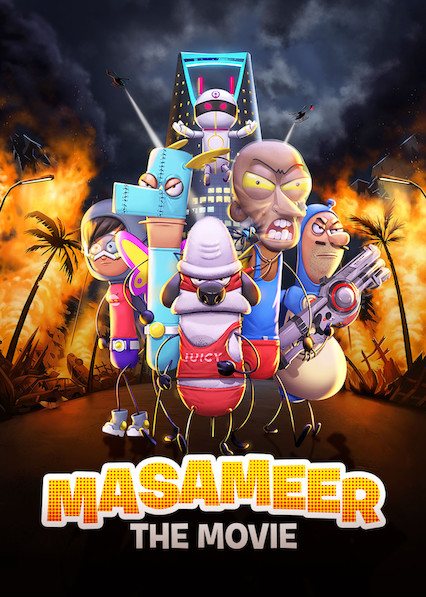
DUBAI: Netflix is now streaming Saudi animation film “Masameer the Movie,” which is based on an animated YouTube series, co-created by Faisal Al-Amer and Malik Nejer, that is considered one of the most successful local cartoon mini-series to date.
Netflix is streaming the Myrkott-produced film with subtitles in more than 30 languages, making it available to more than 167 million viewers in 190 countries around the world.
The animation tells the story of Dana, a Saudi girl with a passion for robots and artificial intelligence, who embarks on a journey to create good in the world using robotics.
The film is based on an animated YouTube series. (Supplied)
Meanwhile, three friends: Saad, Saltooh and Kalb hit rock bottom and go on a journey of their own to prove themselves to society by becoming crime-fighting superheroes.
“We as Saudis, tell a story, our story, and as filmmakers or creators don’t need to sugar-coat or create a flowery image of our society,” Al-Amer told Arab News in a previous interview. “This is us, we don’t create movies for the approval of the West, we make them to express ourselves.”
Netflix’s decision to stream the film comes after “Six Windows in the Desert,” a series of short films created by Saudis made its debut on the streaming giant in February.
KARACHI: In a bright training kitchen in Karachi, young adults with Down syndrome chop vegetables, measure ingredients and prepare sandwiches under the guidance of their culinary instructor, skills their parents once believed were beyond their reach.
The medical condition, caused by the presence of an extra chromosome, can affect learning, motor coordination and speech.
Experts say structured, hands-on training, especially in practical life skills such as cooking, significantly improves independence and confidence, which is what the Karachi Down Syndrome Program (KDSP) aims to deliver through its “Education for Life” initiative.
“Parents say their child could not even turn the stove on earlier,” Shayan Zafar, General Manager Communications and Awareness at KDSP, told Arab News on Friday. “They were scared of a mishap when the child entered the kitchen. Now, thanks to the kitchen and KDSP, they make evening tea for their parents at home.”
Launched three years ago for individuals aged 16 and above, the three-year program offers weaving, sewing, stitching, arts and crafts and a dedicated culinary stream taught in small, supervised groups.
Students learn everything from boiling an egg to baking cupcakes as they progress through the curriculum.
“At the end of the day, when the class concludes and you see their happy faces, it makes you happy too,” Zainab Durrani, the culinary and pastry instructor guiding the class, said. “And that motivates you to do all of this.”
Student Dua Shahid is dicing chicken in Karachi, Pakistan, on Dececmber 12, 2025. (AN Photo)
Trained at the College of Tourism and Hotel Management (COTHM), Pakistan’s leading international hospitality college, she said the facility did not have a proper kitchen when she first joined it.
However, that changed as its management decided to introduce culinary classes.
“In the first year, we teach them the basic skills enough for them to make their breakfast at home. For instance, boiled egg, toast and fried egg,” she continued.
The 10 students taking the class said they enjoyed working with Durrani who helps them acquire cooking skills.
“Today, I am making a chicken cheese sandwich and cupcakes along with it,” 20-year-old Dua Shahid, one of Durrani’s students, said while slicing spring onions with careful focus.
“[My most favorite is] chicken cheese sandwich,” she added. “[It is made with] onion, capsicum, chicken, cucumber, bread, mayonnaise [and some] sauce.”
Dua said she also cooks the dishes she learns at home.
“I made chicken vegetable pasta at home. It was very delicious, everyone liked it.”
Another student, Nauroz Khan, 21, shared proudly: “I know how to make pizza, burger [and] eggs. I make all of these at home. I really enjoy [being part of the class].”
Durrani said students often struggle initially with motor skills or coordination, requiring gradual introduction.
“For instance, they may have a problem holding the knife,” she added. You can give them a toy knife and I suggest giving them play dough to begin with,” she said, adding that visual aids help them identify ingredients.
Zafar, who leads communications and awareness programs, said the initiative has demonstrated tangible outcomes.
“We have had a previous batch who just graduated with us, and they are running their own businesses. They have their own Instagram pages which they are running by themselves. Each of them has their respective niche, from weaving to block printing.”
KDSP, now in its 11th year, operates five facilities nationwide — three in Karachi, one in Islamabad and one in Faisalabad — with new centers planned for Hyderabad and Lahore.
Under its KDSP Café brand, the organization also provides a platform for students to promote and sell their work in corporate settings.
“There would be 30,000 individuals with Down syndrome in Karachi while the number would be 300,000 in the entire Pakistan,” said Zafar.
“At this point, we are serving 2,800 of them,” he added. “The goal is to get to every individual, and we have plans to do that through the development of an app and other initiatives across the country.”