

It’s official: Tokyo Olympics postponed until 2021 due to coronavirus

International Olympic Committee President Thomas Bach walks with Japan’s Prime Minister Shinzo Abe during the ‘One Year to Go’ ceremony celebrating one year out from the start of the summer games on July 24, 2019. (Reuters)
Short Url
Updated 25 March 2020
Follow

It’s official: Tokyo Olympics postponed until 2021 due to coronavirus

  • Postponement is first in Games’ 124-year history
  • Games to be rescheduled beyond 2020 but not later than summer 2021

DUBAI: On Tuesday, what even the most optimistic of sport fans must have suspected all along, was confirmed: The Tokyo Olympics will now be postponed due to the coronavirus disease (COVID-19) crisis.

After a conference call on Tuesday morning that saw President of the International Olympic Committee (IOC) Thomas Bach, Japanese Prime Minister Shinzo Abe and other stakeholders discuss the latest developments, it was announced that Tokyo 2020 will be pushed back to a later date.

The official IOC statement said: “In the present circumstances and based on the information provided by the WHO today, the IOC President and the Prime Minister of Japan have concluded that the Games of the XXXII Olympiad in Tokyo must be rescheduled to a date beyond 2020 but not later than summer 2021, to safeguard the health of the athletes, everybody involved in the Olympic Games and the international community.”

The announcement brings to an end a prolonged saga of indecision. Late on Monday night, a comment by IOC member Dick Pound in USA Today had all but confirmed a delay was a mere formality. 

“The parameters going forward have not been determined but the games are not going to start on 24 July, that much I know,” he said.
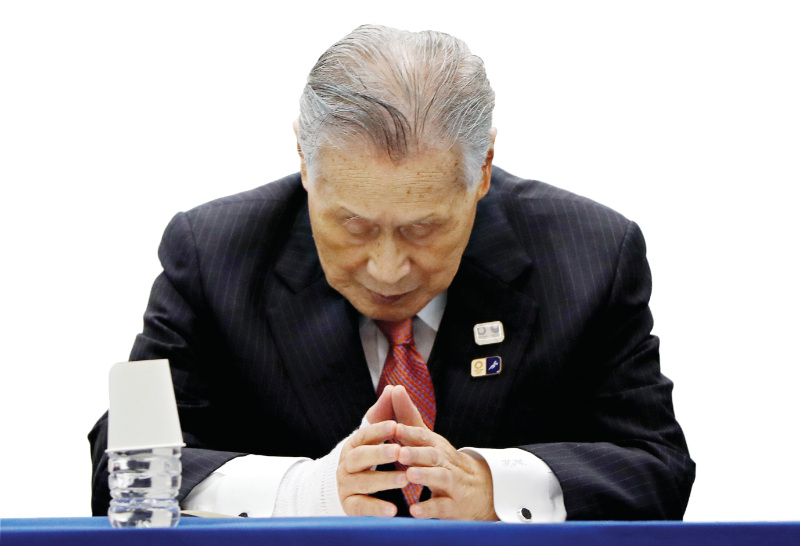


Yoshiro Mori, president of the Tokyo 2020 Olympic Games Organizing Committee, at a news conference after a telephone meeting with IOC President Thomas Bach Tuesday. (Reuters)

A subsequent statement by the British Olympic Association calling for postponement made the UK the latest country unwilling to risk the health of its athletes.

The cancellation was the unavoidable conclusion of a series of events and announcements made over the previous 48 hours.

First came the announcement on Sunday night by the IOC that a decision on whether the Tokyo Olympics would go ahead in July would be taken in four weeks time.

As the world came to a stand- still due to the spread of COVID- 19, even this concession seemed out of touch with the reality on the ground.

Things were changing by the hour. On Monday morning, Abe, speaking to parliament, acknowledged that the country must seriously consider postponing Tokyo 2020, potentially until next year, though there was no suggestion that it would be canceled.
“The IOC’s decision is along the lines of what I said before, of holding the event in its complete form,” he said.

“If that becomes difficult, and thinking first about the health of the athletes, we may have no option but to consider postponing the games.”
Even that statement faced criticism for what many considered to be a failure to take into account the rapidly changing health crisis.

Around the world, major sporting leagues, competitions and activities had long been suspended, including football’s Euro 2020, which was pushed back to 2021. And yet the organizers of the Tokyo Olympics had stubbornly held their ground.
In recent weeks, there had been a swell of opposition to the games taking place as scheduled, with many individual country federations fearing for the safety of their athletes, and that’s before getting to the issue of ensuring the health of staff, volunteers and fans still considering attending the events.

In the Middle East, the developments cast a shadow over a prevailing sense of of wary optimism. On March 18, a delegation from the UAE National Olympic Committee (UAE NOC) met with Akima Umezawa, consul-general of Japan in Dubai, to discuss preparations and logistics for the games. 

The delegation received a replica of Tokyo 2020’s mascot “Miraitowa.”

However, events elsewhere over a dramatic 48 hours rapidly overtook  this sense of normalcy. On March 20, the Saudi Arabian Olympic Committee (SAOC) had thrown its support behind the IOC in a tweet that confirmed talks with the World Health Organization regarding the crisis were ongoing.

“Following a conference call this morning, led by the President Dr Thomas Bach, and the Asian Olympic Committee to discuss the impact of COVID-19 pandemic on the preparation for Tokyo 2020, Saudi Arabian Olympic Committee and its president Prince Abdul Aziz Turki Al-Faisal express their full support to the efforts of the IOC, in collaboration WHO, to overcome this very critical time,” the statement said. 

It added: “SAOC wishes that the Tokyo 2020 Games will be the moment that the world celebrates the successful transition to prosperity after defeating this global pandemic.” That celebratory moment will now have to wait.


Al-Hilal complete second-half comeback against ten-man Al-Nassr to extend SPL lead

Updated 12 January 2026
Follow

Al-Hilal complete second-half comeback against ten-man Al-Nassr to extend SPL lead

  • Simone Inzaghi’s side move onto 38 points after a 3-1 victory, seven clear of Al-Nassr
  • Al-Nassr goalkeeper Nawaf Al-Aqidi was sent off in the 60th minute for violent conduct

RIYADH: It was an evening of football drama in Riyadh as the much-anticipated Capital Derby between Al-Hilal and Al-Nassr took place at the Kingdom Arena in the headline fixture of Matchday 15. With Al-Nassr four points behind the league leaders prior to the game, victory was essential for Jorge Jesus’ side as they remain in search for their first Saudi Pro League title in seven years.

The game kicked off at a slow place. Inzaghi, setting up his Al-Hilal side in a 5-4-1 defensive shape, tried to draw Al-Nassr deep into their half to exploit them on the counter. With Rúben Neves playing in the middle of a back three, his long passes proved key for the Blues as they targeted the space behind Al-Nassr’s defence.

Al-Nassr did not respond as expected. Jesus’ side have played at a blistering pace this season, characterised by a relentless high press, but this encounter saw Al-Nassr adopt a more cautious approach. Instead, they relied on moments of individual brilliance to break past the compact Al-Hilal structure.

Kingsley Coman was central to that strategy, as his movement between the channels saw the visitors’ most dangerous momment in the 19th minute. Mohammed Al-Rubaie, who had a shaky start in goal, managed to tip the ball wide for a corner.

Neither side appeared willing to overcommit, with the play concentrated in midfield. It was there that João Félix, spotting Coman on the shoulder of his defender, lofted a pass from deep to release the Frenchman, who laid it off to Cristiano Ronaldo for the opener.

Jesus’ first-half paid off, with the goal on the cusp of half-time giving Al-Nassr a vital boost heading into the break. They managed to keep the pressure on early in the second half, but the tide changed within minutes.

Malcom, attempting to cut inside for a shot, was brought down by Mohamed Simakan for a penalty in the 56th minute. Salem Al-Dawsari slotted it with confidence to bring the hosts back into the game, but the defining moment followed shortly after.

As Al-Hilal attempted to retrieve the ball from the net, Al-Nassr goalkeeper Nawaf Al-Aqidi intervened. In the ensuing scramble, he struck Neves in an incident deemed violent conduct by the referee as he was given his marching orders in the 60th minute.

Despite being reduced to ten men, Al-Nassr did not retreat. However, with Angelo sacrificed for replacement goalkeeper Mubarak Al-Buainain, their attacking threat diminished, making clear chances increasingly difficult to come by.

This opened the door for Al-Hilal’s return into the game, and in the 81st minute, a pinpoint cross by Neves from the left flank found Mohammed Kanno who finished to give the hosts the lead.

Ronaldo was substituted soon after, as Jesus sought fresh impetus through youngster Wesley, but the change failed to alter the course of the match. Al-Hilal were once again awarded a penalty after Al-Dawsari was brought down in stoppage time, before Neves stepped up to convert his penalty for Al-Hilal’s third of the night.

Al-Nassr, who began the season with ten consecutive wins, have now gone four games without a victory — three of them defeats. Their tally freezes at 31 points, as Al-Hilal move clear at the summit onto 38.

Elsewhere in the Saudi Pro League, Al-Hazem moved further clear of the relegation zone after a stunning comeback against Al-Najma. The latter, who were minutes away from their first win of the season, conceded two goals in the sixth and eighth minute of stoppage time to succumb to a 3-2 defeat. Meanwhile, Al-Ettifaq welcomed Al-Khaleej in the Eastern Province, losing 2-1 after a Jack Hendry own goal in the 86th minute gifted the visitors the win.

Action returns on Tuesday, with Al-Okhdood facing Al-Kholood at 6:25pm, followed by Al-Fateh against Al-Riyadh and Damac against Al-Ittihad, both kicking off at 8:30pm.