

Egyptians vent frustration at lack of coronavirus measures as metro images go viral

1 / 4
The pictures that surfaced online claim to show a carriage where commuters appear to be packed in with no distancing at all between the riders. (Facebook)
2 / 4
A man wearing a protective face mask is seen at the underground Al Shohadaa "Martyrs" metro station while Egypt ramps up its efforts to slow down the spread of the coronavirus disease (COVID-19) in Cairo, Egypt March 22, 2020. (Reuters)
3 / 4
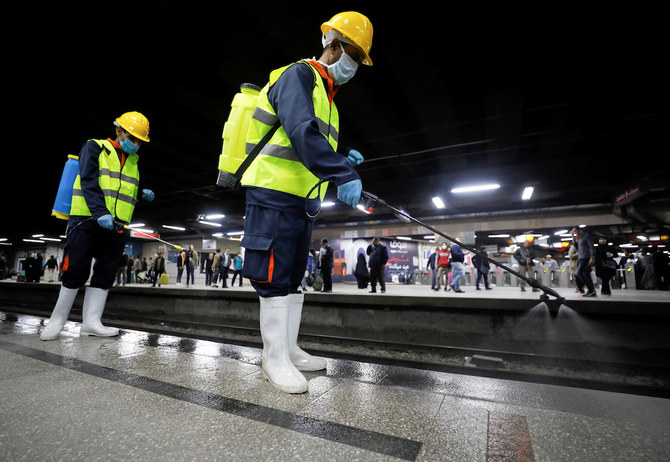
A member of medical team sprays disinfectant as a precautionary move amid concerns over the coronavirus disease (COVID-19) outbreak at the underground Al Shohadaa "Martyrs" metro station in Cairo, Egypt March 22, 2020. (Reuters)
4 / 4
Members of medical team spray disinfectant as a precautionary move amid concerns over the coronavirus disease (COVID-19) outbreak at the underground Al Shohadaa "Martyrs" metro station in Cairo, Egypt March 22, 2020. (Reuters)
Short Url
Updated 22 March 2020
Follow

Egyptians vent frustration at lack of coronavirus measures as metro images go viral

  • The pictures claim to show a carriage where commuters appear to be packed in with no distancing at all
  • Online comments spoke of fears of the spread of COVID-19

CAIRO: Internet users in Egypt are expressing concern at images showing metro commuters packed on a train as the country tries to slow the spread of coronavirus.

The pictures that surfaced online claim to show a carriage where commuters appear to be packed in with no distancing at all between the riders.  

Online comments spoke of fears of how not suspending the subway service would contribute to the spread of COVID-19.

The country's transport minister, Kamel El-Wazir, said suspending Cairo's metro system due to the virus would not be possible because the subway and the railway serve about 3.6 million citizens on a daily basis.

El-Wazir was quoted by local media saying that sterilization operations were taking place up to 6 times every 24 hours as a precautionary measure. 
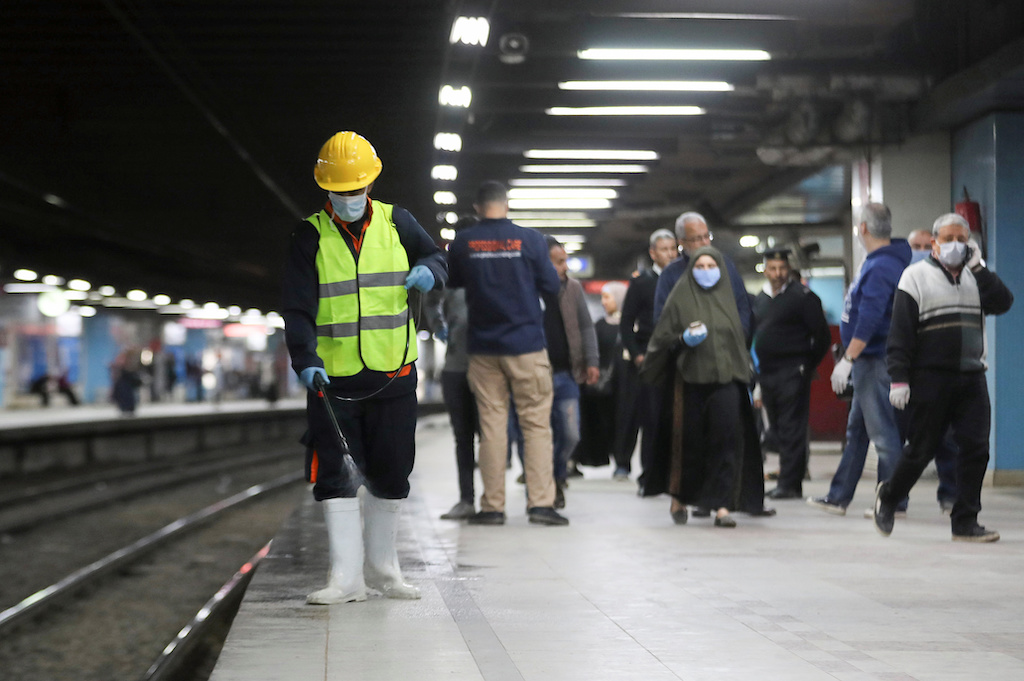
Egypt took measures over the weekend to sterilize buildings for public and private sectors as well as public areas and subway stations and trains. It is also broadcasting awareness messages on the internal radio at the subway stations and public buses about personal hygiene. 


Lebanon, Jordan seek solutions after Damascus bans non-Syrian trucks

Updated 3 sec ago
Follow

Lebanon, Jordan seek solutions after Damascus bans non-Syrian trucks

  • Lebanon and Jordan are seeking a solution with Syria after the latter barred foreign trucks from entering its territory, officials from both countries told AFP on Tuesday.
BEIRUT: Lebanon and Jordan are seeking a solution with Syria after the latter barred foreign trucks from entering its territory, officials from both countries told AFP on Tuesday.
Damascus had issued a decision on Saturday stipulating that “non-Syrian trucks will not be allowed to enter” the country, and that goods being imported by road must be unloaded at specific points at border crossings.
The decision exempts trucks that are only passing through Syria to other countries.
Dozens of trucks unable to enter the country were lined up on the Lebanese side of the Masnaa border crossing on Tuesday, an AFP photographer saw.
Ahmad Tamer, head of land and maritime transportation at the Lebanese transport ministry told AFP that discussions were underway with Damascus over the decision.
He said the issue was not specifically targeting Lebanon — which is trying to reset ties with Damascus after the fall of Bashar Assad — adding that he hoped to hold a meeting with the Syrian side soon.
Lebanon sends around 500 trucks to Syria per day, according to Tamer.
In Jordan, also affected by the decision, transport ministry spokesperson Mohammed Al-Dweiri told AFP that “discussions are currently underway, and we are awaiting a response from the Syrian side regarding allowing foreign trucks to enter and cross.”
Dweiri said that Jordanian trucks were continuing to unload their cargo at the free zone at the Nassib border crossing with Syria despite some “confusion.”
Around 250 Jordanian trucks travel to Syria daily, according to him.
A source in the Syrian General Authority for Ports and Customs told AFP that the decision aimed to “regulate the movement of cargo through the ports.”
Representatives of unions and associations in Lebanon’s transport sector denounced the decision on Tuesday and warning of “negative repercussions,” according to the state-run National News Agency.
Syria is the only land route Lebanon can use to export merchandise to wealthy Gulf markets.
As part of continued attempts to rekindle ties, the two countries signed an agreement on Friday to hand around 300 Syrian convicts over to Damascus.