Australia announces nearly $40 billion in coronavirus relief

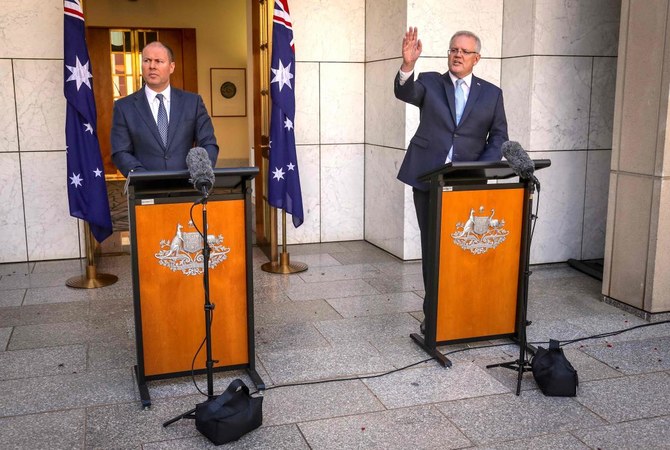
Australian Prime Minister Scott Morrison (R) speaks as he stands with the Australian Treasurer Josh Frydenberg during a press conference at Australia's Parliament House in Canberra on March 22, 2020. (AFP)
Short Url
Updated 22 March 2020
Follow

Australia announces nearly $40 billion in coronavirus relief

  • Workers whose income has fallen by at least 20 percent due to the coronavirus outbreak will be able to access their retirement funds early
  • The country appears poised to slip into recession as a result of the coronavirus outbreak after a record 29-year run of economic growth

SYDNEY: Australia on Sunday announced a $38 billion spending plan to limit the economic damage from the coronavirus pandemic, as citizens were told to cancel domestic travel plans to slow the virus spread.

Treasurer Josh Frydenberg said the latest Aus$66 billion announced Sunday brought government and central bank measures to support the economy to Aus$189 billion — or nearly 10 percent of gross domestic product (GDP).

“These extraordinary times require extraordinary measures and we face a global challenge like we have never faced before,” he told reporters in Canberra.

“Today’s announcement will provide hope and support for millions of Australians at a time when they need it most.”
Small businesses and non-profits will receive cash subsidies of up to Aus$100,000, unemployment payments will be temporarily doubled and pensioners will receive Aus$750 cash.

Workers whose income has fallen by at least 20 percent due to the coronavirus outbreak will be able to access their retirement funds early, with those facing hardship allowed to withdraw up to Aus$20,000 over two years.

Frydenberg said the economic shock was now expected to be “deeper, wider and longer” than was believed just 10 days ago and additional measures would be required.

The country appears poised to slip into recession as a result of the coronavirus outbreak after a record 29-year run of economic growth.
Australia has recorded more than 1,200 cases and seven deaths from COVID-19.

Prime Minister Scott Morrison said the government was also “moving immediately” to recommend against non-essential travel, warning stronger measures were imminent to deal with localized outbreaks.

He said work-related trips, the transport of essential supplies and travel on compassionate grounds could continue but people should cancel any other travel plans ahead of the upcoming Easter school holidays.

“More stronger measures will be coming and they will be coming in more localized areas to deal with outbreaks,” Morrison said.

“What that means is, what may be necessary in a part of Sydney may not be necessary at all in... other parts of the country.”

Australia has already sealed off its borders, putting in place an unprecedented ban on entry for non-residents in the hope of stemming the rise of COVID-19 infections.

Three Australian regions — the island state of Tasmania, South Australia state, and the Northern Territory — have also implemented a 14-day self-isolation period for all visitors.

New South Wales state on Sunday announced a shutdown of non-essential services, with supermarkets, pharmacies and petrol stations among those businesses that are exempt.

Morrison said political leaders would meet Sunday evening to consider stricter isolation rules.


Russian pensioners turn to soup kitchen as war economy stutters

Updated 7 sec ago
Follow

Russian pensioners turn to soup kitchen as war economy stutters

SAINT PETERSBURG: Dishes clatter, steam bursts from large cooking pots and music is seeping through the bustling chatter of Russian pensioners, hunched over bowls of free meals in a Saint Petersburg soup kitchen.
The general mood is upbeat but the place, at full capacity, is a testament to financial hardships plaguing an ever-increasing number of Russia’s elderly people, struggling to make ends meet as the country’s war economy stutters.
Nina, a 77-year-old retired engineer, said she could no longer go to the supermarket, getting her lunch and dinner from the soup kitchen instead, as she was not able to afford her own groceries.
“I haven’t been to a shop for three years because I don’t have the money. There’s simply no point in going,” she told AFP, her voice resolute but eyes glistening.
“Should I just go, look around and leave?,” she asked.
The cost of living in Russia — particularly in large cities — has skyrocketed in the four years since Moscow launched its full-scale offensive in Ukraine.
Huge spending on the military helped Russia buck predictions of economic collapse, but has pushed up inflation — a headache for the Kremlin which has aimed to shield citizens from the fallout of its war.
Prices have surged by a combined 45 percent since Russia launched its offensive, according to official data.
And though President Vladimir Putin recently hailed a cooling of inflation amid high interest rates, pensioners in the Saint Petersburg soup kitchen say their situation is still dire.

- ‘Poor boys’ -

On a bright winter day, AFP met former accountants, doctors and engineers turning to the free bowls of soup and pasta on offer.
Zinaida, a 77-year-old former paediatrician, told AFP her pension was 26,400 rubles ($345) a month.
“Over the last two to three years, we have seen food prices rise,” Zinaida said, attributing the surge to raising taxes.
In order to plug holes in Russia’s stretched public finances, the Kremlin has tapped the pockets of its citizens, raising the nationwide sales tax from 20 to 22 percent, starting this year.
For many pensioners like Zinaida, juggling monthly expenses has become increasingly tricky.
“By our age, everyone has a whole load of illnesses,” she said, and the medications were “very expensive.”
“You work just to pay for the utilities and the pharmacy. There is almost nothing left for anything else.”
That sentiment is shared by Anna, 66, who, despite a career as a surgeon, said she struggled to pay her bills in retirement.
“When you go to the pharmacy, you start to wonder if you’ll be able to buy anything for lunch.”
The Central Bank, which has hiked borrowing costs in a bid to tame price rises, expects annual inflation to ease to Moscow’s four-percent target only in 2027.
That is just one of the Russian economy’s worsening indicators as the war in Ukraine drags into its fifth year.
Growth slowed dramatically to one percent in 2025, Putin said earlier this week — down from 4.3 a year prior.
But for Tatyana, a former accountant, “it’s only fair that things should get more expensive.”
“We have this war going, with our poor boys there. May God grant them all good health.”