Shehbaz Sharif returns to Pakistan after four months

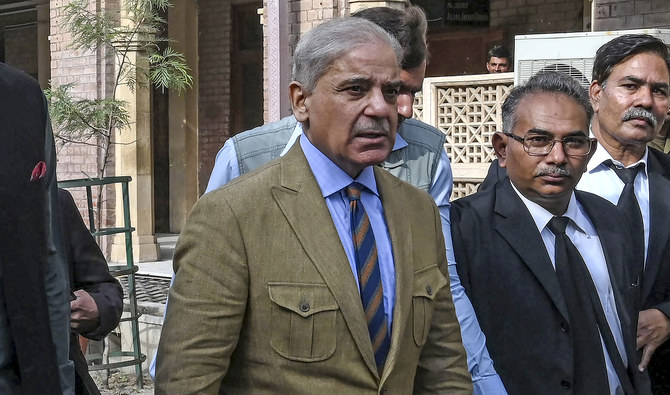
In this file photo, Shahbaz Sharif arrives at the High Court to attend a hearing in Lahore on Nov. 16, 2019, as party had petitioned the Lahore High Court seeking an unconditional end to Nawaz Sharif's travel ban. (AFP)
Short Url
Updated 22 March 2020
Follow

Shehbaz Sharif returns to Pakistan after four months

  • Sharif had left Pakistan with his older brother, former PM Nawaz Sharif, for the latter’s medical treatment on bail
  • He decided to return as Pakistan announced it was suspending all incoming international flights

ISLAMABAD: President of the opposition party Pakistan Muslim League (N), Shehbaz Sharif, returned to Pakistan on Sunday, after four months being in the United Kingdom, to offer assistance with efforts against the coronavirus outbreak in the country, his party announced on Saturday.
Sharif, currently the leader of the opposition in the national assembly, has served three terms as Chief Minister of Pakistan’s most populous province, Punjab. His leadership is widely considered pivotal in controlling the spread of dengue fever in the province in recent years. 
His party’s spokesperson, Maryam Aurangzeb, said Sharif had decided to return in order to “play his role in saving the nation from coronavirus.”
The announcement came as Pakistan announced it would be suspending all incoming international flights to the country for the next two weeks. Only flights of national carrier PIA would be allowed to bring previously booked passengers home. Sharif is scheduled to land on Sunday morning.
“As a Pakistani, a leader of the opposition, and a political person, it is my duty to return,” Sharif said in a video message that was posted on Twitter before his departure.
Sharif had left with his brother and party supremo, Nawaz Sharif, for London in November last year, after Pakistani courts allowed the jailed former Prime Minister to travel abroad on medical bail.
He said he was scheduled to stay in London until his brother’s heart surgery, but had decided to return to Pakistan to help during the coronavirus outbreak.


Pakistan engages Saudi Arabia, China in bid to ease surging Middle East tensions 

Updated 10 March 2026
Follow

Pakistan engages Saudi Arabia, China in bid to ease surging Middle East tensions 

  • Pakistan’s foreign minister stresses need for de-escalation in conversations with Chinese, Saudi counterparts
  • Tensions in the Middle East continue to remain high as conflict between US, Israel and Iran intensifies

ISLAMABAD: Pakistan’s Deputy Prime Minister Ishaq Dar spoke to the foreign ministers of Saudi Arabia and China on Tuesday, stressing the importance of diplomatic engagement to de-escalate tensions in the Middle East as the Iran war intensifies. 

Pakistan has constantly engaged regional countries in efforts to broker a ceasefire in the Middle East, after the US and Isreal launched coordinated strikes against Iran on Feb. 28. 

Iran launched fresh attacks on Gulf countries on Tuesday morning, where it has targeted US military bases in recent weeks. In addition to firing missiles and drones at Israel and American bases in the region, Iran has also been targeting energy infrastructure which, combined with its stranglehold on the Strait of Hormuz, has sent oil prices soaring worldwide. 

Dar spoke to Saudi Foreign Minister Prince Faisal bin Farhan to discuss developments in the Middle East and ongoing deliberations at the UN Security Council, Pakistan’s foreign office said in a statement. 

“DPM/FM shared Pakistan’s perspective, underscoring the importance of continued coordination and diplomatic engagement to support de-escalation and promote peace and stability across the region and beyond,” the statement said. 

Dar, who also serves as Pakistan’s foreign minister, spoke to Chinese foreign minister Wang Yi over the telephone separately. The two discussed the evolving regional situation and broader global developments.

Dar underscored the need to ease tensions in the Middle East and the wider region during the conversation, the foreign office said. 

Yi appreciated Pakistan’s constructive efforts aimed at promoting de-escalation and stability in the region, it added. 

“The two leaders stressed the importance of de-escalation and emphasized the need to pursue dialogue and diplomacy in accordance with the principles of the UN Charter,” the foreign office’s statement said. 

The conflict in the Middle East has hit Pakistan hard as well, forcing Islamabad to hike petrol and diesel prices by Rs55 per liter last Friday. 

Pakistan’s government has also announced a set of austerity measures, which include closing schools and cutting down on government expenditures, as it evaluates petrol stocks and looks for alternative supply routes.