Iraq Shiites defy coronavirus curfews to commemorate revered imam

1 / 3
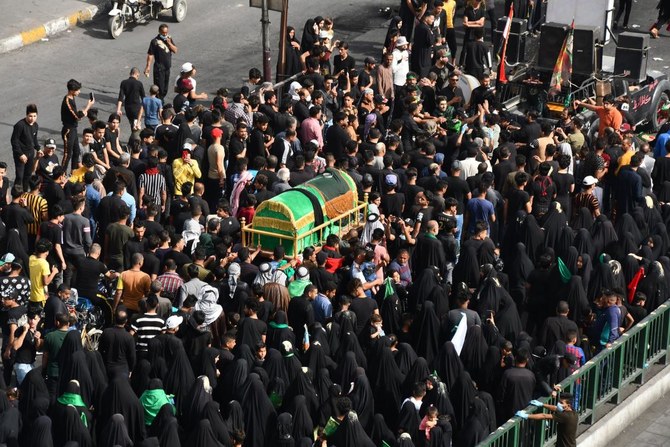
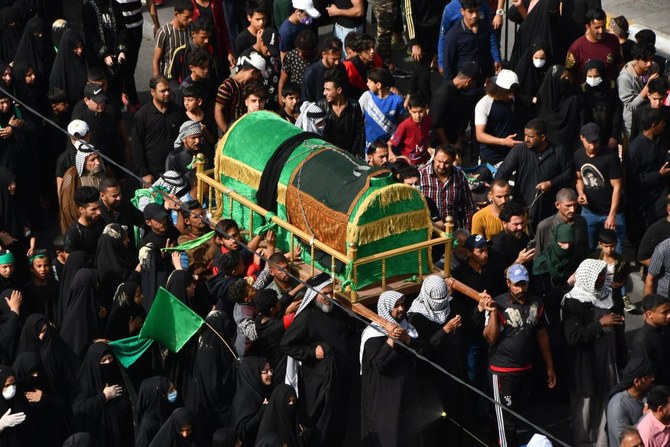
Iraqi Shiite pilgrims carrying a mock coffin or their shoulders to mark the anniversary of the death of Imam Moussa Al-Kadhim in Iraq's southern city of Nasiriyah, on March 21, 2020. (AFP)
2 / 3
Iraqi Shiite pilgrims carrying a mock coffin mark the death of Imam Moussa Al-Kadhim in Iraq's southern city of Nasiriyah on March 21, 2020. (AFP)
3 / 3
Iraqi Shiite pilgrims carrying a mock coffin mark the death of Imam Moussa Al-Kadhim in Iraq's southern city of Nasiriyah on March 21, 2020. (AFP)
Short Url
Updated 21 March 2020
Follow

Iraq Shiites defy coronavirus curfews to commemorate revered imam

  • The anniversary typically draws millions of devout followers from around the world who visit and kiss the shrine housing the remains of Musa Al-Kadhim
  • Iraq banned travel to and from Iran last month over coronavirus fears

BAGHDAD: Tens of thousands of Iraqi Shiites turned out to commemorate a revered imam on Saturday, defying curfews imposed to stem the spread of the coronavirus.
On foot, they streamed to the golden-domed mausoleum of Imam Al-Kadhim in Baghdad, where authorities kept an outer gate open to allow pilgrims into the surrounding courtyard.
The inner shrine remained closed despite some pilgrims pressing authorities to let them in, a shrine official told AFP.
“There are many fewer pilgrims than in previous years,” the official said, asking not to be identified.
“For the first time, there are no foreign pilgrims — everyone comes from Iraqi provinces.”
The anniversary typically draws millions of devout followers from around the world who visit and kiss the shrine housing the remains of Musa Al-Kadhim, who died in 799 in the custody of Abbasid caliph Harun Al-Rashid.
Many come from Iran, which is now battling one of the world’s deadliest coronavirus outbreaks.
Iraq banned travel to and from Iran last month for fear of a potential spillover.
Last week, it expanded the measures into a total flight ban until March 24 and shut shrines across the country.
The country’s top Shiite cleric Grand Ayatollah Ali Sistani has urged Iraqis not to gather in large numbers for prayers, where the risk of contamination could be high.
On Friday, his representative issued another rare statement urging Muslims to abide by medical advice on social distancing, but did not specifically tell pilgrims to stay home.
Authorities have struggled to enforce lockdowns announced in more than half of Iraq’s 18 provinces, as well as a ban on travel between provinces.
In the southern city of Nasiriyah, thousands of pilgrims packed onto a bridge with a mock coffin to honor the fallen Imam as they could not make it to Baghdad.
Influential cleric Moqtada Al-Sadr called on his followers to take part in the pilgrimage to the Imam Al-Kadhim mosque despite federal authorities urging otherwise.
The Iraqi health ministry has documented 208 COVID-19 cases and 17 deaths, but many expect the real number is much higher as only some 2,000 people have been tested in a country of 40 million.
A fully fledged outbreak would be devastating for the country, where years of conflict and underinvestment have ravaged the health care system.


First responders enter devastated Aleppo neighborhood after days of deadly fighting

Updated 12 January 2026
Follow

First responders enter devastated Aleppo neighborhood after days of deadly fighting

  • The US-backed SDF, which have played a key role in combating the Daesh group in large swaths of eastern Syria, are the largest force yet to be absorbed into Syria’s national army

ALEPPO, Syria: First responders on Sunday entered a contested neighborhood in Syria’ s northern city of Aleppo after days of deadly clashes between government forces and Kurdish-led forces. Syrian state media said the military was deployed in large numbers.
The clashes broke out Tuesday in the predominantly Kurdish neighborhoods of Sheikh Maqsoud, Achrafieh and Bani Zaid after the government and the Syrian Democratic Forces, the main Kurdish-led force in the country, failed to make progress on how to merge the SDF into the national army. Security forces captured Achrafieh and Bani Zaid.
The fighting between the two sides was the most intense since the fall of then-President Bashar Assad to insurgents in December 2024. At least 23 people were killed in five days of clashes and more than 140,000 were displaced amid shelling and drone strikes.
The US-backed SDF, which have played a key role in combating the Daesh group in large swaths of eastern Syria, are the largest force yet to be absorbed into Syria’s national army. Some of the factions that make up the army, however, were previously Turkish-backed insurgent groups that have a long history of clashing with Kurdish forces.
The Kurdish fighters have now evacuated from the Sheikh Maqsoud neighborhood to northeastern Syria, which is under the control of the SDF. However, they said in a statement they will continue to fight now that the wounded and civilians have been evacuated, in what they called a “partial ceasefire.”
The neighborhood appeared calm Sunday. The United Nations said it was trying to dispatch more convoys to the neighborhoods with food, fuel, blankets and other urgent supplies.
Government security forces brought journalists to tour the devastated area, showing them the damaged Khalid Al-Fajer Hospital and a military position belonging to the SDF’s security forces that government forces had targeted.
The SDF statement accused the government of targeting the hospital “dozens of times” before patients were evacuated. Damascus accused the Kurdish-led group of using the hospital and other civilian facilities as military positions.
On one street, Syrian Red Crescent first responders spoke to a resident surrounded by charred cars and badly damaged residential buildings.
Some residents told The Associated Press that SDF forces did not allow their cars through checkpoints to leave.
“We lived a night of horror. I still cannot believe that I am right here standing on my own two feet,” said Ahmad Shaikho. “So far the situation has been calm. There hasn’t been any gunfire.”
Syrian Civil Defense first responders have been disarming improvised mines that they say were left by the Kurdish forces as booby traps.
Residents who fled are not being allowed back into the neighborhood until all the mines are cleared. Some were reminded of the displacement during Syria’s long civil war.
“I want to go back to my home, I beg you,” said Hoda Alnasiri.