

Pakistan Super League playoff matches postponed amid virus outbreak

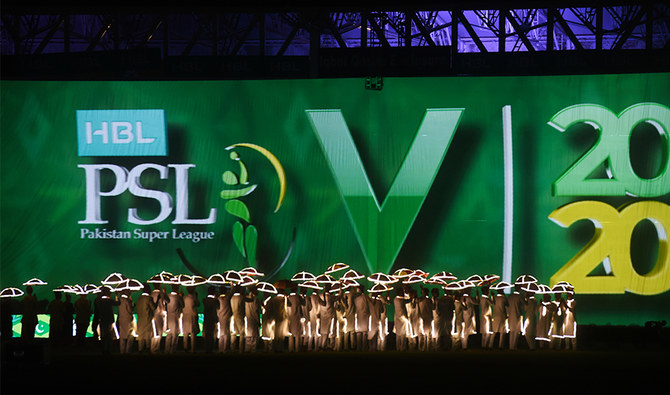
Artists perform during the opening ceremony of the Pakistan Super League (PSL) at the the National Cricket Stadium in Karachi on February 20, 2020. (AFP)
Short Url
Updated 17 March 2020
Follow

Pakistan Super League playoff matches postponed amid virus outbreak

  • Cricket board says decision taken after one foreign player who left Pakistan developed coronavirus symptoms
  • Two semi finals were scheduled to be played at Lahore’s Qaddafi stadium on Tuesday

KARACHI: Pakistan Super League (PSL) playoff matches have been called off after the recent spike in coronavirus infections recorded in the country, a Pakistan Cricket Board (PCB) official told Arab News. 

Emmad Hameed, a PCB official, said that the tournament was “postponed,” to be rescheduled as Lahore’s Qaddafi Stadium was due to host the two semifinals on Tuesday. 
The first playoff between Multan Sultans and Peshawar Zalmi was called off just hours before the match.
“Unfortunately, the PSL’s final matches have been postponed,” Javed Afridi, chairman of the Peshawar Zalmi, told Arab News. “PSL 2020 was postponed as state of emergency is declared in the country as a precautionary measure against the ongoing Novel Corona Virus, COVID-19 situation in Pakistan,” he added. 

The Peshawar Zalmi owner said, “After reviewing the situation altogether, I believe it is right in favor of everyone involved in PSL20.” 

The tournament was already tweaked by four days replacing three matches of qualifiers and eliminator stages with semi finals which were scheduled to be played at the Lahore’s Qaddafi stadium. 

Most of the foreign players have already left Pakistan and the last five matches were played in closed stadiums.

Pakistan on Tuesday confirmed five new coronavirus cases In Karachi taking the national tally to 188 with majority documented in southern Sindh province.

Meanwhile, the Pakistan Super League officially posted on twitter that the matches had been called off until further rescheduling. 

“IMPORTANT ANNOUNCEMENT. #HBLPSLV postponed, to be rescheduled. More details to follow in due course,” the tournament’s official website said.


Pakistan army chief meets world leaders in rare Davos appearance

Updated 6 sec ago
Follow

Pakistan army chief meets world leaders in rare Davos appearance

  • Field Marshal Asim Munir attends World Economic Forum alongside prime minister
  • Pakistan delegation holds meetings with US, Saudi and Azerbaijani leaders

ISLAMABAD: Pakistan’s Chief of Army Staff Field Marshal Syed Asim Munir is attending the World Economic Forum’s annual meeting in Davos this week alongside Prime Minister Shehbaz Sharif, marking a rare appearance by a serving army chief at the global gathering of political and business leaders.

Pakistan’s participation at Davos comes as Islamabad seeks to attract investment, project economic stability and deepen engagement with key international partners following recent reforms aimed at stabilizing the economy. 

While Pakistani leaders routinely attend the World Economic Forum, it is uncommon for a serving army chief to be present. In 2017, former army chief Raheel Sharif addressed the forum only after his retirement, while General Pervez Musharraf spoke at Davos on a number of occasions in his role as president, not as military chief. 

Pakistan’s governance structure has evolved in recent years, particularly through the expanded role of the military in economic decision-making through bodies such as the Special Investment Facilitation Council, a civil-military platform designed to fast-track foreign investment in sectors including minerals, energy, agriculture and technology.

“The Prime Minister and the Field Marshal met with the President of Azerbaijan Ilham Aliyev, United States Secretary of State Marco Rubio, and Saudi Arabia’s Foreign Minister Prince Faisal bin Farhan Al Saud,” Sharif’s office said in a statement.

Officials say the delegation’s engagements focused on strengthening economic ties and maintaining high-level contact with partners in the Middle East, Central Asia and the United States at a time of shifting global economic and strategic alignments.

The World Economic Forum’s annual meeting brings together heads of state, ministers, investors and corporate leaders to discuss global economic risks, investment trends and geopolitical challenges. Davos is not a military forum, and while security issues are discussed there, the physical presence of a serving military chief remains the exception, not the norm, across countries. When military figures do appear, it is usually because they are heads of state or government, retired and speaking as security experts or hold a civilian defense portfolio such as defense minister or national security adviser.