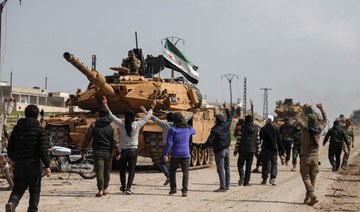
LONDON: Almost 118,000 civilian deaths, 6.6 million internally displaced, 5.6 million refugees worldwide, four peace conferences, nine years, one war, one country: Syria.
What started off as peaceful protests against President Bashar Assad quickly escalated into a bloody proxy war involving the US, Russia, Iran and Turkey.
Nine years and hundreds of thousands of deaths later, foreign players backing the opposition have come to terms with Assad staying in power.
But one would not have expected such an outcome in 2013, with most of the country split among anti-Assad groups and Kurdish militias.
That year, then-US President Barack Obama delivered his now-infamous “red line” speech following the Assad regime’s use of chemical weapons in an attack on the rebel-held Damascus suburb of Eastern Ghouta. Also that year, Iran deployed 4,000 troops to Syria in support of Assad.
“Without Iran and its proxies, Assad wouldn’t be in power,” Phillip Smyth, Soref fellow at the Washington Institute, told Arab News.
“Iran’s Shiite militias both helped rebuild what was left of the SAA (Syrian Arab Army), allied militias, and provided the bulk of the forces needed to not only retake territory, but hold many strategic areas. Iran’s involvement was the key game-changer for the conflict.”
Now Iran and its proxies — namely its strongest, Hezbollah — run the show, with only one option in mind: Total military victory.
On Nov. 18, 2015, Iran’s Deputy Foreign Minister for Arab and African Affairs Hossein Amir Abdollahian said: “If not for Iran’s support for the regime of Syrian President Bashar Assad and the efforts of its military advisers, Damascus would have fallen during the first three years of the war.”
Former Syrian Brig. Gen. Ahmed Rahhal told Arab News: “It’s Iran and Hezbollah who are fighting today and making all the political and military decisions.”
He added: “The Assad regime obeys the Iranian military and follows the Iranian approach, and Iran accepts only the military option … Iran is unable to find a solution, but is rather capable of obstructing all solutions.”
KEYNOTES
• March 15, 2011: Start of Syrian uprising.
• May 6, 2011: Hezbollah intervenes in Syria, backing Assad regime.
• June 9, 2013: Iran sends 4,000 troops to Syria to back Assad.
• Aug. 21, 2013: First chemical weapons attack by Assad regime on Eastern Ghouta.
Alongside Hezbollah are Iran’s Islamic Revolutionary Guards Corp. and its Quds Force. On Jan. 13, 2020, the Assad regime honored Qassem Soleimani — commander of the Quds Force, who was killed in Iraq on Jan. 3 by a US missile strike — with the “Hero of the Syrian Arab Republic” medal, Iran’s Islamic Republic News Agency reported.
Ahmad Khasm, a 29-year-old human rights activist in northern Syria who was forcibly displaced from southern Idlib, told Arab News: “The loss that I have is a decade of my life. I should’ve had a family by now enjoying a youthful life, learning, and being with my family and friends in our hometown.”
Smyth said: “The conflict, while quite costly for Tehran, has provided benefits in terms of gained experience, and it gave Tehran the first real taste in how to deploy a multinational force under its command.”
(Zouhir AlShimale contributed to this article)